.png)
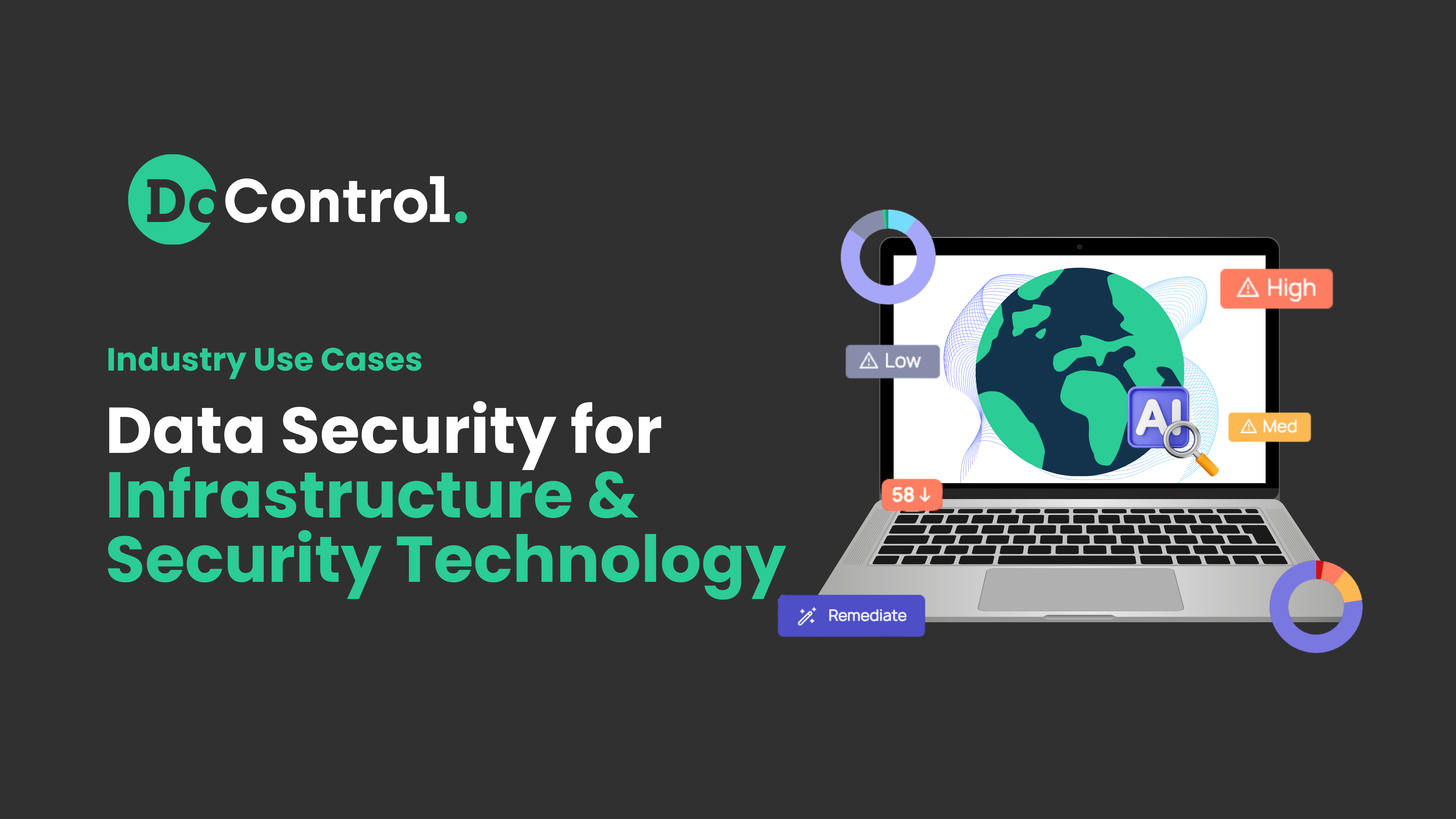
A comprehensive review of how infrastructure and security technology companies protect sensitive data through intelligent, automated data security.
Why Infrastructure & Security Technology Companies Need Data Security
Infrastructure and security technology companies are inherently cloud-native. Their products, teams, and customers all operate within SaaS-driven environments where data must move constantly to support growth, innovation, and customer success.
Sales teams share information with prospects. Customer success collaborates closely with customers. Marketing works with external agencies. Engineering partners with cloud providers and third-party vendors. This continuous exchange of data is foundational to how technology companies operate and scale.
At the same time, these organizations must strike a delicate balance: enabling frictionless collaboration while ensuring sensitive data does not reach untrusted parties.
Adding to the challenge, infrastructure and security companies experience high employee turnover, with average tenure often under two years, with studies indicating average turnover rate for technology companies in this space at over 20% (which is well above the average rate in other industries).
Most of this employee turnover are employees going to DIRECT competitors.
Zscaler employees → Wiz | Snap Inc. employees → Meta
And the list goes on. These employees want to take their information, playbooks, and processes to help them in their new role - causing their direct competitor to now have trade secrets, company IP, and a new competitive advantage.
These organizations are new, exciting, and innovative. They’re pioneering AI adoption, which is reshaping how data is accessed and surfaced internally. And, most of all, they’re scaling fast. They need security that scales with them, and protects them along the way without slowing business velocity..
Industry Overview: The Data Challenge in Infrastructure & Security Technology
Infrastructure and security technology companies operate at the center of complex data ecosystems. Their teams rely heavily on SaaS platforms like Google Workspace, Slack, and Microsoft 365 to collaborate internally and externally at speed.
At the same time:
- Sensitive data is constantly shared across teams, partners, customers, and agencies, increasing the risk of exposure if access controls are too permissive.
- High employee turnover introduces persistent access risk, especially when departing employees retain access or transfer company data to personal accounts often before going to direct competitors.
- AI-powered tools and internal search capabilities are rapidly being adopted, creating new pathways for sensitive data to be surfaced to users who should not have access.
- Security teams must operate at scale, detecting risky behavior and enforcing controls across thousands of users and data interactions without relying on manual processes.
These realities demand a new approach to data security, one that prioritizes visibility, automation, and context-aware controls.
Key Security Challenges in Infrastructure & Security Technology Environments
1. Preventing data exposure through personal accounts and former employee and third-party access
Employees frequently share data to personal email accounts for convenience (or when leaving the company for good), and access is often not fully revoked when individuals leave the organization. This creates significant risk when former employees move to competitors.
2. Gaining visibility and control over internal data access and governance as AI innovation ramps up across the business
As AI search tools and LLM-powered assistants like Gemini become embedded into internal workflows, organizations must ensure sensitive data is not inadvertently surfaced to unauthorized users. If access isn’t correct, LLMs can expose data that users were never meant to see.
3. Enforcing dynamic policies and security workflows at scale
Organizations in this sector are constantly innovating: adding integrations, acquiring companies, increasing output, adopting AI, and hiring new talent. As a result, new data, identities, systems, and applications are introduced into the SaaS environment every day. This complexity must be managed effectively and at scale, requiring security controls that can keep pace with continuous change.
Key Use Case 1: Detecting and Remediating Risky External Sharing and Former Employee Access
The Challenge
Infrastructure and security technology companies must ensure that sensitive data does not leave the organization through personal accounts or remain accessible to former employees. With frequent role changes and high turnover, access can easily become outdated - creating exposure risk that traditional tools can’t detect in time.
Why It Matters
- Data leakage to competitors can undermine years of product development, strategy, and customer trust.
- Former employee access represents one of the highest-risk vectors, especially in an industry where talent always moves between competing organizations.
- Manual offboarding and access reviews cannot keep pace with organizational change, leaving critical gaps in visibility and control.
If Ignored
- Sensitive company data may follow employees to competitors, weakening market position, strategic advantage, stock price, investor confidence, and more.
- Personal account sharing increases the likelihood of data loss, with zero visibility or ability to remediate once data leaves the corporate environment.
- Reputational damage, especially for security-focused companies, can erode customer confidence and credibility in the market.
Key Use Case 2: Preparing Internal Data Access for AI and LLM-Driven Tools
The Challenge
As AI-powered search and LLMs are introduced into internal workflows, data access patterns change dramatically. Information that was previously siloed can suddenly be surfaced across teams within seconds just by a simple search in Google’s Gemini. This increases the risk of data exposure if the proper permissions and access controls are not precise.
Why It Matters
- AI tools amplify existing access issues, making misconfigurations more dangerous than ever.
- Internal permissions and boundaries must be enforced, ensuring sensitive data is only visible to appropriate users.
- Organizations need confidence that AI adoption will not compromise security.
If Ignored
- Sensitive data may be inadvertently surfaced to users who shouldn’t have access through AI tools.
- Loss of trust in internal systems, slowing adoption of productivity-enhancing technologies.
- Increased compliance and security risk, especially as AI usage expands.
Key Use Case 3: Enforcing Dynamic Policies and Security Workflows at Scale
The Challenge
Infrastructure and security technology companies operate in a state of constant evolution. They are continuously adding new integrations, acquiring companies, expanding product lines, adopting AI-driven tools, and onboarding new employees. As a result, new data, identities, systems, and applications enter the SaaS environment every single day.
Manual reviews, one-time configurations, and rigid controls cannot keep up with environments where access needs, data sensitivity, and risk profiles are constantly shifting. Security teams need dynamic, automated controls that adapt in real time, without slowing innovation or creating operational friction.
Why It Matters
- Security controls must scale at the same speed as the business. As organizations grow, every new user, integration, and application introduces potential risk that must be governed immediately (and automatically!).
- Static policies quickly become outdated, leaving gaps where sensitive data can be accessed or shared without appropriate oversight. Policies need to be enforced with context (who is the user, what action are they taking, does that make sense in regards to their role and scope, etc.)
- Innovation depends on flexibility, and security must enable - not restrict! - teams as they build, integrate, and adopt new technologies like AI and LLMs.
If Ignored
- Overly restrictive controls slow down sales, customer success, and engineering, impacting revenue and growth.
- Security policies fail to reflect reality, allowing outdated permissions and risky access paths to persist as the environment changes.
- Risk compounds silently, as new systems and users are added without consistent guardrails in place.
- Security teams become reactive, spending time chasing low value alerts, hunting down false positives, and focusing on the wrong incidents instead of proactively managing risk. This leads to job dissatisfaction, burnout, waste of time and resources, and a weakened security posture.
How DoControl Helps Infrastructure & Security Technology Companies
Granular Access Controls and Identity Threat Detection & Response (ITDR)
DoControl provides deep, contextual visibility into every identity and every action across the SaaS environment. Through granular access controls and its ITDR capabilities, security teams can understand who a user is, what data they have access to, why they have that access, and whether it is appropriate based on role, department, scope, and responsibilities.
DoControl continuously monitors what users are doing with data - including downloads, sharing behavior, and access patterns - and automatically revokes or remediates access when risk is detected.
Cleaning Up Access Controls for AI and LLM-Driven Tools
As AI and LLM-powered tools are introduced into the environment, DoControl helps organizations prepare by ensuring access controls are accurate, intentional, and enforced consistently. This includes cleaning up permissions, remediating historical access that no longer reflects current roles and scopes, and preventing sensitive data from being surfaced to ‘unauthorized’ users through AI-driven search or automation.
DoControl also detects and governs risky shadow AI applications as they enter the organization, providing visibility and control over how data is accessed, indexed, and reused across emerging tools.
Dynamic, Scalable Security Workflows That Eliminate Friction
DoControl enables organizations to automate security responses through dynamic workflows that scale with the business. Risky actions can trigger immediate remediation - such as removing collaborators, time-boxing shares, restricting access, or requiring approvals - without slowing teams down.
These workflows intelligently engage the right people at the right time - including managers, end users, and security teams - to resolve risk in context and educate them on security best practices. By eliminating manual bottlenecks and reducing unnecessary friction, DoControl ensures every action and workflow is secured consistently, efficiently, and at enterprise scale.
Key Takeaways
Infrastructure and security technology companies thrive on speed, innovation, and constant change, but these same forces create significant data security challenges.
Protecting sensitive information, managing employee and contractor access, preparing for AI-driven data access, and enforcing dynamic security policies at scale are now essential bare-minimum requirements, not ‘future considerations’ to add to the roadmap.
With automated, context-aware data security, organizations can keep pace with growth without sacrificing control. They gain the visibility, governance, and enforcement needed to protect their SaaS environments - even as those environments evolve every day.
DoControl enables Infrastructure and security technology companies to take back control of their SaaS data and protect what matters most: the integrity of their business, their people who drive it forward, and the trust customers place in the tech that power the modern digital world.
{{cta-1}}