.png)
Most DSPM tools can tell you what sensitive data lives inside a file.
They can identify financial records, source code, customer information, contracts, or regulated data. That visibility matters, but it’s only part of the story.
Knowing what’s inside a file doesn’t tell you whether that file is actually risky.
Security teams still need answers to questions like:
- Who is this file shared with?
- Is it publicly accessible?
- Was it shared externally, and by who?
- Who has been accessing the file?
- Does a former employee still have access?
- What should we fix first? And how?
Without those answers, security teams are left with incomplete alerts and manual investigation.
Two files may contain the same sensitive information, but only one may represent an urgent risk. That is why content alone does not signal risk. It only signals presence.
Today, DoControl is proud to announce the launch of our unified, contextual Data Classification.
The Limitations of Traditional Classification Strategies
Most classification solutions were designed to help organizations discover sensitive data across cloud environments. That solved an important first challenge: visibility.
But, many security leaders are now realizing that discovery alone does not reduce exposure.
Common limitations include:
1. Content without operational context
Knowing a file contains sensitive data is useful, but then what? Knowing WHO it’s shared with (like external vendors, for example) is actionable. But traditional DSPM doesn’t give you this.
2. Limited identity awareness
Security teams need to understand who owns a file, who shared it, who has access, and whether those users should still have access. Traditional DSPM’s that simply tell you that the files have sensitive data inside do not provide this.
3. Alert volume without prioritization
When every sensitive file is flagged equally, teams struggle to determine what truly matters. Two files could both contain regulated financial data - but only one is shared with third-party contractors from last quarter's audit. Security teams then prioritize the file that isn’t risky - simply because they have no way of knowing which to prioritize.
4. Detection Without Remediation
Finding risky data is only part of the challenge. Security teams also need the ability to take action - whether that means revoking access, timeboxing permissions, triggering access reviews, or enforcing policy automatically. Traditional DSPM approaches that focus primarily on identifying what is inside a file often fall short of this requirement, leaving security teams without truly actionable paths to remediation.
As SaaS adoption and collaboration expands, these gaps become harder to ignore.
Introducing DoControl’s Unified, Contextual Data Classification for Google Workspace
Building on our foundation of just-in-time scanning and best-in-class access visibility and control, DoControl is taking its next step in its evolution to deliver even deeper coverage for customers.
Today, we detect and remediate risk as it happens - during shares, downloads, and other critical moments.
Now, we’re extending that same contextual intelligence to historical data, enabling teams to uncover and address existing exposure with full context already in place. Our unified, contextual Data Classification for Google Workspace is here.
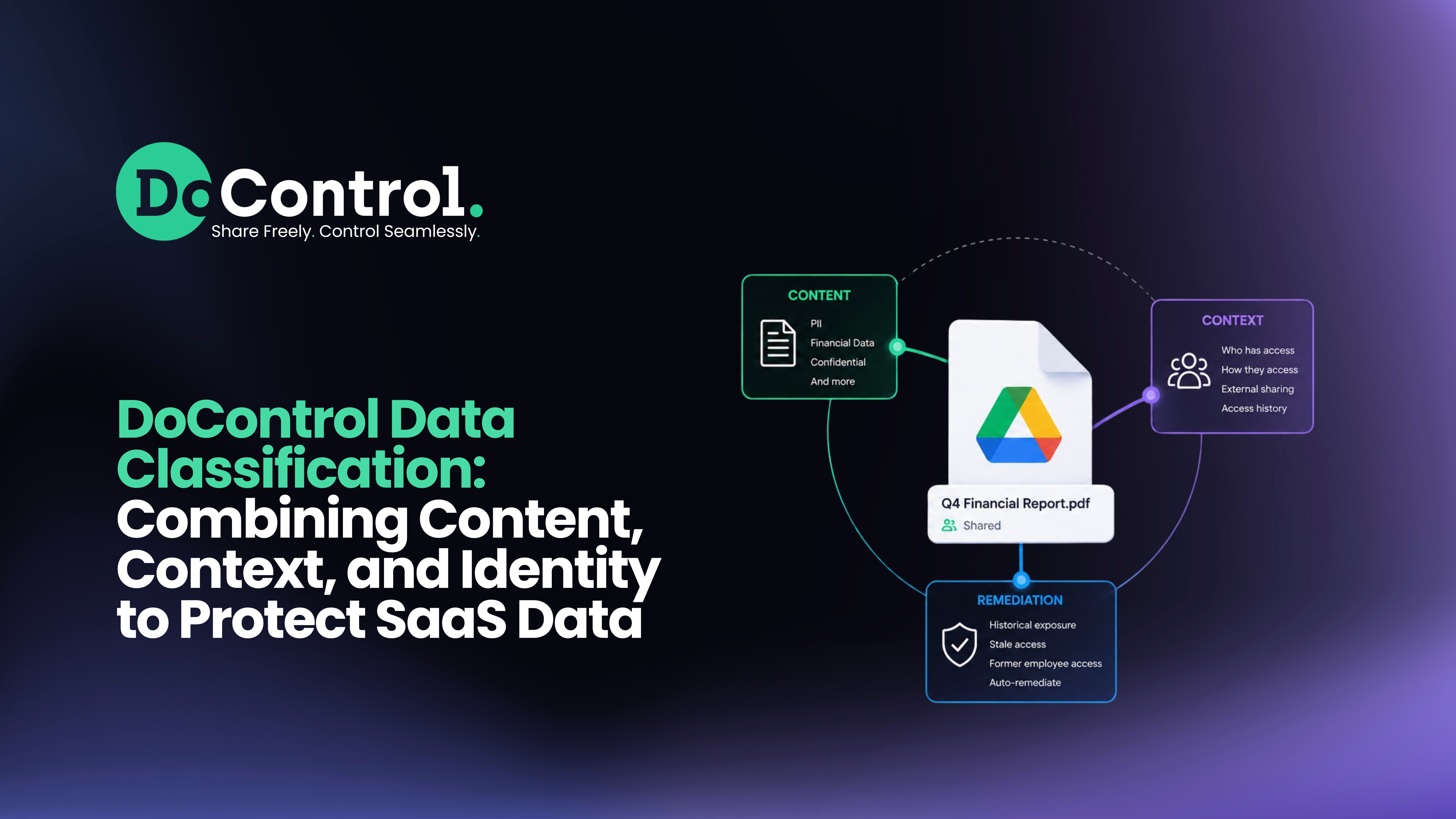
By combining file content + sharing context + access patterns + identity intelligence, DoControl helps organizations accurately identify which files present real security risk and automatically take action.
With DoControl, teams can:
Understand risk with full context
- Identify what’s in each file (PII, financial data, source code, and more)
- See who has access to each file, and how that access was granted
- Understand when and why files are being accessed
- Track ownership, creation, and sharing activity across users
- Determine whether access aligns with legitimate business needs
Remediate exposure, both real-time and historical
- Detect and address risky access, including stale or former employee permissions
- Uncover historical exposure based on data sensitivity and access patterns
- Audit and revoke access, permissions, or collaborators as needed
- Enforce least-privilege with time-based access controls and sharing policies
- Trigger automated remediation workflows to eliminate exposure
Why This Matters Now
Collaboration tools like Google Workspace make sharing frictionless. That’s great for productivity, but it also means sensitive data can spread quickly, often without malicious intent.
The challenge isn’t finding data anymore. It’s understanding exposure and responding fast before it leaves the walls of the environment.
The Future of Data Classification
The next generation of data security won’t rely on content alone. It must combine:
- Content
- Context
- Identity
- Remediation
- Automation
That’s exactly what DoControl delivers. Because security teams don’t need more visibility. At this point, that's a commodity. They need answers, and action.
{{cta-1}}