.png)
.png)
As companies move sensitive data into cloud infrastructure and SaaS applications, the way data is exposed - and protected - has fundamentally changed.
Security leaders researching DSPM vs DLP are typically trying to answer these four questions:
- What is DSPM?
- What is DLP?
- How are they different?
- Which one do we actually need?
While both Data Security Posture Management (DSPM) and Data Loss Prevention (DLP) focus on protecting sensitive data, they serve different purposes in your 2026 security strategy.
This guide breaks down:
- What DSPM is
- What DLP is (including the evolution to SaaS DLP)
- The key differences between DSPM vs DLP
- Real-world use cases
- Industry leaders in each category
- How to decide which approach aligns with your organization’s risk profile
What Is DSPM (Data Security Posture Management)?
DSPM is a category of security tools designed to help organizations discover, classify, monitor, and protect sensitive data across their entire data estate - particularly in cloud and multi-cloud environments.
DSPM emerged as organizations migrated large volumes of data to:
- Public cloud storage (AWS, Azure, GCP)
- Data lakes and warehouses
- SaaS platforms
- Databases and infrastructure environments
Core Capabilities of DSPM
A typical DSPM solution provides:
- Automated data discovery across cloud environments
- Sensitive data classification at scale
- Risk scoring and exposure analysis
- Misconfiguration detection
- Data inventory dashboards
- Access mapping and permission analysis
DSPM is primarily focused on data visibility and posture assessment.
It helps organizations answer foundational questions such as:
- Where is our sensitive data stored?
- How much regulated data do we have?
- Is it publicly accessible?
- Are permissions overly permissive?
- What is our overall data risk posture?
What DSPM Does Not Do
DSPM is generally not an enforcement-first solution.
It does not typically block file sharing, remove public links, or remediate exposures in real time. Instead, it surfaces risks so security teams can take action. Many DSPM platforms operate on scheduled scans, typically daily or weekly. This means that it’s not fast enough to respond to real-time risk (exposure may exist between scan cycles, and things can slip through the cracks).
In short:
- DSPM identifies and prioritizes data risk.
- It provides visibility across cloud data environments.
- It supports governance, compliance, and data inventory initiatives.
Now let’s contrast that with DLP.
What Is DLP (Data Loss Prevention)?
Data Loss Prevention (DLP) is a category of security solutions designed to prevent unauthorized access, sharing, or transmission of sensitive data.
Historically, traditional DLP solutions were built for perimeter-based environments and focused on monitoring:
- Network traffic
- Email gateways
- Endpoint devices
- On-prem systems
They used predefined policies and content inspection to detect sensitive data such as:
- Personally identifiable information (PII)
- Payment card data (PCI)
- Protected health information (PHI)
- Intellectual property
The Limitations of Traditional DLP
Traditional DLP was effective back when:
- Data lived inside corporate networks
- Employees worked primarily on managed devices
- Email was the primary sharing channel
However, SaaS collaboration platforms changed the threat model.
Today, sensitive data is frequently:
- Shared through public links
- Collaborated on in real time
- Accessible to external partners, vendors, & third parties
- Exposed through misconfigured permissions
- Connected to third-party applications (including AI tools)
Traditional DLP tools often struggle in this environment because they:
- Lack SaaS context (they don’t have context on the users performing these actions)
- Generate excessive false positives (they can’t discern what’s legitimate vs. risky)
- Rely on static policy rules (either ‘block’ or ‘allow’ with no nuance in between)
- Cannot directly remediate exposure inside SaaS apps (visibility without remediation = useless)
This shift led to the rise of SaaS DLP.
What Is SaaS DLP?
SaaS DLP is the evolution of traditional DLP, purpose-built to protect sensitive data directly within SaaS applications such as:
Instead of monitoring traffic at the perimeter, SaaS DLP operates inside collaboration platforms where sensitive data is actively stored, shared, and modified.
Core Capabilities of SaaS DLP
1. Deep Contextual Visibility
SaaS DLP evaluates:
- Data sensitivity
- User identity and role
- Access permissions
- Sharing settings
- External collaborator presence
- Third-party app access
Context is typically gathered from HRIS and IdP systems to enrich the events happening in SaaS and inform alerts - thereby reducing noise and improving precision.
2. Real-Time Monitoring and Remediation
Modern SaaS DLP solutions can:
- Remove public sharing links
- Restrict external access
- Downgrade permissions automatically
- Notify file owners or engage security operations teams
- Trigger automated remediation workflows
This reduces the exposure window from days to minutes.
3. Identity-Aware Risk Enforcement
Because SaaS environments are identity-driven, effective DLP must correlate:
- User behavior
- Privilege level
- Data sensitivity
- Exposure posture
This enables smarter enforcement without disrupting productivity.
4. Automation and Operational Efficiency
SaaS DLP platforms help security teams:
- Prioritize high-risk exposure
- Automate remediation playbooks
- Streamline compliance reporting
- Reduce manual investigation
In SaaS environments, enforcement must happen where the actual data lives - not just at the network edge.
DSPM vs DLP: Key Differences Explained
Although DSPM and DLP both address sensitive data protection, their primary goals differ significantly:
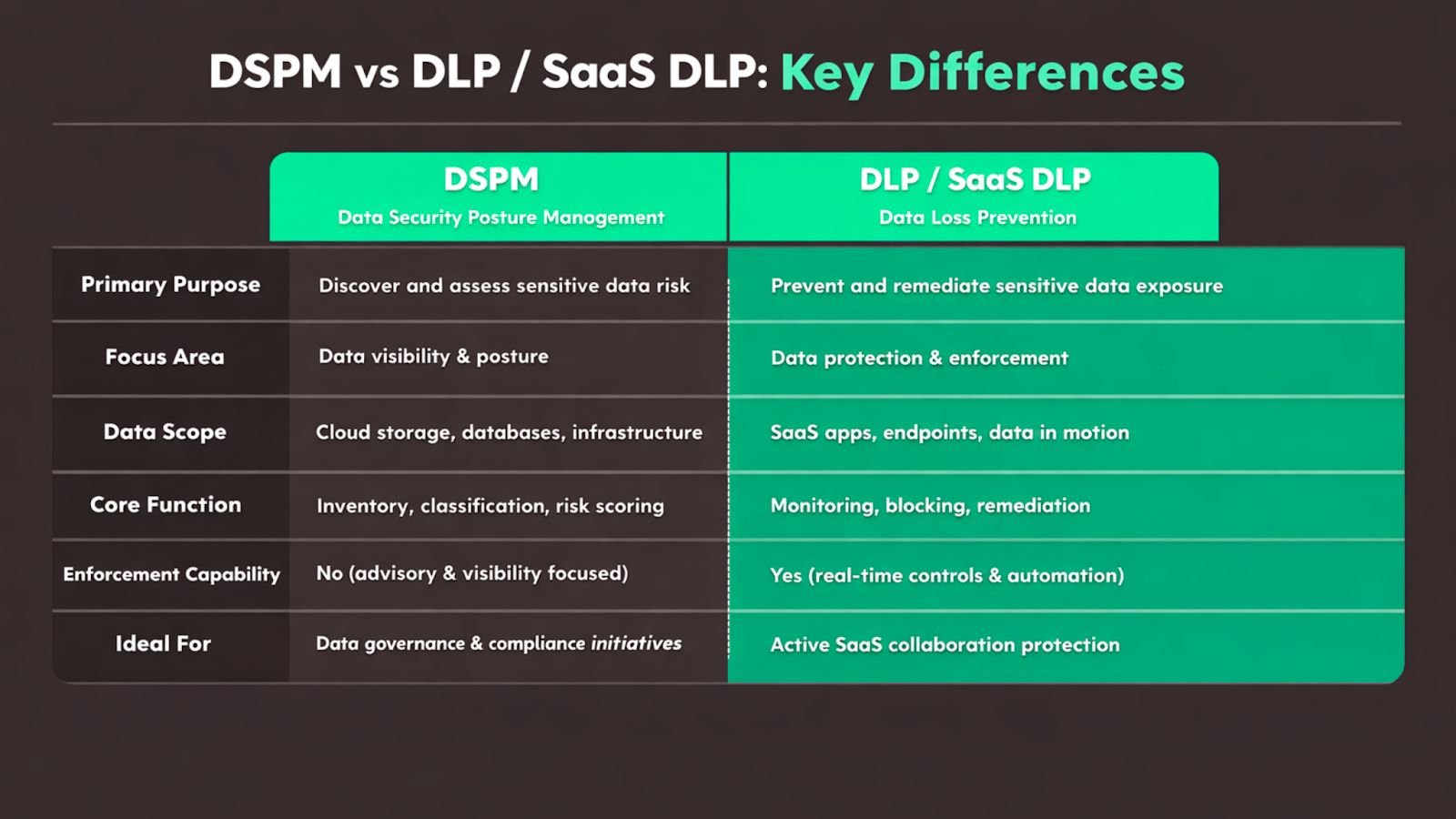
The Core Difference
- DSPM identifies, classifies, and prioritizes data exposure risk across cloud and SaaS environments.
- SaaS DLP identifies, classifies, and prioritizes data exposure in SaaS environments, but also actively monitors, protects, and remediates exposed sensitive data within those SaaS applications.
This distinction becomes especially important in environments where exposure can occur in seconds, but posture scans may only run periodically.
Organizations focused on large-scale cloud data discovery and governance programs may evaluate DSPM solutions.
Organizations concerned about real-time file sharing, excessive permissions, and SaaS collaboration risk typically prioritize enforcement capabilities.
Use Cases: DSPM vs DLP
Each category has specific use cases and solves for different security challenges.
Common DSPM Use Cases
- Cloud data inventory initiatives
- Data classification
- Compliance-driven data mapping
- Infrastructure misconfiguration analysis
- Risk reporting dashboards
Classification Platforms Often Used Alongside DSPM
Many organizations pursuing DSPM initiatives also rely on native data classification tools within their SaaS ecosystems.
For example:
- Google Gemini (within Google Workspace) provides data labeling and classification capabilities that help organizations tag sensitive content directly inside Google Drive and related apps.
- Microsoft Purview offers sensitivity labeling, data classification, and compliance controls across Microsoft 365 and broader cloud environments.
These platforms are commonly used to establish data sensitivity frameworks that can then inform broader governance and security workflows.
Industry leaders in DSPM
Sentra - Sentra is a cloud-native DSPM platform that focuses on continuously discovering and classifying sensitive data across cloud environments. Their strength is helping security teams understand where sensitive data lives and which exposures pose the highest risk.
Cyera - Cyera is another well-known DSPM vendor that provides automated visibility into sensitive data across cloud infrastructure and SaaS environments. The platform is built to help organizations map, assess, and prioritize data risk at scale.
Varonis - Varonis remains a strong player for hybrid and on-prem data security. It’s capabilities extend into DSPM through data discovery and exposure monitoring.
Common SaaS DLP Use Cases
SaaS DLP is designed to protect sensitive data where collaboration actually happens - inside platforms like Google Workspace, Microsoft 365, Slack, and other SaaS applications.
Common use cases include:
- Publicly shared documents (e.g., Google Drive files containing sensitive data)
- Overshared files with excessive permissions granted internally or externally
- Confidential documents still accessible to third parties or contractors after a business engagement has ended
- Employees attempting to exfiltrate data before leaving the company
- Employees sharing sensitive data to personal accounts or unauthorized email domains
- Insider misuse of sensitive data, whether intentional or accidental
- External Slack collaboration risks, including exposed files or messages
- Unmonitored third-party SaaS application access to sensitive data
- Real-time remediation of exposed files, such as automatically removing public links or restricting access
These scenarios reflect active data exposure risks inside SaaS environments - where enforcement, automation, and immediate remediation are critical.
Industry leaders in DLP
DoControl - DoControl is a SaaS-native DLP platform focused on protecting sensitive data inside collaboration tools like Google Workspace and Slack. It provides contextual monitoring, identity-aware risk detection, and real-time remediation workflows to prevent data exposure directly within SaaS applications.
Nightfall - Nightfall offers SaaS-based DLP with a strong engine that spans a broad set of SaaS applications. Its platform includes AI-driven data classification and an API-based architecture that can respond to detected threats.
Netskope - Netskope provides DLP capabilities across SaaS, cloud, and endpoint environments through both inline (agent-based) and API integrations. Its classifier engine supports broad coverage, and DLP can be bundled within Netskope’s larger security platform offerings.
How to Decide Between DSPM and DLP
When evaluating DSPM vs DLP, security leaders should assess their most pressing risk.
Ask:
- Are we struggling with unknown cloud data inventory?
- Or are we dealing with active SaaS data exposure and oversharing?
- Do we need risk dashboards, or real-time remediation, or both?
If your primary initiative is enterprise-wide data discovery and classification across infrastructure, DSPM may align with that objective.
If your primary challenge is real-time exposure inside SaaS collaboration platforms, enforcement-driven SaaS DLP is often the priority.
Many organizations layer strategies over time, and use multiple different tools to fill in security gaps. DSPM and DLP are NOT the same, so many organizations layer both to ensure unified coverage and reduce exposure risk.
How DSPM and DLP Can Work Together
It’s important to note that DSPM and SaaS DLP are not always mutually exclusive. It’s not always one without the other, as data classification can power SaaS DLP enforcement - which is what many organizations do.
An organization may use a DSPM solution to classify sensitive data across cloud storage and SaaS platforms. That classification can then be leveraged within a SaaS DLP platform - such as DoControl - to automatically enforce access controls inside these collaboration tools and SaaS apps.
Instead of simply identifying that a file contains regulated or confidential data, SaaS DLP platforms can actually take action when exposure conditions change.
Here’s a real-world example of how data classification, combined with DoControl’s automated SaaS DLP workflows, can proactively protect sensitive data.
- A file was labeled as “Confidential” through the organization’s classification framework.
- The ‘Confidential’ file was shared externally, and an external collaborator was added to the document in Google Drive.
- DoControl detected the policy violation in real time and collected the context needed.
- The external collaborator was automatically removed.
- The file owner was notified and security operations received visibility into the event as it was effectively remediated.
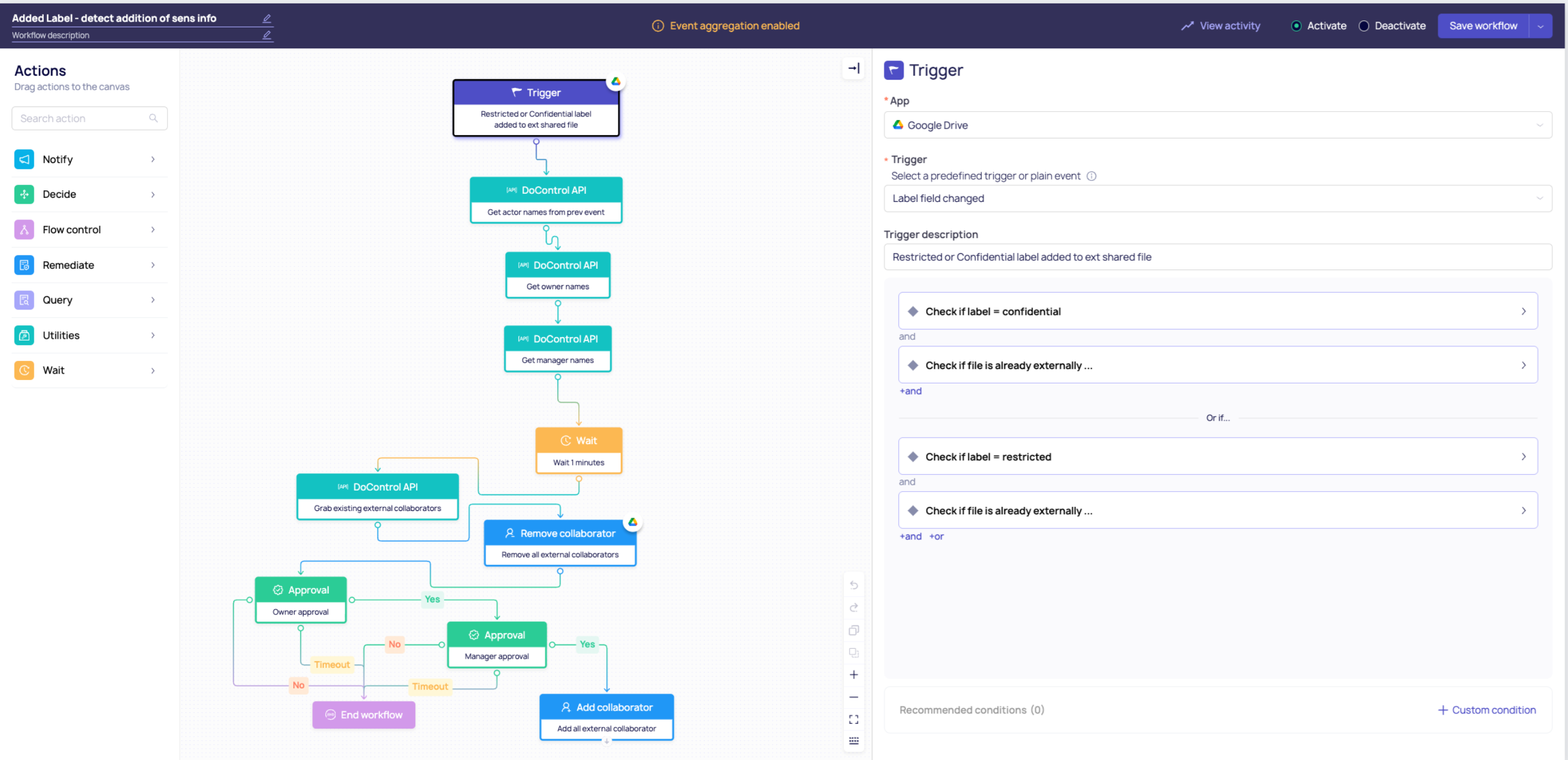
This type of automated, label-driven enforcement significantly eliminates exposure gaps and takes away the bottleneck of manual review - only engaging the relevant manager or security team as needed to keep the business moving.
In this model, classification informs enforcement - and enforcement ensures risk is not left unresolved.
For SaaS-first organizations, this approach allows security teams to move from visibility alone (which won’t actually tangibly protect that data) to measurable risk reduction, without disrupting productivity.
Limitations to Consider for Both
While both categories have their strong-suits, it's important to note that they don't do everything - and each has it's own fair share of limitations.
DSPM Limitations
- Does not directly remediate exposure
- Requires downstream workflows for action
- Primarily visibility-focused
- Often relies on periodic scans, which may not detect or respond to real-time exposure events
Traditional DLP Limitations
- Perimeter-centric architecture
- Limited SaaS context
- High false positive rates
SaaS DLP Considerations
- Requires strong SaaS API integrations
- Must balance security with collaboration
- Needs intelligent automation to scale
Understanding these distinctions helps organizations align solutions to real risk.
Final Thoughts: DSPM vs DLP in Modern Data Security
The comparison between DSPM vs DLP is not about choosing a winner - it’s about understanding different layers of data security and how they fit into your program.
- DSPM focuses on data discovery and posture visibility.
- Traditional DLP protects data in motion.
- SaaS DLP protects sensitive data directly inside collaboration platforms through real-time monitoring and remediation.
In SaaS-driven enterprises, protecting exposed data where work actually happens is essential. Understanding the distinction between visibility and enforcement helps security leaders make informed, risk-aligned decisions that work for them and their organizational needs.
Frequently Asked Questions (FAQ)
Is DSPM a replacement for DLP?
No. DSPM (Data Security Posture Management) and DLP (Data Loss Prevention) solve different layers of the data security problem. DSPM focuses on discovering, classifying, and assessing sensitive data risk across cloud and SaaS environments, while DLP enforces policies to prevent unauthorized access, sharing, or transmission of that data. Organizations concerned with real-time exposure prevention still require enforcement capabilities that DSPM alone does not provide.
Can SaaS DLP work without DSPM?
Yes. SaaS DLP can operate independently to monitor, protect, and remediate sensitive data exposure directly within SaaS applications like Google Workspace, Microsoft 365, and Slack. While DSPM provides visibility into data risk across infrastructure, SaaS DLP focuses on enforcing access controls and reducing real-time exposure within collaboration environments. Many SaaS-first organizations prioritize enforcement before layering in broader posture management tools.
What is the biggest difference between DSPM and DLP?
The biggest difference is their primary function. DSPM identifies, classifies, and prioritizes sensitive data risk across cloud environments, often through periodic scans and posture analysis. DLP, particularly SaaS DLP, actively enforces controls, monitors sharing activity, and remediates exposure in real time. In simple terms, DSPM provides visibility into risk, while DLP reduces that risk through enforcement.
Which is better for SaaS environments?
For organizations primarily concerned with active file sharing, external collaboration, and insider-driven exposure, SaaS DLP is typically more directly aligned with SaaS risk. It operates inside collaboration platforms to monitor permissions, detect exposure, and automatically remediate risky sharing behavior. DSPM may support broader cloud data governance initiatives, but enforcement capabilities are critical for reducing immediate exposure inside SaaS environments.
How do DSPM and SaaS DLP work together?
In some environments, organizations use DSPM to classify and inventory sensitive data across cloud storage, then leverage those classifications within a SaaS DLP platform to automate access controls. For example, if a file labeled as “Confidential” is shared externally, a SaaS DLP solution can automatically remove external collaborators or restrict permissions. In this model, DSPM provides classification and visibility, while SaaS DLP ensures real-time enforcement and risk reduction.
Read more on the subject:
Choosing the Right SaaS DLP Solution: A Buyer’s Checklist for Security Leaders