.png)
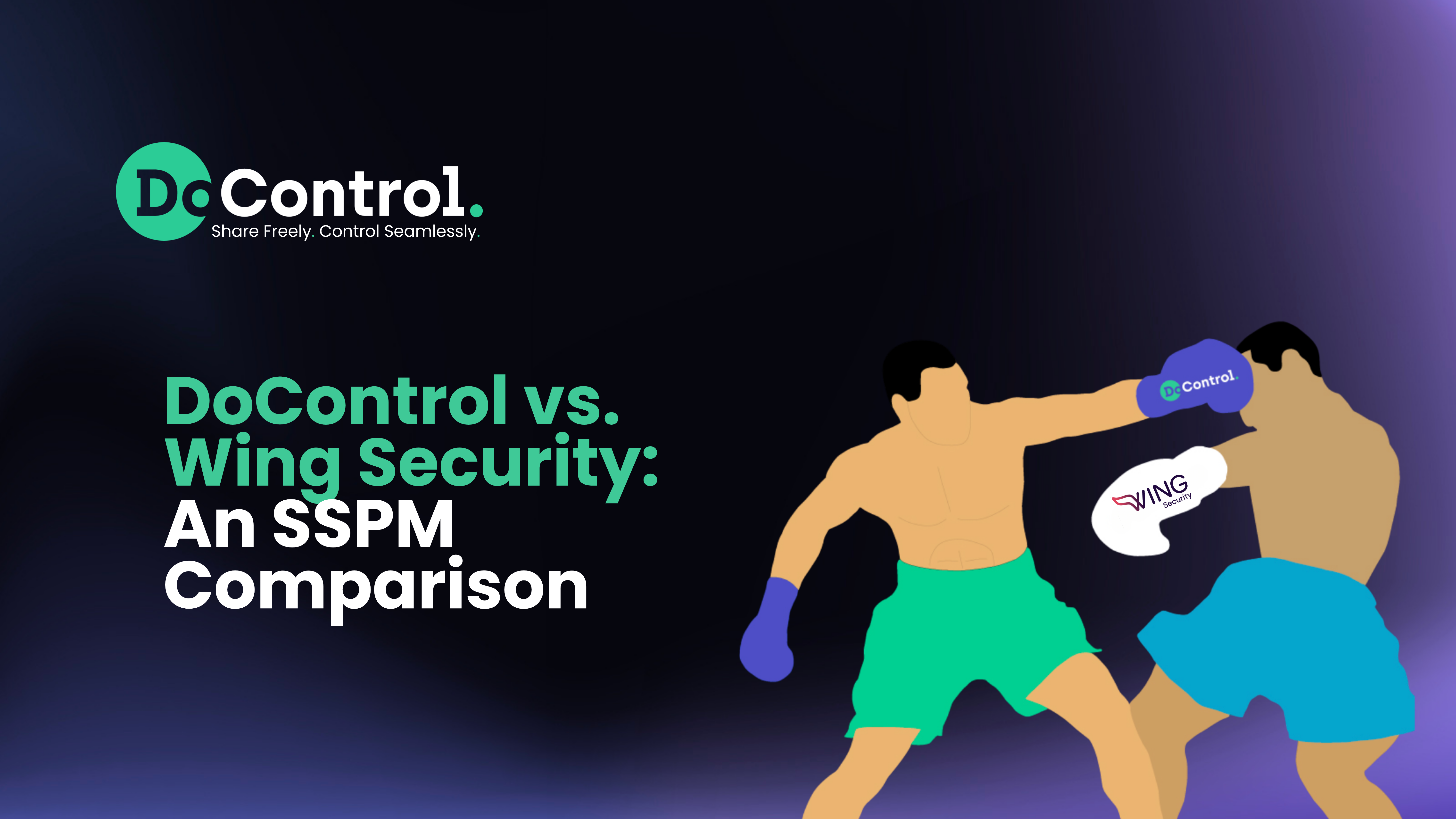
As SaaS environments continue to expand, organizations are rethinking how they secure data, identities, and configurations across dozens - sometimes hundreds - of applications. In this evolving sector of security, both DoControl and Wing Security have emerged as recognized players within the SaaS Security Posture Management (SSPM) category.
Wing Security has positioned itself as a growing vendor in the SaaS security market, with strong capabilities around SaaS discovery, AI governance, misconfiguration detection, and attack surface visibility. Its focus on inventory, posture insights, and identity-related risk signals has made it a consideration for organizations looking to better understand and manage their expanding SaaS ecosystems.
At the same time, DoControl operates squarely within the SSPM space, with a focus on helping organizations move beyond visibility into operational control. As SaaS environments mature, many security teams are discovering that identifying risk is only part of the equation - enforcing policies, remediating exposure, and maintaining least-privilege access are equally critical.
In this comparison of DoControl vs Wing Security, we’ll explore how each platform approaches four core industry challenges shaping the SSPM market today:
- Visibility vs. data-level control
- Workflow automation and remediation depth
- Identity risk detection vs. enforced least privilege
- SaaS attack surface discovery vs. data access governance
Rather than positioning one solution as categorically better than the other, this article examines how each vendor approaches these challenges - and how those differences may matter depending on your organization’s SaaS security priorities.
Industry Challenge 1: SaaS Visibility vs. Control Over Data Exposure
The Problem
SaaS environments are dynamic by design. Employees collaborate across shared drives, messaging platforms, project management tools, CRM systems, and AI productivity tools. They share data constantly. With this level of collaboration (and the inevitable overexposure of data that comes with it) introduces a steady stream of file sharing activity, permission changes, third-party integrations, and configuration changes.
SSPM tools have become highly effective at surfacing risky behaviors and dangerous misconfigurations across these applications. They can identify exposed admin settings, overly permissive policies, risky OAuth integrations, or suspicious user activity. This visibility is essential, as security teams can’t protect what they can’t see.
But in practice, most real-world SaaS breaches don’t start with a dashboard alert about posture. They start at the data layer:
- A sensitive file shared publicly
- A confidential doc containing customer data exposed to “anyone with the link”
- An external collaborator granted excessive access on a file that has company IP
- An over-permissioned user with access to critical information regarding pay data
- Sensitive data stored in collaboration platforms without proper guardrails
Simply knowing that exposure exists does not eliminate it. Visibility into posture is important, but knowing you have risks doesn’t make them go away.
To meaningfully reduce risk, organizations need the ability to actively control, restrict, and remediate risky data access, not just identify it.
Wing Security’s Approach
Wing Security approaches this challenge through strong SaaS inventory and posture visibility. The platform provides:
- Broad SaaS application discovery and attack surface mapping
- Misconfiguration detection across connected applications
- Identity risk signals and behavioral analytics
- AI tool discovery and governance capabilities
- Risk scoring and posture-based insights to help prioritize issues
Wing’s strength lies in helping organizations understand their SaaS and AI footprint: what applications are in use, how they are configured, and where potential risks may exist. It gives security teams clarity into configuration drift, identity behaviors, and areas of exposure across their SaaS stack.
In short, Wing focuses on surfacing configuration risks, mapping identities, and providing structured visibility into SaaS and AI environments so teams can assess where issues may arise. It tells security teams what’s wrong and paints a clear picture of their risk, but it doesn't go as far to actually remediate that risk and eliminate the problems after they're found.
DoControl’s Approach
DoControl approaches SaaS security with comprehensive visibility across every major risk layer within the environment. The platform provides insight into data loss prevention (DLP), data access governance, identity risk management, insider threat activity, SaaS misconfigurations, third-party OAuth applications, and AI-connected tools. Security teams gain a centralized view of how their SaaS stack is configured, how data is being shared, where sensitive information resides, and where exposure may exist.
This breadth of visibility ensures organizations are not just monitoring posture at a surface level, but understanding risk across data, identities, applications, and configurations simultaneously. In that sense, DoControl delivers the level of visibility modern SSPM buyers expect.
Where the platform differentiates itself is what happens next.
DoControl extends visibility into direct, in-platform control. When risky exposure is detected - whether it’s a public link, excessive permissions, misconfigured sharing settings, or sensitive data overshared externally - automatic remediation workflows kick into gear. Access can be revoked, permissions can be adjusted, external sharing can be removed, and sensitive content can be secured in real time.
Remediation can be performed individually or in bulk, allowing organizations to address both isolated risks happening on a day-to-day basis, and large-scale historical exposure efficiently.
The distinction between the two products is subtle but important:
Both DoControl and Wing provide visibility into SaaS risk, but DoControl extends that visibility into direct control and remediation, ensuring that once exposure is identified, it can be resolved within the same workflow, not deferred to manual processes outside the platform.
In an SSPM market where visibility has become table stakes, the ability to control and remediate data exposure is what ultimately reduces risk.
Industry Challenge 2: Workflow Automation and Remediation at Scale
The Problem
As SaaS environments grow, so does the volume of security findings.
Even with prioritization and risk scoring, alerts can accumulate quickly. As findings stack up across dozens of SaaS applications, alert fatigue becomes inevitable. Security leaders and analysts simply cannot investigate and manually remediate every single issue that surfaces.
Without built-in remediation:
- Alert fatigue sets in
- Valuable time is pulled away from strategic initiatives and higher-risk threats
- Unresolved findings pile up
- Response times slow down
- Backlogs grow
- Real risks remain exposed longer than necessary
- The overall security posture weakens
Over time, the difference between detection and resolution becomes critical. Workflows ultimately determine whether a platform meaningfully reduces risk, or simply surfaces it.
Wing Security’s Approach
Wing Security provides workflow capabilities tied to risk findings within its platform. These include:
- Risk scoring and prioritization to highlight high-impact issues
- Contextual alert enrichment to support investigation
- Automation triggers based on posture violations
- Integration with SIEM and SOAR platforms for downstream response orchestration
Wing’s workflows are designed to ensure that findings are structured, prioritized, and routed efficiently within broader security operations.
However, Wing does not provide native remediation capabilities within SaaS applications themselves. While it can surface exposure and route alerts, the platform does not directly execute bulk permission changes, revoke sharing links, quarantine files, or enforce data-level controls automatically inside the SaaS environment.
As a result, once a risk is identified, remediation must be handled manually or through external tooling.
In practice, this means Wing workflows focus on detection and orchestration - not direct in-platform enforcement.
DoControl’s Approach
DoControl was designed with a different philosophy: workflows should not just escalate risk, they should resolve it.
The platform includes native, conditional-logic remediation workflows built directly into the SaaS environment. When exposure is detected, DoControl can take immediate action without requiring external systems or manual intervention.
Automated actions include:
- Revoking public links
- Removing external collaborators
- Adjusting user permissions
- Blocking or restricting external sharing
- Quarantining sensitive files
These actions can be applied to individual assets or executed in bulk across thousands of files simultaneously, enabling organizations to remediate both isolated incidents and large-scale historical exposure efficiently.
DoControl also includes a playbook library for common SaaS exposure scenarios, allowing teams to deploy proven remediation policies quickly.
In addition, workflows can incorporate end-user engagement through Slack or Gmail, enabling organizations to:
- Capture business justification for access
- Notify data owners
- Trigger approval-based remediation steps
This ensures remediation happens quickly while still preserving business continuity.
The result is a meaningful reduction in manual workload. Common exposures can be automatically resolved in the background, leaving security teams focused only on the highest-risk issues that truly require investigation.
The distinction here is a bit more straightforward:
Wing workflows help structure and route findings.
DoControl workflows execute enforcement directly within the SaaS environment, eliminating exposure at scale rather than adding it to a queue.
Industry Challenge 3: Identity Threat Detection vs. Enforced Least Privilege
The Problem
Identity has become the new perimeter in SaaS environments. As organizations adopt more SaaS applications, access sprawl increases - often quietly and under the radar.
Over time, users accumulate permissions they no longer need. Roles change, projects end, contractors remain in systems, and access is rarely reduced at the same pace it is granted. The result is over-permissioned accounts, stale access, and unnecessary exposure across collaboration platforms.
At the same time, identity-based threats are rising. Compromised credentials, insider misuse, employee data exfiltration, and privilege escalation attacks are now common breach vectors.
Detection plays a critical role in identifying suspicious behavior. But detection alone does not eliminate excessive access.
Reducing identity risk requires more than spotting anomalies, it requires actively enforcing least privilege.
Wing Security’s Approach
Wing Security addresses this challenge through Identity Threat Detection and Response (ITDR) capabilities. The platform leverages:
- Behavioral analytics mapped to MITRE ATT&CK frameworks
- Risk scoring based on anomalous identity behavior
- Detection of suspicious user activity across SaaS environments
- Identity risk mapping tied to posture and configuration insights
Wing’s approach emphasizes identifying risky behaviors and surfacing identity-related threats so security teams can investigate potential abuse or compromise.
In this model, detection and behavioral analysis are central - providing visibility into how identities interact with SaaS applications and where anomalies may indicate elevated risk.
DoControl’s Approach
DoControl approaches identity risk from a complementary but distinct angle: minimize unnecessary access before it becomes a problem.
The platform provides granular visibility into user access across SaaS collaboration environments, including:
- Who has access to what data
- How they received that access
- Whether that access aligns with their role, department, or employment status
By enriching access data with context from HRIS, IdP, and endpoint systems, DoControl evaluates permissions through a business-aware lens - not just a technical one. The platform understands who the user is within the organization, what their role requires, how long they’ve held certain permissions, and whether their access aligns with their function and employment status.
This contextual foundation enables more accurate, risk-driven decisions around access governance.
In addition to static role alignment, DoControl continuously analyzes user behavior to establish individualized behavioral baselines per employee. Users are dynamically risk-scored based on changes in activity patterns, unusual access behavior, excessive sharing, or deviations from expected norms within the SaaS environment.
When a user’s risk score spikes - whether due to abnormal access patterns, suspicious activity, or behavior that falls outside their established baseline - they can be flagged for review or placed on a watchlist for closer monitoring. This allows security teams to focus attention where it matters most, without overwhelming them with unnecessary alerts.
The result is identity governance that is both proactive and precise, combining contextual awareness, behavioral intelligence, and automated enforcement to reduce exposure before it turns into incident response.
The distinction here is subtle but meaningful:
Wing emphasizes detecting identity-based threats and risky behavior.
DoControl focuses on reducing identity risk at its source - by actively minimizing unnecessary access and enforcing least privilege across the SaaS environment.
In environments where identity sprawl is inevitable, proactive access control can be just as critical as threat detection.
Industry Challenge 4: SaaS Attack Surface Discovery vs. Data Access Governance
The Problem
SaaS environments rarely stay static. New applications are adopted continuously. Third-party integrations connect systems together. AI tools and browser-based extensions expand the ecosystem even further. Over time, this growth significantly increases the organization’s SaaS attack surface.
Shadow apps, unmanaged OAuth connections, and AI-powered tools introduce additional complexity. Many of these applications request broad permissions to read, write, or modify data inside collaboration platforms.
Discovering these applications is an important first step. Security teams need to know what’s connected to their environment and what permissions have been granted.
But discovery alone does not govern risk.
Once applications are identified, organizations must determine:
- What level of access is appropriate
- Whether permissions are excessive
- Whether sensitive data is exposed
- How to continuously enforce access policies over time
True SaaS security requires not just mapping the attack surface - but governing data access within it.
Wing Security’s Approach
Wing Security emphasizes SaaS and AI tool discovery as a core component of its platform. Capabilities include:
- SaaS and AI application inventory
- Integration mapping and attack surface visibility
- Posture benchmarking against industry frameworks
- Threat intelligence integration to contextualize risk
Wing’s approach centers on helping organizations understand the breadth of their SaaS and AI environments. By mapping applications, configurations, and connections, security teams gain insight into where risk may originate and how their posture aligns with best practices.
This visibility supports informed decision-making and strengthens overall awareness of the SaaS attack surface.
DoControl’s Approach
DoControl extends beyond discovery to actively govern and control access across the SaaS ecosystem.
The platform includes OAuth app governance capabilities that identify over-permissioned, unused, or risky third-party applications - and enables direct remediation when access exceeds policy thresholds.
More broadly, DoControl operationalizes a full data access governance lifecycle:
- Inventory of users, files, apps, and integrations
- Sensitivity scoring to identify regulated or business-critical data
- Exposure mapping across internal, external, and public sharing
- Remediation through direct access enforcement
- Continuous monitoring to prevent re-exposure
Rather than stopping at visibility into connected apps, DoControl focuses on how those apps interact with sensitive data - and whether that access aligns with policy.
If an OAuth application is granted excessive permissions, access can be revoked. If historical sharing exposure is discovered, it can be remediated in bulk. If risky patterns reappear, automated enforcement can prevent the issue from recurring.
This distinction is less nuanced and more straightforward:
Wing emphasizes mapping and understanding the SaaS and AI attack surface.
DoControl focuses on governing and controlling data access across that surface, ensuring exposure is not just identified, but actively reduced and continuously managed.
Conclusion
Wing Security has earned recognition in the SSPM market for its strong visibility capabilities, SaaS and AI discovery, and posture management insights. For organizations looking to better understand their SaaS attack surface, benchmark configurations, and detect identity-related risk signals, Wing provides structured visibility across complex environments.
Make no mistake: visibility is essential. No security program can operate effectively without clarity into applications, configurations, identities, and integrations.
However, as many organizations evaluating SSPM solutions are discovering, visibility is only part of the equation.
Modern SaaS security requires not just insight into risk - but the operational depth to remediate it efficiently and at scale. As alert volumes increase and SaaS ecosystems grow more dynamic, the ability to enforce policies, reduce exposure automatically, and close the loop on findings becomes just as important as detection itself.
This is where DoControl’s approach stands apart.
DoControl is:
- Data-centric, focusing on exposure at the file and access level
- Enforcement-driven, enabling direct remediation within SaaS environments
- Workflow-mature, with native automation designed to resolve - not just escalate - risk
- Built to close the loop, turning visibility into immediate and scalable control
Rather than positioning this as a matter of “better” or “worse,” the distinction in the DoControl vs Wing Security comparison comes down to operational philosophy. Wing emphasizes mapping and understanding risk. DoControl emphasizes governing and reducing it in real time.
The most effective security programs are layered, combining visibility, detection, governance, and enforcement across multiple tools where necessary. But for organizations seeking an SSPM platform that moves beyond posture monitoring and into proactive data access control, remediation depth becomes a defining factor.
In today’s SaaS environments, visibility is foundational, but control is what ultimately reduces risk.