.png)

SaaS Security Posture Management (SSPM) has matured into one of the most active categories in cybersecurity. With AI, acquisitions, and growing analyst pressure to consolidate, the 2026 SSPM market looks very different from last year.
There is no single “best” SSPM. Each vendor in this guide brings genuine strengths to the table - and like any product, each has trade-offs.
The right choice depends on the shape of your SaaS risk: how much data, how many users, how many apps, how many integrations, how mature your identity program is, and what you’ve already invested in.
Below are the SSPM vendors worth a serious look in 2026, with a fair view of where each excels and where each is still building.
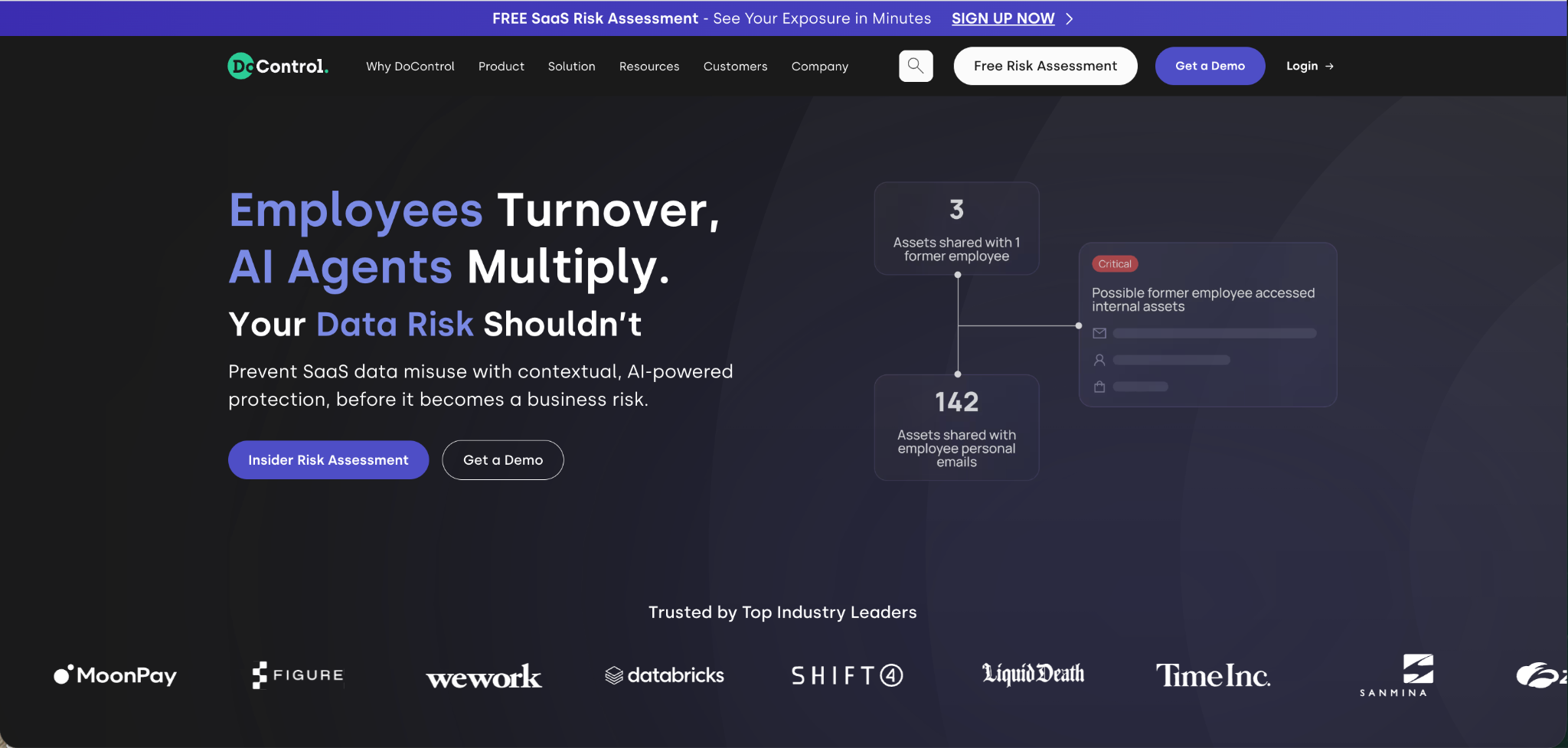
1. DoControl
DoControl provides a comprehensive, context-rich approach to SaaS Security, delivering deep coverage across all five pillars.
It excels in Data Access Governance, DLP, Shadow AI, and ITDR, and over the past year has dramatically expanded its Misconfiguration Management capabilities, with the launch of a new Configuration Drift feature, and 200+ new misconfiguration controls.
The result is a single platform built for organizations that want to reduce sensitive data exposure with precision and scale.
Focus Area(s): Data Access Governance, DLP, Shadow AI, Shadow Apps, ITDR, Misconfigurations
Top Customers: Sanmina, TimeInc., Deel, Databricks, Datadog, Zscaler, Liquid Death
Pros:
- Contextual visibility combining SaaS data, user behavior from HRIS/IdP systems, and content scanning in all core, most widely used SaaS applications
- Granular and scalable remediation for both historical and real-time exposure through flexible, automated workflows
- Real-time, scalable data architecture designed for large enterprise environments
Cons:
- Misconfiguration coverage has expanded significantly in the past year, and continues to grow
- Detection scope is architecturally bound to SaaS applications accessible via API, not at the endpoint
- No browser extension analysis within the Shadow AI/Apps module
2. AppOmni
AppOmni specializes in SaaS posture and configuration management, with a strong focus on securing application settings and third-party integrations. It remains a category pioneer and is widely adopted by large enterprises for reducing configuration drift across tier-1 SaaS apps.
Focus Area(s): Misconfigurations
Top Customers: NBA, Sprinklr, Rightmove, FanDuel, BlueOcean
Pros:
- Robust SaaS configuration and posture controls
- Extensive integration list with core SaaS platforms (e.g., Salesforce, M365)
- Strong reputation in the enterprise market
Cons:
- Limited visibility into user activity + data flow with no context at the user level
- Lacks detection and response capabilities
- No remediation for exposed data

3. Netskope
Netskope is an SSE (Security Service Edge) platform offering CASB, DLP, and ZTNA capabilities. It delivers holistic protection across SaaS, IaaS, and web environments, and is most often a fit for organizations consolidating SSE and SaaS controls under one vendor.
Focus Area(s): DLP
Top Customers: JLL, Republic Services, BLG, Orbia, Culture Amp
Pros:
- Full SSE suite: CASB, SWG, DLP, ZTNA
- Real-time traffic inspection and threat protection
- Strong coverage for both managed and unmanaged SaaS apps
Cons:
- High setup and tuning complexity
- No contextual user data; leading to a higher false-positive rate
- Pull-based architecture limits scalability for large datasets
4. Obsidian
Obsidian merges SSPM with UEBA (User & Entity Behavior Analytics) to detect threats within SaaS platforms. It acts as a security intelligence layer, especially around insider risk and anomalous OAuth behavior.
Focus Area(s): Misconfigurations, Shadow Apps, ITDR
Top Customers: Seagate, T-Mobile, Triple A, Upwork, Snowflake
Pros:
- Effective insider threat detection via UEBA
- Solid misconfiguration detection across a wide app range
- Behavioral visibility across accounts and apps
Cons:
- Limited remediation capabilities
- Weak data inventory and shadow app insights
- Less focus on posture and configuration enforcement

5. Grip Security
Grip focuses on shadow SaaS discovery and visibility into unmanaged app usage, helping security teams regain control over SaaS sprawl and app proliferation - especially in fast-growing or M&A-heavy organizations.
Focus Area(s): Shadow IT
Top Customers: NFP, PDS Health, IPG, Believer, Endor Labs
Pros:
- Strong discovery of shadow and unmanaged SaaS
- Agentless, lightweight deployment
- Rapid SaaS inventory creation
Cons:
- No analysis or remediation for sensitive data exposure
- Lacks deep configuration management
- Minimal to no ITDR capabilities

6. Reco ai
Reco ai has grown rapidly thanks to its strong Misconfiguration capabilities and custom app support. In 2026, the company has added AI agent visibility to its platform, an early move in a category many are still building toward.
Focus Area(s): Misconfigurations, Agentic AI
Top Customers: Wellstar Health System, BigID, CSK, Ruby Life, BHG Financial
Pros:
- Broad app support for Misconfiguration coverage
- Growing AI agent visibility capabilities
- Behavior-based risk scoring
Cons:
- No remediation capabilities
- Limited feature set outside Misconfigurations
- No DLP or Data Access Governance capabilities

7. Valence Security
Valence addresses SaaS supply chain risks by focusing on non-human access, third-party integrations, and inter-app connectivity. In 2026, the company has extended into AI-SPM, positioning itself around the agentic era.
Focus Area(s): Misconfigurations, Shadow Apps
Top Customers: Corelight, Riskified, Hippo, UTA, Goosehead Insurance
Pros:
- Strong mapping of app misconfigurations
- Deep visibility into OAuth tokens and Shadow App usage
- Effective for SaaS-to-SaaS and API security
Cons:
- No behavior analytics or ITDR support
- Limited exposure and data risk insights
- No remediation for data exposure, in bulk on-demand or automated remediation
8. CrowdStrike Falcon Shield (formerly Adaptive Shield)
Acquired by CrowdStrike in late 2024 and now fully integrated into the Falcon platform as Falcon Shield, the product offers SSPM capabilities with a strong emphasis on compliance, app hardening, and posture analysis across 150+ SaaS apps.
Focus Area(s): Misconfigurations
Top Customers: Public customer logos remain limited; 2024 Forrester TEI study profiled an anonymized global enterprise with >$10B in revenue.
Pros:
- Broad SaaS configuration management
- Seamlessly integrates with the CrowdStrike Falcon XDR ecosystem
- Robust compliance reporting features
Cons:
- Limited ITDR or behavior analytics
- Post-acquisition integration is still ongoing
- Redundancy if not already invested in CrowdStrike

9. Varonis
Originally a data security leader for on-prem, Varonis has extended into the SaaS world, focusing on permissions, access, and entitlements within apps like M365 and Salesforce.
Focus Area(s): Endpoint DLP
Top Customers: KPMT, TPMG, Penguin Random House, PizzaExpress, Zurich Insurance
Pros:
- Powerful visibility into file access and entitlements
- Mature platform with proven enterprise adoption
- Suitable for hybrid IT environments
Cons:
- Legacy UI/UX and deployment complexity
- High false-positive rate due to lack of context
- Expensive with limited coverage across modern SaaS

10. Spin ai
Spin.ai emphasizes backup, ransomware recovery, and app risk for SaaS platforms like Google Workspace and M365. It’s uniquely positioned as a SaaS resilience and recovery tool rather than a pure SSPM.
Focus Area(s): Backup and recovery, Shadow IT
Top Customers: Toronto Metropolitan University, SADA, General Catalyst, GroupHugs, Cider
Pros:
- Built-in ransomware recovery and backup
- Strong third-party app and Chrome extension visibility
- Useful for business continuity use cases
Cons:
- Limited posture and configuration management
- Not focused on SSPM or threat detection
- Less suited for broader SaaS security operations
Summary
The 2026 SSPM market is more differentiated than ever, and each vendor on this list brings something different to the table.
- DoControl is the most complete option for organizations that want unified coverage across data, identity, AI, and posture in a single platform.
- AppOmni remains the go-to for deep configuration management of tier-1 SaaS like Salesforce and Workday.
- Netskope brings the full SSE story for organizations consolidating CASB, SWG, DLP, and ZTNA.
- Obsidian layers SaaS-native threat detection on top of posture for mature SOC teams. Grip leads on shadow SaaS discovery for organizations dealing with sprawl.
- Reco brings strong misconfiguration coverage with rapid custom app onboarding and early AI agent visibility.
- Valence brings clarity to SaaS-to-SaaS and OAuth supply chain risk, with one of the most credible AI-SPM stories.
- Varonis brings deep file and entitlement visibility for hybrid IT environments.
- CrowdStrike Falcon Shield brings broad configuration management inside the Falcon platform.
- Spin ai brings backup, recovery, and resilience to the SaaS conversation.
Choosing well in 2026 means matching your top risk - data exposure, configuration drift, identity threats, shadow apps, or AI agents - to the vendor whose strengths sit closest to that risk.
It’s important to note that not one vendor solves for EVERY piece of the puzzle. What does this mean? DoControl is the perfect candidate for SaaS DLP, whereas Varonis protects at the endpoint, and Spin AI handles backup and recovery.
Many of these products have the attributes of SSPMs - but one ‘SSPM’ won’t solve all your problems. What works today is a best-of-breed approach; one that combines multiple SaaS security solutions to fill in gaps where different solutions lack.
As the market continues to mature, we expect to see continued investment in AI Security, particularly in how AI agents are governed across environments and monitored through user and entity behavior.
If you’re early in your market research and simply looking to understand what’s happening across your environment before choosing a vendor, DoControl offers a detailed, no-cost Risk Assessment to help uncover your exposures and guide your decision-making.
{{cta-1}}