.png)
Imagine it's a Tuesday morning. Your CISO walks into your office before the 10 a.m. and asks for thirty minutes. By the end of those thirty minutes, you are no longer running the day you planned to run.
A connected SaaS application has been compromised. Sensitive customer data has been exfiltrated. Forensics is engaged, outside counsel is on a bridge, and someone - the obvious someone is you - needs to decide, very quickly, whether this rises to a material event that requires disclosure.
When a SaaS incident lands, the CFO is responsible for translating the financial impact in the language the board, the regulators, and the auditors actually use.
The better approach would have been to make the underlying decisions before the incident, not during it. But, unfortunately, that rarely happens.
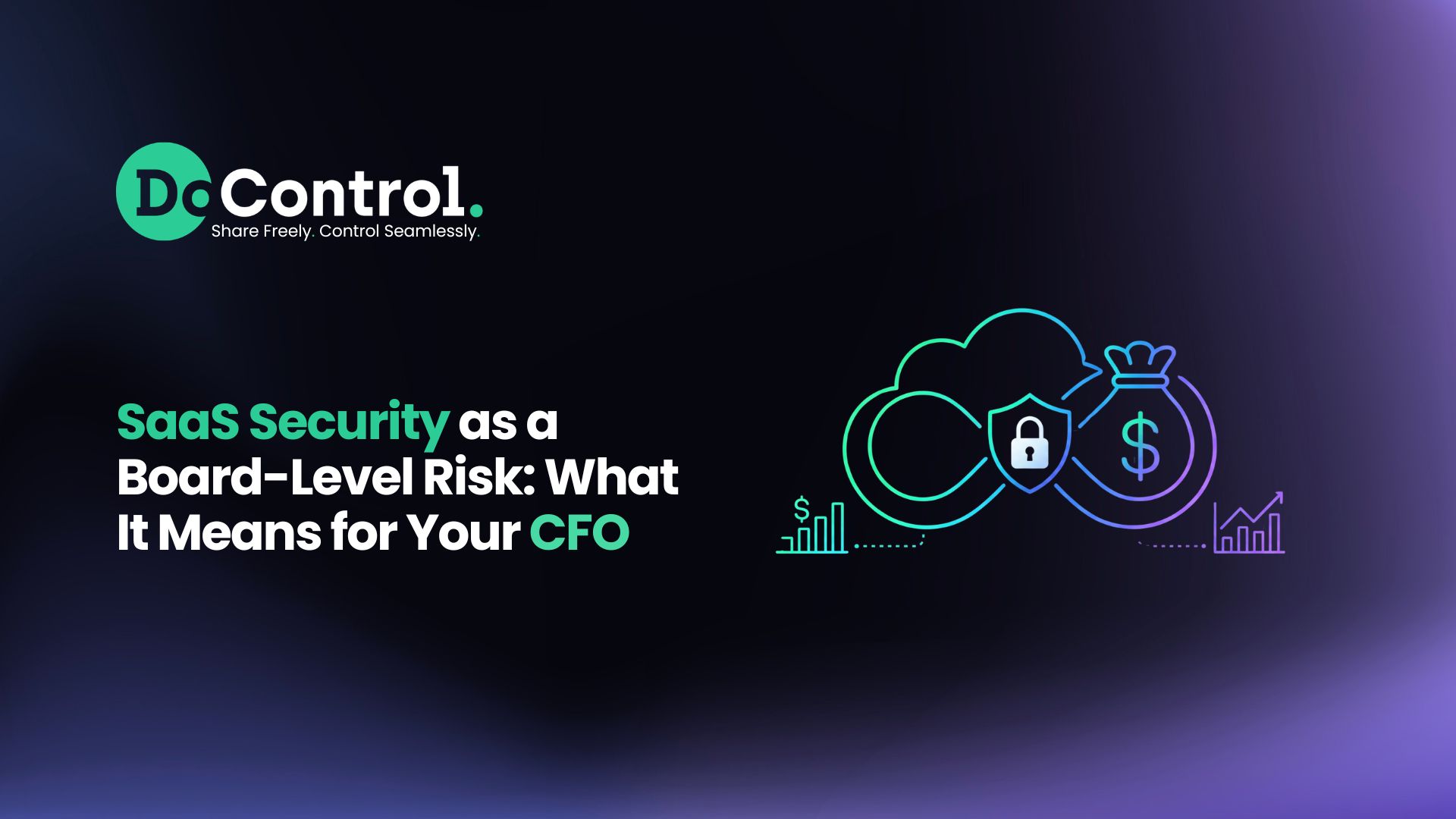
Many CFOs know the cost of a data breach, but it’s not just about that. It’s about asking three questions that need to be answered when making a decision.
There are three business questions every CFO already knows how to answer; they just never think to ask the questions as it relates to cybersecurity. They are: how big is the problem, can we solve it ourselves, and does the investment pay off over time?
1. How big is the problem - and what does it cost us to ignore it?
Start with the magnitude. According to IBM, the average cost of a data breach in 2025 is $4.24 million - and SaaS-based breaches routinely run well above that average. SaaS applications have become the connective tissue of the modern enterprise, which means they are also one of the largest and fastest-growing categories of financial risk sitting on the balance sheet.
Let’s start with the problem: SaaS data sharing is at an all-time high. In platforms like Google Workspace, employees routinely share documents, files, and sensitive information across teams, external partners, and third-party collaborators to keep work moving.
But this collaboration creates a growing exposure risk. Employees often leave organizations while still retaining access to shared drives, documents, and files containing sensitive data. Contractors and vendors are frequently left attached to projects long after their engagement ends, unintentionally preserving access to internal information.
As a result, sensitive data is constantly being accessed, copied, and reshared across an expanding network of users and systems - often without clear visibility or control.
The outcome is straightforward: sensitive data is continuously in motion, widely accessible, and increasingly difficult to track, making it inherently at risk.
At the same time. SaaS adoption is accelerating, AI integrations are rapidly expanding across organizations. Every new tool the business adopts increases the potential attack surface, and the security program your team built three years ago is no longer equipped to address today’s risks.
A few broader shifts have pushed SaaS data exposure squarely into the finance arena, making it just as much the CFO’s concern as the CISO’s:
- Regulatory frameworks (GDPR, HIPAA, SOC 2, ISO 27001) have sharpened their expectations on data sharing, insider risk, SaaS misconfiguration and third-party access, and enforcement needs to be proven and scalable.
- Customer procurement and security reviews have escalated. A single SaaS data exposure event or a finding from a major customer can stall a renewal or expansion conversation that finance was already counting on.
- Brand reputation has become a measurable financial asset. Public breach disclosures linger in search results, trade press archives, and customer due-diligence questionnaires for years after the incident - and the cost compounds with every prospect who reads the headline before they read the pitch deck.
- Investor and analyst scrutiny has tightened. For public companies, breach disclosures now move share prices on the day of filing. For private companies, breach history is a standard question in late-stage diligence, and a material finding can affect valuation multiples in subsequent rounds.
- Customer confidence sits underneath every contract. Enterprise customers increasingly require security attestations, breach notification clauses, and indemnification language as standard parts of contracting. A breach disrupts the trust foundation and can trigger renegotiation, additional security commitments, or termination - each of which has a direct ARR impact.
The answer to question 1:
The cost of doing nothing is incredibly structurally expensive.
It looks like this:
(Tangible cost of an incident + Intangible business impact) × an attack surface that grows every quarter
Tangible costs
These are the immediate, measurable expenses that follow a breach:
- Paying incident response teams, legal counsel, and internal employees pulled into remediation
- Covering recovery efforts, forensic investigations, and system cleanup
- Replacing or restoring lost data, including potential ransom payments
- Purchasing emergency tooling, outside consultants, and compliance support
- Managing operational downtime and disrupted productivity
Intangible costs
These are harder to quantify – but often far more damaging over time:
- Renewals stall as enterprise customers trigger procurement and security reviews that delay expansions finance was already forecasting
- Brand damage lingers long after the incident, resurfacing in search results, due diligence questionnaires, and boardroom conversations for years
- Investor and analyst scrutiny intensifies, impacting market perception, valuation multiples, and confidence in future growth
- Customer trust erodes gradually, contract by contract, weakening retention and directly impacting ARR
- Internal momentum slows as leadership attention shifts from growth initiatives to crisis management and reputational recovery
And the reality is: SaaS data risk is only growing as a problem. Companies scale, they onboard employees, offboard employees, hire third-parties, integrate apps, experiment with AI tools, connect vendors to their systems…and the list goes on.
Every over-permissive share, every new SaaS app, AI integration, vendor connection, and employee transition creates another pathway for exposure.
So yes – there is a cost to doing nothing. And every quarter, that cost gets bigger.
2. Buy vs. build – can we solve this internally?
The instinct to solve a problem internally is healthy. For most enterprise systems, the internal team is closer to the business, and has the ability to move faster than a vendor for a number of reasons. However, SaaS data security is one of the categories where the math is different - and worth working through.
Building SaaS security internally is not a single project. It is a portfolio of programs that have to run continuously and in parallel across every SaaS application the business depends on – Google Workspace, Microsoft 365, Salesforce, Slack, GitHub, Box, and the long tail of niche apps your teams adopt without telling anyone. At a minimum, that portfolio has to include:
- Continuous discovery of where sensitive data lives across the SaaS environment and who actually has access to it.
- Detection and remediation of oversharing – public links, external collaborators, departing-employee exposure – at the scale a productivity-first business generates every day.
- Governance over third-party SaaS-to-SaaS integrations and the OAuth tokens that connect them, including the AI tools your teams are adopting faster than security can review them.
- Configuration monitoring against the SOC 2, HIPAA, GDPR, and ISO 27001 baselines your auditors test against, with drift detection and proof of enforcement.
- Identity-aware, automated remediation workflows that resolve issues at scale without sending every alert to a human security analyst.
Every one of those workstreams requires its own engineering against each SaaS vendor's API, its own detection logic, its own response process, and its own roadmap to keep pace as each SaaS vendor evolves.
In effect, an internal build is standing up a small SaaS data security platform in-house – for a category of risk that did not exist in this form five years ago and that expands every quarter.
The framing finance leaders find most useful here is core vs. context:
For a specialist SaaS data security vendor, this work is the core of the business: the entire product roadmap, the entire engineering team, and the entire customer-facing motion are dedicated to it.
For the enterprise, it is context: one important responsibility on a security team that owns endpoint, network, identity, cloud, and a dozen other categories.
Context work tends to under-deliver against core work, not because the people are less capable, but because attention drifts to whatever the current priority is, and SaaS data security stops being the current priority the day after the most recent incident.
The line-item cost of an internal build understates the real cost in three ways:
- Opportunity cost on the security team → every engineer building SaaS detection is an engineer not building something else the business needs.
- Attrition risk → the niche talent required to keep pace with SaaS vendor APIs is expensive to hire, expensive to retain, and easy to lose.
- Growing coverage gap → the program tends to fall behind the environment over time, because the SaaS environment keeps growing, and internal teams rarely scope upward at the same rate.
The answer to question 2:
Can it be solved internally? Not realistically – at least not at the level of coverage this problem requires. The right move for most security teams is to buy a SaaS data security platform from a specialized vendor, not build one internally.
Specialized vendors already have a full-fledged product purpose built to solve this problem, use context and AI to track user behavior, keep data inside the companies digital walls, maintain integrations across the SaaS apps companies use every day, continuously adapt to changes in those platforms, and spread the engineering investment across many customers. Replicating that internally is expensive, time-consuming, and difficult to sustain.
So the decision is not really “buy vs. build.” It’s “buy vs. under-build.” And for SaaS data security, buying is usually the stronger path.
3. Long-term ROI – does the value compound?
The third question every CFO asks about a new investment is simple: does the value last for a year, or does it compound across multiple budget cycles?
For SaaS data security, the return is structural, and it compounds in the right direction. The return shows up in three layers:
Layer 1: Direct financial protection.
A single avoided breach can outweigh multiple years of platform spend, especially when GDPR, HIPAA, or SEC disclosure exposure is involved.
Layer 2: Operational efficiency.
Mature SaaS security programs reduce recurring friction across the business: audits move faster, customer security reviews require less manual effort, cyber insurance conversations become easier, and security teams spend less time reacting to incidents and more time supporting the business. These benefits appear every fiscal year, whether or not a breach occurs.
Layer 3: Strategic.
This is often the hardest to measure – and the most valuable over time. A scalable governance layer allows the business to adopt new SaaS applications and AI tools more quickly and with greater confidence. Security becomes an enabler of growth instead of a constraint on it.
The reason this investment compounds rather than depreciates is the same reason the risk keeps growing, and the SaaS environment never stops expanding.
Every new application the business adopts is governed through the same platform. Every new AI integration, OAuth connection, vendor collaboration, and employee transition falls under the same control layer without requiring proportional increases in cost or headcount. Coverage grows while the marginal cost of maintaining that coverage declines.
The inverse is also true. Internal programs tend to lose effectiveness over time because the environment evolves faster than internal teams can keep up. Priorities shift, engineering resources move elsewhere...and the SaaS environment expands faster than coverage does. Five years into an internal build, many companies discover they have spent heavily and still lack visibility across the environment they actually operate today.
A specialized platform is structurally better positioned against that drift because staying current with the SaaS environment is its entire purpose.
There is also a simpler way to frame the investment: it functions as a form of operational insurance for one of the company’s most valuable assets: its data.
No finance organization would leave a critical facility, supply chain, or revenue-generating asset uninsured simply because a loss event might never happen. SaaS data now sits in the same category of business-critical exposure.
The difference is that, unlike many traditional risks, the attack surface expands every quarter as the business adds more people, more users, more data, adopts more applications, integrations, AI tooling, and increases the amount of risk within the company.
The answer to question 3:
Does the value compound? Yes. This is not a one-year security expense, it is a long-term investment in controlling a category of risk that continues to grow with the business itself – and the return improves with every new piece of data, tool, integration, and workflow the company adopts.
The bottom line: SaaS security is a board-level issue
A CFO does not need to become the head of SaaS security. But they do need confidence that the business understands where its exposure lives, what it could cost, and how quickly the company could respond if something went wrong.
Every company is vulnerable to a SaaS breach. The difference is preparedness. Endpoints have largely been secured, cloud infrastructure has matured, but SaaS security remains one of the most overlooked layers of enterprise risk - even though this is where modern business data lives, moves, and gets shared every second of every day.
For CFOs, SaaS security is no longer an IT line item. It is an input into customer trust, regulatory posture, insurance economics, operational resilience, and long-term enterprise value. The financial impact of a breach does not end when the incident is contained; it continues through delayed renewals, damaged reputation, increased scrutiny, and the lingering cost of lost confidence.
It is time to recalibrate how the finance organization thinks about ROI in cybersecurity. The true return is not just efficiency; it is the prevention of the kind of incident that negatively affects, reshapes, and kills a successful fiscal year - or, an enterprise legacy.