.png)
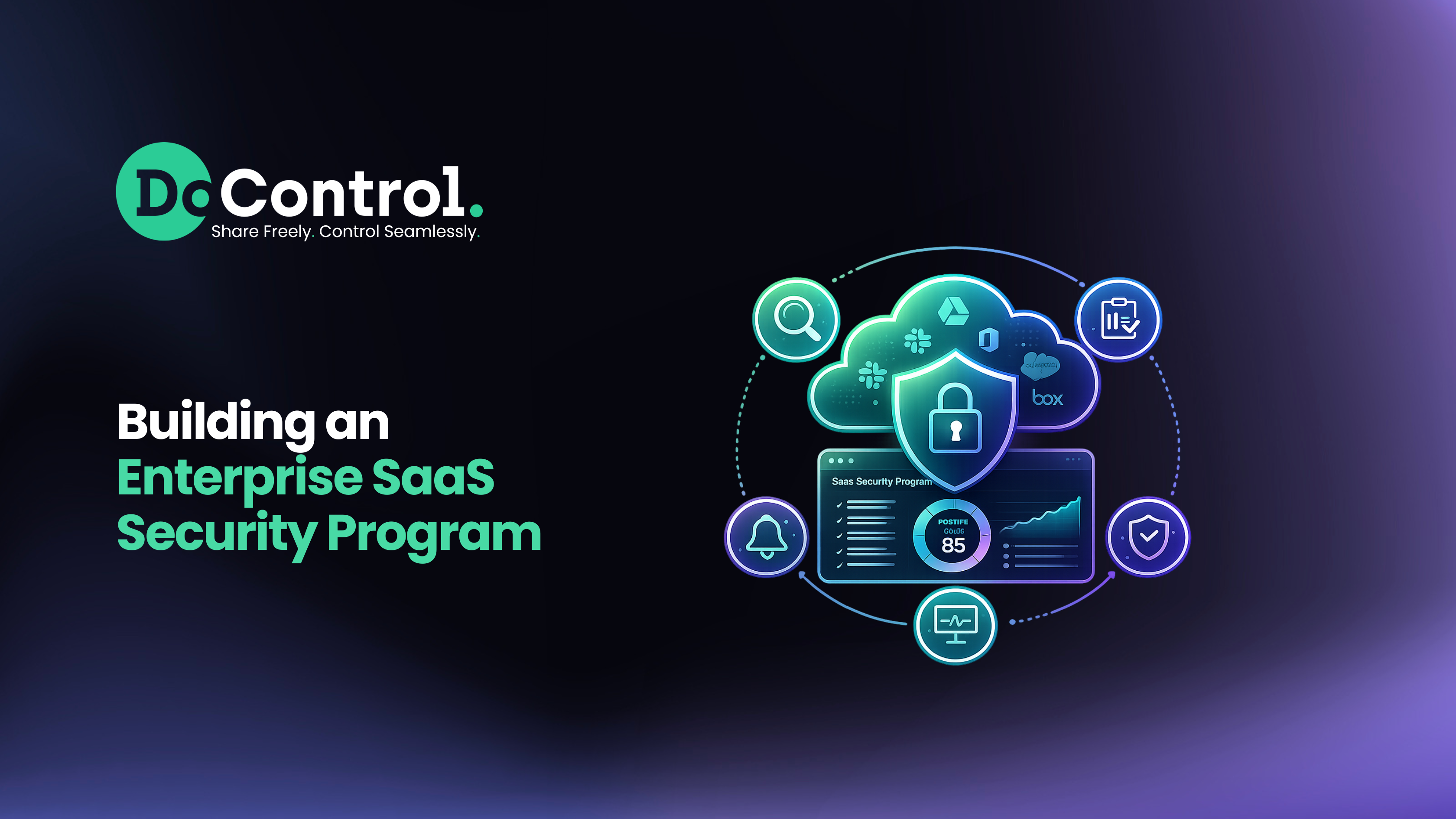
Most security teams already know what they should be doing about SaaS security. They know oversharing is a problem. They know offboarding leaks. They know shadow apps are everywhere and that non-human identities are growing faster than they can track them.
Knowing isn't the issue. Operationalizing is.
Our SaaS security checklist gives you a snapshot of where you stand.
Our side-by-side of cloud security vs. SaaS security clarifies what you're actually trying to protect.
Now, we’re detailing how to build the muscle to stay protected as your environment changes every single day.
Below is the framework for building an enterprise SaaS security program - one that doesn't reset to zero every time an employee leaves, an OAuth scope expands, or an AI agent gets connected to your data.
If you're still new to SaaS security as a discipline, start with our complete guide to SaaS security in 2026. This piece is what comes next: turning checks and concepts into a continuous, scalable program.
Why SaaS Security Has to Be a Program - Not a Project
Most security programs were built around static assumptions. Quarterly access reviews, annual audits: a predictable cadence of joiners, movers, and leavers handled mostly by IT.
SaaS broke that model.
In a modern enterprise running on hundreds of SaaS applications, the environment changes constantly:
- Files are shared externally every hour
- New OAuth apps are authorized daily, often without security review
- Employees join, switch roles, and leave on rolling cycles
- AI agents and service accounts take actions on behalf of users 24/7
- Configurations drift away from baseline the moment exceptions are made
Treating SaaS security as a project - a one-time audit, a quarterly cleanup, a tool rollout - guarantees the program goes stale within weeks.
A program, by contrast, is designed for continuous execution. It assumes the environment will keep moving, the risks will keep scaling, and builds controls that move and scale with it.
This is also why SaaS security has become a board-level conversation. Departing employees taking customer lists, contractors retaining access months after engagements end, AI integrations with admin-level scopes - these aren't hypothetical edge cases. They're the everyday risks executive teams are now being asked about by board members, auditors, insurers, and customers.
The Foundational Principles Every SaaS Security Program Needs
Before getting into the phases, every enterprise SaaS security program needs to be grounded in four core principles. Without these, the framework collapses.
1. Shared responsibility is your problem. The SaaS vendor secures the infrastructure. You are responsible for the data, the identities, the configurations, and the behavior inside the app. That's where almost all SaaS risk actually lives.
2. Context is everything. A user downloading 200 files at 11 p.m. could be a routine end-of-quarter export, or it could be exfiltration before they resign on Monday. The signal is the same. Only context - role, tenure, employment status, recent HRIS events, device, geography - tells you the difference. Any program built on signals alone will drown in false positives.
3. Visibility without remediation is theater. Knowing you have 4,000 publicly shared files doesn't reduce risk. Revoking them does. If your program stops at dashboards, you've built a reporting tool, not a security program.
4. Continuous beats periodic. A point-in-time audit can identify 40 issues. By the time you finish remediating them, the next 40 are already in the environment. Programs that depend on quarterly reviews leave wide windows of exposure between cycles.
With those principles in place, the program itself can be built in four phases.
The 4-Phase Maturity Framework
Most enterprises don't get to mature SaaS security on day one. They get there by moving through four phases - each one building on the last. Skipping a phase or trying to start at automation without visibility is one of the most common reasons programs stall.
Phase 1: Visibility - Know What You're Protecting
You can't secure what you can't see. The first phase is building a complete, current map of your SaaS environment.
That means inventorying:
- Every sanctioned and unsanctioned SaaS application in use (including shadow apps and shadow IT)
- Every human identity with access (employees, contractors, partners, guests)
- Every non-human identity - service accounts, bots, API integrations, AI agents
- Every OAuth connection and its permission scopes
- Every externally shared file, link, and folder across collaboration tools
The outcome of Phase 1 is a defensible answer to the question "Who has access to what, and how is it being used?" - not at a single point in time, but continuously.
This is also where most programs first realize how wide their attack surface actually is. It's common to find dormant service accounts with admin privileges, OAuth apps from vendors no one remembers procuring, and thousands of files shared with "anyone with the link."
{{cta-1}}
Phase 2: Risk Prioritization - Know What's Most Likely to Break
Once you have visibility, the next phase is filtering it. Not every exposure carries equal risk, and security teams don't have the bandwidth to remediate everything at once.
Risk prioritization is where the program becomes intelligent. It requires:
- Sensitive data mapping. Where do PII, financial data, source code, customer records, and other regulated data actually live? Which apps and folders hold the highest concentrations?
- Insider risk scoring. Which users are operating in elevated-risk windows - those on performance plans, post-notice, recently transferred, or working in sensitive role transitions?
- Exposure quantification. How many files are publicly accessible? How many contain sensitive data? Who outside the org has standing access, and is that access still warranted?
- OAuth and NHI blast radius analysis. Which integrations have the most expansive scopes, and which would do the most damage if compromised?
The outcome of Phase 2 is a ranked list of where to focus. Without this, programs default to whoever's making the loudest noise - which is rarely where the most risk actually sits.
Phase 3: Control Implementation - Solidify Your Policies
With visibility and prioritization in place, the program is ready to put controls in writing - and then in the platform.
Control implementation translates policy into enforcement:
- SaaS DLP policies that prevent sensitive data from being shared externally or copied to personal accounts
- Automated sharing restrictions, link expirations, and external collaborator approval flows
- Automated OAuth governance with scope-based approval tiers
- Ongoing NHI lifecycle controls (ownership, rotation, deprovisioning triggers)
- Misconfiguration baselines for each critical SaaS platform, mapped to frameworks like SOC 2, ISO 27001, and GDPR
The work here isn't just writing the policies - it's getting them enforced at the platform layer, where users actually behave. Policies that live in a Confluence page don't change anything. Policies wired into the SaaS environment do; this is why organizations need a SaaS security program that provides automated remediation workflows for on-going governance and control.
Phase 4: Automation & Remediation - Stay at Baseline Forever
This is the phase where programs either become sustainable or quietly collapse under their own weight.
Manual remediation works for the first 50 issues. It breaks down at 500. And in a SaaS environment, you'll be at 5,000 in about a week.
Phase 4 is built around two motions:
Bulk historical cleanup. Most organizations discover a sizable backlog of legacy exposure during Phases 1 and 2 - overshared files from years ago, abandoned OAuth apps, contractors who never lost access, NHIs no one owns. These need to be remediated at scale, not one ticket at a time.
With tools like DoControl, users can bulk remediate up to a million files with a single click. Keep in mind that the historical clean up needs to be able to handle mass amounts of exposure that's been neglected for months (or in most cases - years).
Continuous automated workflows. Once the backlog is cleared, the program shifts to ongoing enforcement. Automated workflows handle the moment-to-moment events: revoke public sharing the moment a sensitive file is exposed, expire shares when an HRIS event fires, suspend sessions during anomalous activity, kill OAuth tokens for high-risk integrations, route exceptions to managers or SecOps with full context.
These workflows need to be contextual, flexible, and dynamic enough to protect the data while also keeping the day-to-day business ops running smoothly.
The outcome of Phase 4 is a program that doesn't depend on its team re-running audits to stay current. It just is current - all the time, because the platform is enforcing it.
Who Owns This? Building the Cross-Functional Operating Model
A SaaS security program isn't just a security team problem - and treating it like one is a fast way to under-resource it.
In practice, an effective program spans four functions:
- Security owns policy design, risk prioritization, workflow logic, and incident response.
- IT owns identity lifecycle, provisioning, and integration with the IdP and HRIS.
- HR is the source of truth for joiner-mover-leaver events that should trigger access changes downstream.
- Legal and Compliance map controls to regulatory requirements and own audit-readiness.
Executive sponsorship matters too. Programs without a clear board- or CISO-level owner tend to get deprioritized the moment another fire starts.
Programs with one tend to be funded for the long haul, with metrics that get reported up: exposure reduction over time, mean-time-to-remediate, percentage of access changes triggered automatically by HRIS events, OAuth scopes reduced, NHIs governed.
Common Pitfalls When Building a SaaS Security Program
A few patterns show up repeatedly in programs that stall:
- Treating it as a tool selection problem. Buying an SSPM doesn't build a program. Process, ownership, and automation logic matter more than the dashboard.
- Stopping at visibility. SSPM-only programs surface risk but never close it. Without DLP enforcement and automated remediation, dashboards just document the problem in higher resolution.
- One-time cleanups without ongoing enforcement. Running our 15-step checklist once and calling it done virtually guarantees you'll be at the same exposure level inside a quarter.
- Underestimating non-human identities. In many enterprises, over 50% of SaaS events are generated by NHIs. Programs that govern only humans are governing less than half the surface area.
- No defined ownership. When everyone is responsible, no one is. The program needs a named owner with the authority to drive cross-functional change.
How DoControl Operationalizes the Entire Program
This is precisely the gap DoControl was built for: connecting all four phases of an enterprise SaaS security program into one continuous, automated motion.
DoControl is the only SSPM that also acts as a SaaS DLP - meaning it doesn't just identify risk, it eliminates it. The platform delivers visibility across users, files, OAuth apps, and NHIs; risk prioritization that incorporates HRIS, IdP, and EDR context; native enforcement of:
- DLP
- data access governance
- insider risk management
- shadow app discovery and remediation
- ITDR
- misconfiguration management
and, a deep workflow engine for both bulk historical cleanup and continuous automated enforcement.
What makes the difference is the context the platform brings to every signal. Pulling from your HRIS, IdP, and EDR, DoControl understands not just what's happening - but who's doing it, why, and whether it's actually a risk given that user's role, tenure, employment status, and behavior.
An anomalous-looking access pattern is one thing for an employee who just switched departments and got promoted; it's another for a contractor whose engagement ended six months ago.
The result is an enterprise SaaS security program that runs itself - and stays at baseline regardless of how fast the environment changes.
Getting Started
Building a program is a journey, not a sprint. Most organizations don't start at Phase 4 - they start with visibility and mature toward automation over months.
The fastest way to begin is with a clear picture of your current exposure. A free risk assessment maps your sanctioned and shadow SaaS apps, quantifies external exposure, surfaces over-privileged OAuth integrations and NHIs, and identifies the misconfigurations most likely to lead to a breach.
From there, the framework above gives you the structure to move from "we ran an audit" to "we run a program."
That's the difference between knowing what to check, and actually staying secure.