.png)

You invested in SASE. Zero Trust access controls, secure web gateway, ZTNA, the whole stack. Your perimeter feels locked down, and your security team finally exhales.
Then, you get the call: sensitive customer data was exposed through a misconfigured Google Drive sharing setting. Or, a departing engineer quietly shared files to their personal email for three weeks before their last day. Or, an OAuth integration that an employee who left six months ago connected is still pulling data from your core systems - and it was just compromised by ShinyHunters.
None of those incidents touched your network perimeter. SASE never saw them coming.
Here is the uncomfortable truth: 75% of organizations experienced a SaaS-related security incident last year, and most traced back to misconfigurations and identity risks that had nothing to do with network access.
SASE and SSPM are not competing tools; they solve fundamentally different problems, and running only one leaves a dangerous gap in your SaaS security posture.
TL;DR: SASE controls who gets in; SSPM governs what happens once they are there, and you cannot afford to run without both.
What SASE and SSPM Actually Do (And Where Each One Stops)
Think of your SaaS environment like a corporate office building.
SASE is the front gate: it checks credentials, verifies identity, and decides who gets through the door.
SSPM is the alarm system, the access logs, and the security camera network inside the building. It watches what happens after someone walks in.
Let's go deeper into what each actually does:
What is SASE?
Secure Access Service Edge (SASE) is a cloud-delivered architecture that combines networking and security into a single service. Instead of managing separate tools for connectivity and protection, SASE brings them together to securely connect users, devices, and applications - no matter where they are located.
A SASE platform typically includes:
- Secure Web Gateways (SWG): Filter internet traffic, block malicious content, and enforce company browsing policies
- Next-Generation Firewalls (NGFW): Inspect traffic in real time to detect and prevent threats and intrusions
- Zero Trust Network Access (ZTNA): Grant access based on identity, device posture, and context rather than network location
- Cloud Access Security Brokers (CASB): Protect and govern access to cloud applications and data
SASE emerged as organizations shifted to SaaS applications, remote work, and distributed environments. Traditionally, these capabilities were delivered by separate vendors and managed independently. Combining them into a unified platform simplified deployment, reduced operational overhead, and improved the user experience.
That consolidation delivers important benefits: simplified management, more consistent policy enforcement, and improved user connectivity. But it also comes with limitations - especially when it comes to securing SaaS applications themselves.
But, while SASE solutions are designed to secure access to SaaS applications, they typically have limited visibility into the security posture within those applications.
In other words, SASE can help determine who gets access to Google Workspace, Microsoft 365, or Slack - but it does not continuously monitor whether those environments are securely configured, overexposed, or drifting from compliance standards.
That’s where SSPM (SaaS Security Posture Management) becomes essential.
SSPM solutions complement SASE by securing the SaaS layer itself: identifying misconfigurations, risky third-party integrations, excessive permissions, insider threats, and compliance gaps across business-critical applications.
Together, SASE and SSPM provide a more complete SaaS security strategy - one protecting access, the other protecting the applications and data after access is granted.
What is SSPM?
SaaS Security Posture Management (SSPM) is the practice of continuously monitoring and securing SaaS applications against misconfigurations, excessive access, risky integrations, and data exposure.
An SSPM platform typically helps organizations:
- Monitor SaaS configurations: Detect risky settings, policy drift, and compliance gaps across applications
- Manage identities and permissions: Identify excessive access for employees, contractors, service accounts, and third-party users
- Govern OAuth and third-party apps: Discover connected applications, assess their risk, and revoke unnecessary access
- Protect sensitive data: Detect external sharing, overshared files, and exposure risks across SaaS environments
- Discover shadow SaaS and AI tools: Uncover unsanctioned apps, AI agents, and integrations connected to company data
SSPM emerged as organizations rapidly adopted SaaS applications like Google Workspace, Microsoft 365, Salesforce, Slack, and hundreds of other SaaS services. As business operations moved into SaaS environments, traditional security tools struggled to provide visibility into how those platforms were configured, accessed, and interconnected.
Unlike perimeter-focused security solutions, SSPM is designed to secure the SaaS layer itself. It continuously evaluates the security posture of SaaS applications, helping organizations detect risky behavior, enforce least-privilege access, maintain compliance, and reduce the likelihood of data exposure or account compromise.
This is why SSPM and SASE are complementary technologies rather than competing ones.
SASE secures access to applications and networks.
SSPM secures the applications, identities, configurations, and data within those SaaS environments.
Together, they provide a more complete approach to modern SaaS security.
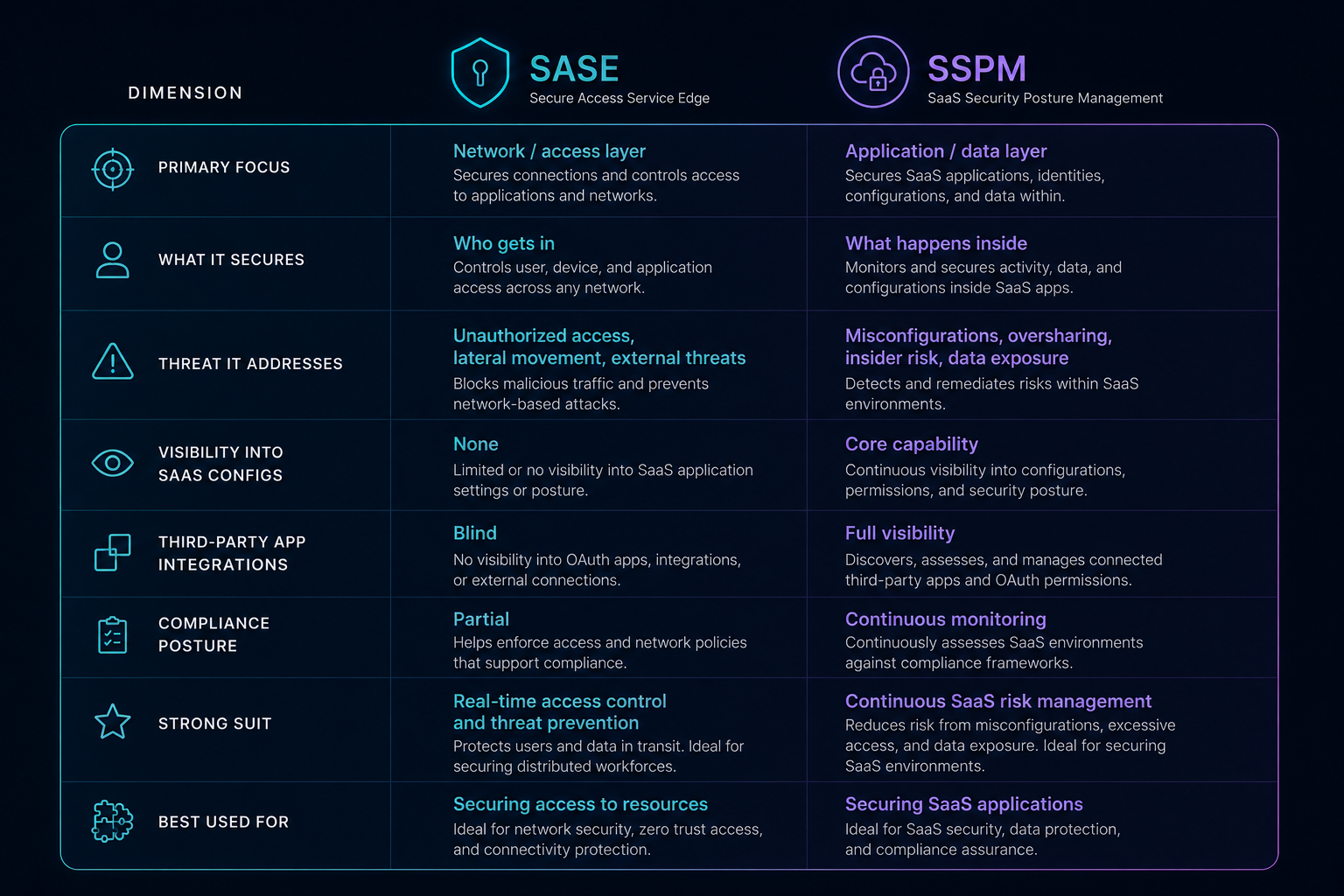
The Blind Spots SASE Leaves Open in Your SaaS Stack
Picture this scenario: your security team runs a quarterly access review, checks the firewall logs, confirms SASE is operating normally, and marks the review complete. Three weeks later, you learn that a third-party Google Workspace OAuth application connected by a former employee retains persistent API access to Gmail and Drive months after offboarding. SSPM detects and remediates the risk. SASE misses it entirely.
The OAuth connection was approved months ago. It passed every network-layer check. SASE had no reason to flag it.
This is the dominant attack pattern of the current era. Here are a few more examples:
- A Google Drive folder containing financial forecasts and customer data is accidentally set to “Anyone with the link.” The files become publicly accessible without IT realizing it. SASE cannot detect this because the exposure happens entirely inside Google Workspace.
- A misconfigured Salesforce instance exposes PII to guest users through an overly permissive sharing setting. SASE cannot see this because the data never moved through an unauthorized network path.
- A Slack AI integration quietly exfiltrates channel data to an external service. SASE has no visibility into what happens inside the application layer.
These are not just theoretical scenarios meant to scare security teams, real breach cases follow this exact pattern:
- Data exfiltration via departing employees at Google, Intel, Palantir, and Nuance
- Data theft through a Google Workspace OAuth connection in the Vercel breach
- Data extortion via a misconfigured public link in the Scale AI incident
All of them bypassed SASE because they occurred within already-authenticated sessions.
The problem is compounding. Every AI copilot, autonomous agent, and MCP connection creates a new non-human identity with its own permission scopes and blast radius. SASE tracks none of these. They exist entirely within the application layer.
To be fair: SSPM alone does not prevent unauthorized initial access. It cannot replace network-layer controls for enforcing who reaches an application in the first place. That is exactly why both tools belong in your stack.
But, understanding why these threats slip through SASE is one thing. Understanding how SSPM closes those gaps at the application layer is what turns awareness into action.
How SSPM Secures What SASE Can't Reach
Most security teams discover SaaS misconfiguration risks the same way: after an incident, during the post-mortem, when someone pulls the audit log and realizes the exposure had been sitting there for months. SSPM changes that dynamic from reactive to proactive - and continuous!
A mature SSPM solution does several things that no network-layer tool can replicate:
- It continuously monitors configuration settings across your entire SaaS stack, including Google Workspace, Microsoft 365, Salesforce, Slack, and Box, comparing them against security benchmarks in real time.
- It audits user permissions and flags dormant accounts that have not been touched in 90 days but still hold access to sensitive data.
- It maps every SaaS-to-SaaS integration and scores each one for risk based on the data scopes it holds.
- It tracks sensitive data exposure through shared links, public links, and misconfigured permissions.
- It monitors user behavior 24/7 (whether it's an employee, contractor, or third-party) and contextualizes their data access patterns in context.
And most critically, it does not just alert. A capable SSPM platform drives active remediation, automated or guided, so teams are not manually triaging hundreds of findings.
One important thing to note: SSPM tools vary significantly in depth.
Solutions that only check configuration settings without data-level visibility or behavioral detection leave insider threat and exfiltration risks unaddressed. You need both aspects to have a true, full coverage SSPM that actively protects your SaaS data.
SSPM should also address historical exposure. A capable SSPM tool should be able to identify and remediate files that were overshared or misclassified months or years ago, not just forward-looking risk.
This historical remediation matters enormously when you consider how long misconfigured sharing settings typically sit undetected before someone notices.
SSPM fills the application-layer gap that SASE leaves open. But, neither tool operates in isolation.
The organizations that achieve genuine SaaS security coverage treat SASE and SSPM as complementary layers of a Zero Trust architecture, not competing line items in a security budget.
How DoControl Closes the Gap SASE Leaves Behind
You now understand the gap. The question is what fills it.
DoControl is a purpose-built SaaS Security Posture Management platform. It was designed specifically for the application-layer risks that SASE cannot reach, covering the major SaaS ecosystems where sensitive data actually lives: Google Workspace, Microsoft 365, Slack, Salesforce, and Box.
While SASE focuses on securing connectivity and controlling access, DoControl focuses on what happens inside SaaS applications like Google Workspace, Microsoft 365, Slack, Salesforce, and Box: permissions, sharing, identities, integrations, configurations, and sensitive data exposure.
The risks discussed throughout this article map directly to SSPM use cases DoControl addresses every day.
- A Google Drive folder accidentally shared publicly? DoControl continuously monitors external sharing, sensitive data exposure, and risky permissions across SaaS environments to identify oversharing before it becomes a breach.
- A former employee still connected to Google Workspace through an old OAuth app? DoControl discovers and governs third-party integrations, shadow SaaS, and persistent OAuth access that often go unnoticed after offboarding.
- An AI assistant or SaaS integration quietly gaining broad access to company data? DoControl provides visibility into connected AI tools, non-human identities, and application permissions across the SaaS stack.
- Misconfigurations slowly accumulating across Microsoft 365, Salesforce, or Slack? DoControl continuously detects configuration drift, risky settings, and policy violations across connected applications.
SASE and SSPM are not competing approaches - they solve different problems.
SASE helps secure access to applications and networks. SSPM helps secure the SaaS applications, identities, integrations, and data after access is granted.
Together, they provide a more complete SaaS security strategy for modern cloud environments.
Conclusion
SaaS security can’t be solved with a single product. It requires multiple layers of security working together, each addressing risks the others cannot see and aren’t designed to catch.
SASE plays a critical role by securing connectivity, enforcing access controls, and protecting users at the network edge. But securing access to SaaS applications is not the same as securing what happens inside them.
That is where SSPM becomes essential.
SSPM provides visibility into the SaaS layer itself: configurations, identities, permissions, third-party integrations, AI tools, external sharing, and sensitive data exposure across platforms like Google Workspace, Microsoft 365, Slack, Salesforce, and Box.
The reality is that many of today’s most damaging SaaS incidents do not begin with firewall evasion or network compromise. They begin with misconfigurations, abandoned OAuth apps, excessive permissions, overshared files, compromised identities, and risky AI integrations operating entirely inside trusted SaaS environments.
Organizations that rely on SASE alone often secure the front door while lacking visibility into what is happening inside the building.
The modern SaaS environment is distributed, deeply interconnected, and increasingly AI-driven. Security strategies need to evolve alongside it.
SASE and SSPM are not competing solutions - they are complementary layers of a modern SaaS security architecture. One secures access. The other secures the applications, identities, integrations, and data that power the business. And in 2026, you need both.

.png)