.png)
Today's enterprise doesn't run on a handful of SaaS apps anymore. The average organization now operates hundreds of sanctioned SaaS applications, with shadow SaaS and shadow AI apps pushing the real number higher.
Sales lives in Salesforce. Engineering builds in GitHub. Finance models in Workday. HR manages through Okta. And every one of those platforms stores sensitive data, grants third-party access, and exposes configurations that attackers are actively probing.
In 2026, the threat picture around SaaS has shifted in four important ways:
- Identity is the new perimeter. The majority of breaches now start with a compromised SaaS identity: a stolen OAuth token, a session hijack, or a reused credential on an integration.
- AI agents are multiplying non-human identities. Every copilot, autonomous agent, and MCP connection creates a new identity with its own scopes and blast radius.
- Attackers have professionalized the SaaS supply chain. Compromise one third-party app, pivot into dozens of downstream tenants.
- Regulators are catching up. SEC cyber disclosure rules and evolving SOC 2 expectations now explicitly call out SaaS misconfiguration and third-party access as board-level concerns.
SaaS Security Posture Management (SSPM) is the discipline — and the category of tooling — built to address this reality. This guide covers what SSPM is, why it matters, how it works, how it compares to adjacent categories, and what a mature SSPM program looks like.
What is SSPM?
SSPM is a very complex category, but when explained properly; it's actually pretty simple.
The short definition
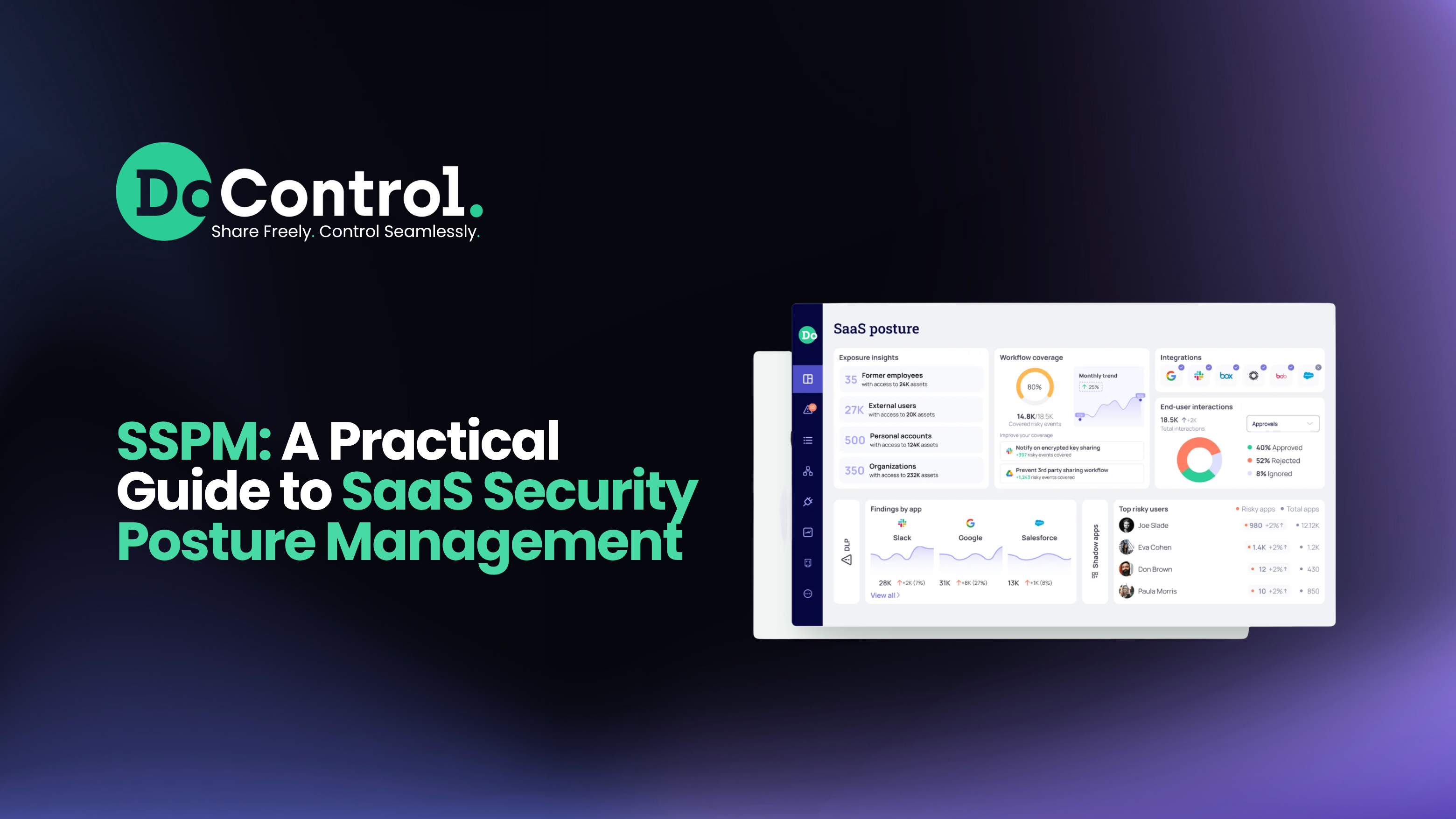
SaaS Security Posture Management (SSPM) is the practice of continuously monitoring SaaS applications for misconfigurations, excessive user and third-party access, risky integrations, and data exposure — and ideally, remediating those risks at scale.
The long definition
SSPM is a category of SaaS security tooling that connects directly to business-critical SaaS applications (Google Workspace, Slack, Microsoft 365, Salesforce, GitHub, Okta, Workday, Box, and hundreds of others) through native APIs.
It inventories configurations, users, permissions, SaaS application users and their access rights, OAuth-connected apps, shared files, and activity logs, then benchmarks them against security best practices, compliance frameworks, and custom policy.
The output is a live posture picture of the SaaS estate — plus (ideally…) a set of recommended or automatically executed remediations to remedy the risks detected.
Unlike infrastructure-focused tools, SSPM focuses on the SaaS control plane and the data plane sitting on top of it: who has access to what SaaS data, how it's shared, which third parties are connected, and whether tenant-level configuration matches the organization's intended security baseline to help protect data across the broader SaaS ecosystem.
Why SSPM matters in 2026
Four forces make SSPM a must-have layer rather than a nice-to-have in 2026.
SaaS sprawl is structural, not cyclical
Every department buys its own tools, and organizations now rely on multiple SaaS applications that integrate with one another, making the resulting graph of apps, identities, and data flows across the SaaS ecosystem too large for manual review.
Breaches have shifted into SaaS
The breaches that hurt most in recent years - data exfiltration via a departing employee like the recent Google, Intel, & Nuance employee exfiltration incidents, the Vercel OAuth breach, the Scale AI misconfiguration incident - all targeted the SaaS layer, where misconfigurations and weak authentication settings can create security gaps that lead to data breaches.
AI agents change the identity math
Non-human identities now outnumber human ones in most enterprises, with over 50% of activity driven in SaaS being completed by NHI's. The worst part? These AI agents tend to accumulate broad scopes. An SSPM platform in 2026 should inventory which agents have access to which SaaS data, revoke unjustified scopes, and detect anomalous agent behavior.
Regulators have noticed
New SEC disclosure rules, DORA, NIS2, and updated ISO 27001 controls all emphasize third-party SaaS risk and configuration management. SSPM turns those obligations into evidence, helps ensure compliance, and provides clear guidance on the changes needed to meet requirements. True SSPM solutions must go beyond visibility to deliver full misconfiguration management.
The core risks SSPM addresses
A modern SSPM platform gives security teams coverage across seven overlapping risk domains:
- External sharing and data oversharing. "Anyone with the link" sharing, contractors with forgotten access, files shared to personal Gmail accounts. The average mid-market organization has 35,000 sensitive assets shared publicly or externally. Oversharing – whether public links, organization-wide access, or unmanaged external shares – creates an attack surface that grows invisibly over time.
- Over-permissive access. Users, contractors, and service accounts accumulate permissions over time and are rarely removed, and SSPM can also flag orphaned or inactive accounts as part of user access risk. Out of a study we conducted with enterprise customers, there was an average of about of 1.2M company assets. Out of that 1.2M, 710,000 are exposed to parties that shouldn't have access.
- Identity threats. Former employees taking data, account compromise, token theft, impossible-travel logins, MFA fatigue attacks. Insider attacks increased sharply, with 95% of security incidents happening due to human error or actions. DoControl research shows 94,000 assets remain exposed to former employees on average across enterprise organizations – individuals who can still access, modify, or share critical company data.
- AI agent access.Gemini, Copilot, Glean, custom GPTs, MCP servers — each needs to be inventoried, scoped, monitored, and remediated. DoControl data found that 70% of actions taken in Sharepoint are done by agents, 60% in OneDrive, 53% in Slack, 45% in Google Workspace, and 45% in Salesforce.
- OAuth and third-party app risk. One rogue or compromised third party applications can read the mailbox of every user who granted it, and SSPM assesses third party saas apps for overbroad access and potential data leakage. (See: Vercel breach.) DoControl data found that on average, an enterprise organization has 730 shadow apps, of which 13% are risky and 14% are abandoned (which is worse – forgotten about AND still serving as an active attack surface!)
- Shadow SaaS. Apps employees adopt without IT blessing; discovered via SSO, OAuth, email, and expense signals. This is a growing attack surface with the rise of unsanctioned Shadow AI apps that employees add to the environment; tools like productivity helpers, note takers, meeting bookers, etc. Each new, un-vetted AI app is a risk to the organization, and a blind spot to the security team.
- Misconfigurations. Drifted admin settings, weak MFA enforcement, disabled audit logs, permissive sharing defaults. SaaS misconfigurations and security misconfigurations are a common source of security gaps. The problem with misconfigurations is that they are constantly moving; and settings are drifting away from their intended security posture quietly, slowly, and painfully until the security posture has just completely unraveled.
How SSPM Works
1. API-native integrations
Modern SSPMs connect directly to SaaS applications via APIs — typically within minutes — pulling data on configurations, users, permissions, and activity in near real time.
2. Data normalization and correlation
Each SaaS app speaks a different "language." SSPMs normalize that data into a single model — users, assets, permissions, and events — so it can be analyzed consistently and correlated across systems.
3. Policy engine with context
The platform compares what's happening in your environment against security policies — CIS benchmarks, internal custom rules, compliance controls, and SaaS configurations — with context-awareness by user role, department, and behavior.
4. Risk prioritization
AI-driven analysis prioritizes real risks, filtering noise and surfacing the security threats, cyber threats, and security gaps that materially affect risk and actually require attention.
5. Automated remediation
Leading platforms take action by automatically correcting security settings, closing security misconfigurations, revoking access, removing risky permissions, or triggering approval flows as part of threat protection. Visibility alone doesn't reduce risk. Remediation does; which is why the strongest SSPM platforms bake automated remediation workflows into their product.
👀 Ready to see your SaaS risk in 15 minutes?
DoControl connects to your SaaS stack and shows you exactly where your risk is — no professional services required.
Start your free risk assessment →
Core capabilities of a modern SSPM platform
SSPM tools vary a lot in what they actually cover, and over 93% of organizations report increased visibility with SSPM.
- Deep SaaS coverage. Depth into your core 10–20 apps matters more than breadth across hundreds.
- External sharing and data exposure detection across files, records, channels, and repositories.
- Configuration and drift monitoring against CIS, NIST, ISO 27001, SOC 2.
- Identity and permissions — employees, contractors, third parties, service accounts, and AI agents.
- OAuth and third-party app governance — evaluate scopes, risk, revoke.
- Shadow SaaS discovery via SSO, OAuth, email, and expense signals.
- Identity threat detection — token theft, impossible travel, account takeover.
- Automated remediation and workflows — not just detection; action.
- Workflow integrations — SIEM, SOAR, ITSM, Slack, email.
- Audit-ready reporting to help teams maintain compliance and demonstrate compliance posture across frameworks.
SSPM vs. CSPM vs. CASB vs. DSPM vs. ITDR vs. SIEM
These categories overlap, but they are not interchangeable. The matrix below is the single most useful artifact for buyers navigating a crowded SaaS security market. SIEM, CASB, and DSPM are complementary security tools, not replacements for SSPM.
The short version:
Here's a condensed, 1 sentence breakdown on each:
CSPM watches your cloud infrastructure.
CASB watches traffic to and from SaaS apps; Cloud Access Security Brokers are often used alongside SSPMs, and many enterprises using CASB's have or are currently switching to SSPMs.
DSPM watches where sensitive data lives.
ITDR watches for identity-based attacks.
SIEM correlates logs from everything.
SSPM watches the inside of the SaaS apps themselves - and, in its modern form, acts on what it sees.
Most mature programs will run more than one of these, with SSPM as the control plane for anything SaaS-native.
How SSPM Fits Within a SASE Architecture
A Secure Access Service Edge (SASE) framework combines networking and security into a unified, cloud-delivered model for securing cloud services. SSPM is a critical component because it complements other security capabilities such as CASBs and secure web gateways while addressing the posture of the SaaS applications users access through the SASE fabric.
While SASE components like CASB and SWG manage how users reach SaaS apps, SSPM secures what's happening inside those apps. SASE secures the path. SSPM secures the destination, and together they strengthen broader cloud security.
Building an SSPM program: a 4-stage maturity model
Deploying an SSPM solution is the beginning of the journey, not the end. We think about SSPM maturity in four stages.
Stage 1 — Discover: Inventory every sanctioned and shadow SaaS app. Map SaaS application users, non-human identities, and third-party applications. Establish the baseline.
Stage 2 — Assess: Benchmark each app against security and compliance frameworks to build a stronger compliance posture and a strong security posture across the SaaS ecosystem. Prioritize findings by business impact.
Stage 3 — Remediate: Close findings — first manually with guided playbooks, then through ticket automation, then direct automated action for well-defined categories.
Stage 4 — Operationalize: Continuous monitoring, automated guardrails, regular posture reviews with business owners, integration into security operations.
Where most organizations are today: Most live in Stage 2. The jump to Stage 3 — automated remediation — is where SSPM starts paying back in reduced risk per security headcount.
Measuring SSPM success: KPIs for business leaders
Posture management programs live and die on whether they can show measurable impact. A useful KPI set for SSPM:
The right metrics give security leaders a concrete story to tell the board: posture is improving, remediation is accelerating, and risk is being closed at scale.
What to look for in an SSPM platform (buyer's checklist)
When evaluating SSPM solutions, test vendors against these key features, not just broad claims.
1) Seamless integrations and fast deployment. Rapid time-to-value with API-native deployment, plus native integrations into SIEM, SOAR, ITSM, identity providers, collaboration tools, and other security tools.
2) Depth over breadth. Deep, write-capable integrations across your most critical SaaS applications - governing sharing, identities, OAuth, data, and configurations - not just surface-level visibility, and able to close SaaS misconfigurations rather than simply flag general issues.
3) Visibility into SaaS data access controls. Clear, real-time visibility into who has access to what data across SaaS apps, how that access was granted, and whether it aligns with policy.
4) Context-aware data governance. Deep insight into how data is used - who is accessing or sharing it, when, where, and why - mapped against normal user behavior and business context.
5) Context-rich intelligence. Every alert is enriched with identity, data sensitivity, behavior, and activity context - eliminating false positives and showing what's actually risky.
6) AI-driven prioritization and response. Built-in AI identifies real threats, prioritizes risk, and automates routine decisions - freeing security teams to focus only on high-impact incidents.
7) Business-aligned DLP enforcement. Policies that protect sensitive data without disrupting operations - enabling the business instead of blocking productivity.
8) Continuous compliance and drift management. Real-time monitoring of configurations against frameworks like CIS, NIST, and SOC 2, with automated compliance controls and automatic correction of drift to maintain compliance, ensure compliance, and maintain a secure baseline.
9) Automated remediation by default. Issues are not just identified - they're fixed automatically. Access can be revoked, permissions adjusted, and misconfigurations corrected without manual intervention.
10) Flexible automation workflows. Fully customizable workflows that align with your policies - revoking access, triggering approvals, or routing to Slack, email, or ticketing systems when needed.
🌐 Comparing SSPM vendors?
See how DoControl stacks up against other SSPM solutions on depth, automation, and data governance.
DoControl’s SSPM: delivering automated protection & remediation
DoControl is built on a simple premise: protect the data that lives in SaaS platforms without hindering business productivity. And our bonus premise: without remediation, SSPM is just visibility. Real security comes from taking action — automatically, at scale, and with context.
DoControl connects via API to the SaaS applications where enterprise data lives (Google Workspace, Slack, Microsoft 365, Salesforce, GitHub, Box, etc.), enriching every signal with identity, activity, and context to drive precise protection, governance, and remediation.
Customers like Sanmina, CLEAR, DataDog, TIME Magazine, Liquid Death, and more all use DoControl's SSPM for full protection of their SaaS environments.
Data Access Governance & DLP — Identify and remediate risky sharing: public links, external collaborators, excessive permissions. Revoke access, remove users, or enforce least privilege automatically.
Insider Risk Management — Detect bulk downloads, unusual sharing, or out-of-scope access; trigger step-up controls, approvals, or automatic restrictions.
Identity Threat Detection & Response — Correlate HRIS and IdP context to SaaS events. Detect token theft, abnormal geolocations, account takeover — and immediately revoke sessions, tokens, or access.
Shadow App Governance — Discover and assess third-party OAuth apps, govern shadow AI tools and MCP servers, automatically revoke risky integrations or limit scopes based on policy.
Misconfiguration Management — Continuously monitor SaaS configs against frameworks and internal policies, automatically correcting drift to maintain a secure baseline.
{{cta-1}}
Frequently asked questions
What does SSPM stand for?
SSPM stands for SaaS Security Posture Management - a category of security tooling that continuously monitors and remediates risks across SaaS applications.
How is SSPM different from CSPM?
CSPM secures cloud infrastructure (AWS, Azure, GCP accounts and resources). SSPM secures the SaaS applications that run on top of that infrastructure - tenant configurations, users, permissions, and data sharing inside apps like Salesforce, Microsoft 365, and Google Workspace.
Do I still need a CASB if I have SSPM?
They solve different problems. CASB inspects traffic between users and SaaS apps. SSPM inspects the configuration and data inside SaaS apps. Many organizations run both, with SSPM as the posture control plane.
What SaaS apps should SSPM cover first?
Start with the apps holding the most sensitive data and the most third-party integrations - typically Microsoft 365 or Google Workspace, a CRM like Salesforce, a code platform like GitHub, and a collaboration tool like Slack. Expand from there.
How long does it take to deploy SSPM?
A modern SSPM platform should show first insights within hours of connecting to the first SaaS app, a full posture baseline within days, and automated remediation workflows within weeks - not months.
Does SSPM help with compliance?
Yes. SSPM platforms map findings to frameworks like SOC 2, ISO 27001, HIPAA, PCI DSS, NIST, and CIS benchmarks, and produce audit-ready evidence of configuration state and remediation history.
Can SSPM automatically fix issues?
Mature SSPM solutions can, for well-defined risk categories - revoking a risky OAuth grant, removing an external share on a sensitive file, rolling back a misconfigured admin setting. Automation should be policy-driven, scoped, and reversible.
How does SSPM handle AI agents and non-human identities?
Modern SSPM treats AI agents, service accounts, and OAuth-connected apps as first-class identities - inventorying their scopes, monitoring their activity, and applying the same posture and least-privilege controls that apply to human users.
What's the difference between SSPM and DSPM?
DSPM focuses on sensitive data wherever it lives (cloud storage, databases, SaaS). SSPM focuses on the SaaS application itself - configuration, identity, permissions, sharing. The two are complementary, and the best SSPM platforms incorporate enough data context to prioritize findings that involve sensitive data.
Is SSPM a replacement for SIEM?
No. SIEM aggregates and correlates logs from across the environment. SSPM is a specialized posture and remediation platform for SaaS. Most organizations feed SSPM events into SIEM for correlation with other security signals.