.png)
🔑 TL;DR
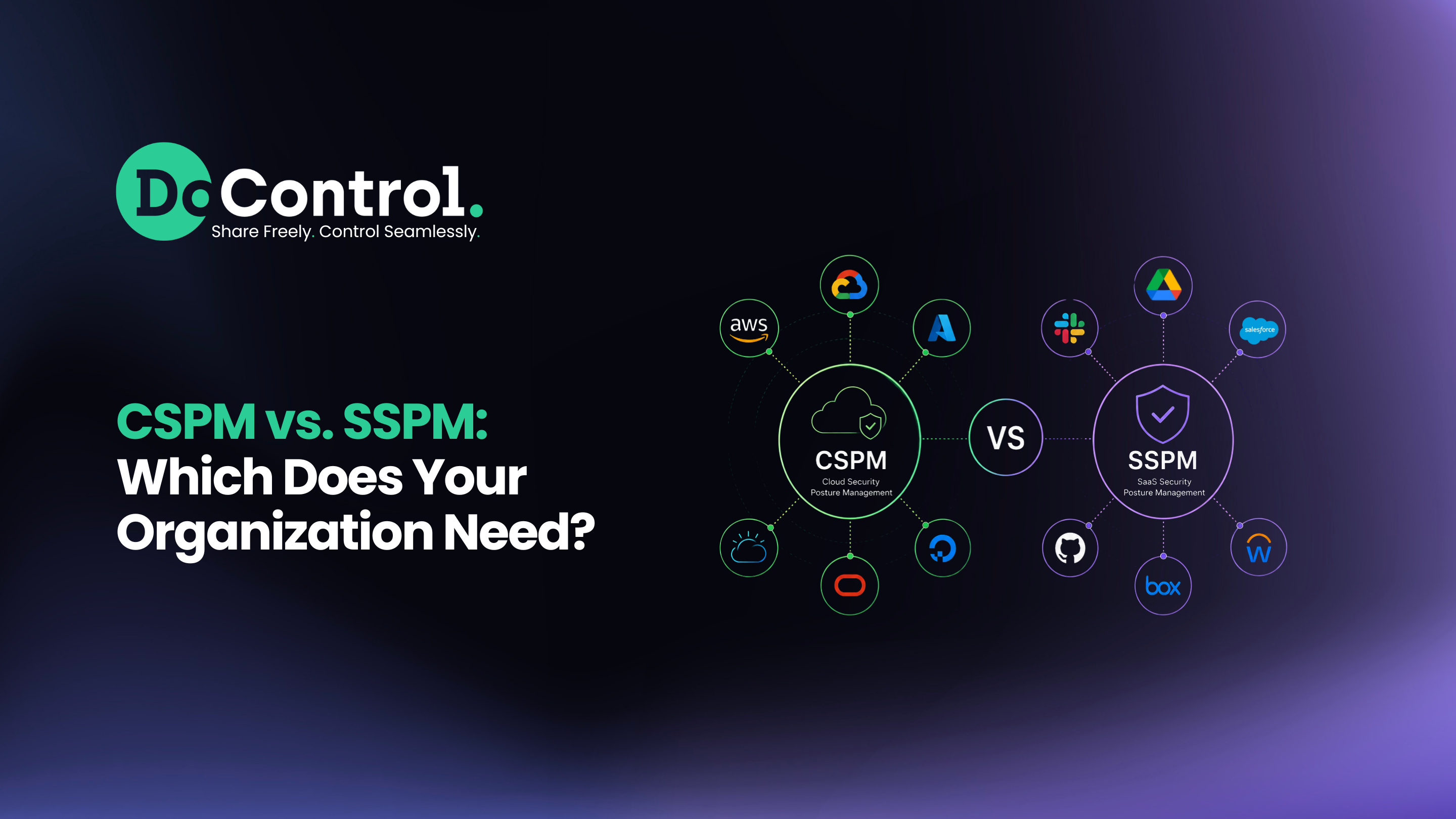
- CSPM and SSPM are not interchangeable. CSPM secures cloud infrastructure (AWS, Azure, GCP). SSPM secures SaaS applications (Microsoft 365, Google Workspace, Salesforce, etc.). They protect different layers of your environment and cannot substitute for each other.
- CSPM has no visibility into the SaaS layer. It cannot detect SaaS misconfigurations, overprivileged SaaS users, risky OAuth integrations, or sensitive data shared externally inside SaaS tools - regardless of how mature your CSPM deployment is.
- Most organizations need both. If your environment includes cloud infrastructure and SaaS applications - which describes nearly every company today - running only one leaves a significant portion of your attack surface unmonitored.
Cloud security has a vocabulary problem. CSPM and SSPM look similar on paper - both involve posture, both involve the cloud, both use the word "management" - so they're frequently conflated, or treated as redundant. They are neither.
Cloud Security Posture Management (CSPM) and SaaS Security Posture Management (SSPM) address fundamentally different attack surfaces, protect different kinds of assets, and require different detection and remediation capabilities. Choosing one when you need the other creates a whole new set of problems, blind spots, and risks.
This guide cuts through the confusion. It explains what each solution actually does, where they diverge, where they overlap, and how to determine what your organization needs based on your environment, tech stack, and security posture.
What Is Cloud Security Posture Management (CSPM)?
Cloud Security Posture Management is a category of security tools designed to continuously assess and enforce secure configurations across cloud infrastructure - specifically Infrastructure as a Service (IaaS) and Platform as a Service (PaaS) environments.
CSPM tools operate at the infrastructure layer: the virtual machines, storage buckets, databases, networking configurations, and IAM policies that form the backbone of cloud platforms like Amazon Web Services (AWS), Microsoft Azure, and Google Cloud Platform (GCP).
Core CSPM Capabilities
- Misconfiguration detection: Identifies exposed storage buckets, open security groups, unencrypted databases, and other infrastructure-level misconfigurations
- Identity and access management (IAM) analysis: Flags overprivileged IAM roles, unused service accounts, and policy violations against least-privilege principles
- Compliance mapping: Continuously maps cloud infrastructure configurations against regulatory frameworks such as SOC 2, GDPR, HIPAA, PCI DSS, and CIS Benchmarks
- Multi-cloud visibility: Provides unified posture visibility across AWS, Azure, and GCP from a single plane
- Remediation guidance: Surfaces prioritized findings with context to help teams fix infrastructure risks at scale
CSPM in Practice
A CSPM tool might:
- Detect that an AWS S3 bucket is publicly readable
- Detect that an Azure IAM role has wildcard permissions attached
- Detect that a GCP Compute Engine instance is missing OS-level patch enforcement
These are infrastructure risks - they exist at the cloud platform layer, not inside the applications running on top of it.
What Is SaaS Security Posture Management (SSPM)?
SaaS Security Posture Management (SSPM) is a security category focused on protecting the SaaS application layer - the data, files, productivity tools, collaboration platforms, and business-critical applications that organizations depend on daily. Think Google Workspace, Microsoft 365, Slack, Salesforce, Box, and hundreds of other applications.
SSPM tools operate inside these applications, not at the infrastructure level underneath them. They analyze data access patterns, file sharing, user permissions, third-party integrations, configuration settings, and policy compliance within the SaaS layer itself.
Core SSPM Capabilities
- Data access governance: Tracks who has access to sensitive SaaS data, what they can do with it, and whether that access is appropriate given role and context
- User permission and insider threats: Detects anomalous behavior, unusual access patterns, overprivileged accounts, dormant users who still hold sensitive access, and improper offboarding
- SaaS-to-SaaS integration risk: Identifies risky third-party OAuth connections - the apps connected to your core SaaS tools that may have excessive scopes or belong to unknown vendors
- SaaS configuration management: Continuously audits application-level security settings across the SaaS portfolio for misconfigurations and policy drift
- Automated remediation: Enforces security policies and triggers remediation workflows without requiring manual intervention from security teams
- Compliance enforcement: Maps SaaS configuration risks to frameworks like SOC 2, ISO 27001, and NIST, specifically within the SaaS environment
SSPM in Practice
An SSPM solution might:
- Detect that a Google Workspace admin account hasn't been used in 90 days, but still holds Domain Admin privileges
- Detect when an employee puts in their two weeks, and then starts mass downloading sensitive files
- Detect that a third-party app connected to your Microsoft 365 environment has read/write access to all mailboxes
Bonus points if the SSPM can then remediate all these exposures that it finds. There is a lot more to SSPM than just detection.
To go deeper on how SSPM works and what it protects, read our comprehensive guide: What Is SSPM? A Complete Guide to SaaS Security Posture Management.
The Core Distinction: Infrastructure vs. the SaaS Application Layer
The most important thing to understand about CSPM and SSPM is that they protect different attack surfaces - and those surfaces have very little technical overlap.
CSPM secures the foundation: the cloud infrastructure where workloads run, where data is stored at the platform level, and where network and identity configurations govern access to compute and storage resources.
SSPM secures the layer above it: the SaaS applications where your employees actually work, where sensitive business data lives in files, documents spreadsheets, emails, and pipelines, and where the identity fabric of modern organizations is increasingly managed.
A CSPM tool has no visibility into whether a former employee's Google Workspace account is still active and shared to a folder containing your entire customer database. It cannot tell you that your Salesforce security settings allow external users to export sensitive deal data. It cannot tell you that It cannot detect that an OAuth app connected to your Slack workspace has posted permissions and is actively exfiltrating messages.
These are SaaS-layer problems. CSPM tools were not built for them, and they cannot solve them - regardless of how mature or feature-rich the CSPM product is.
The reverse is equally true. An SSPM tool is not scanning your AWS IAM policies for privilege escalation paths or checking whether your Azure Storage accounts have public blob access enabled. That's infrastructure security - and that's CSPM's domain.
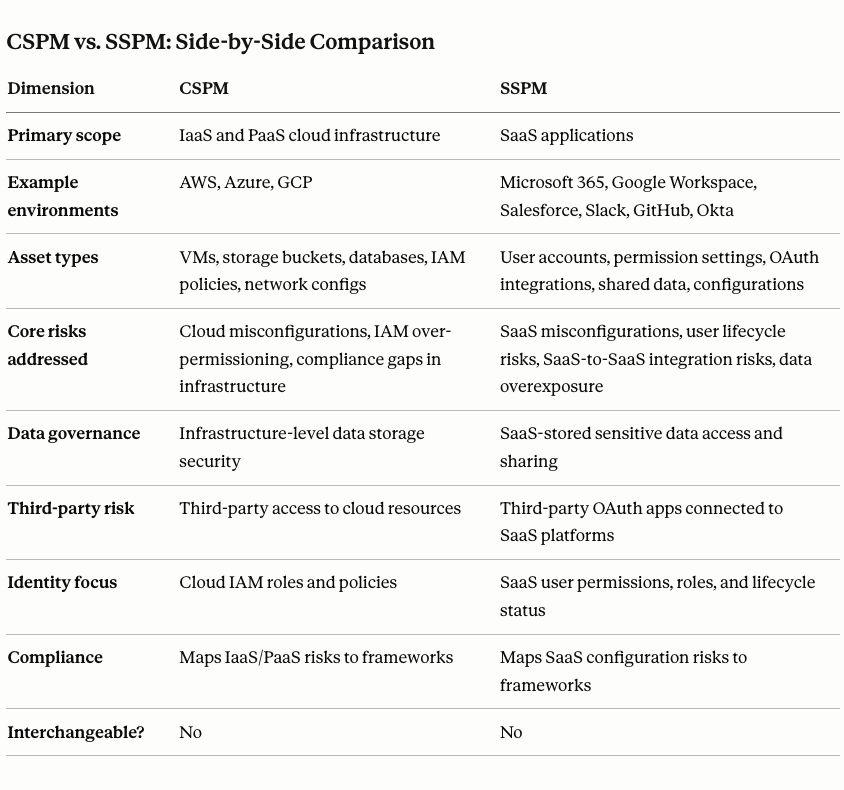
CSPM vs. SSPM: Side-by-Side Comparison
To really compare how each security domain tackles different verticals, we put together a side by side comparison on how each approaches various use cases.
The bottom line? The two are not interchangable.
When Does Your Organization Need Each?
Use CSPM When:
- Your primary workloads run on AWS, Azure, or GCP and you need continuous infrastructure posture monitoring
- You have multi-cloud infrastructure and need unified visibility across platforms
- Compliance requirements specifically mandate cloud infrastructure configuration controls (e.g., FedRAMP, CIS Benchmarks)
- Your security team needs to govern IAM roles, network security groups, and cloud-native access policies at scale
- You are experiencing cloud sprawl and need automated detection of infrastructure misconfigurations
Use SSPM When:
- Your organization runs a significant SaaS portfolio and needs visibility into how those applications are configured
- User permission hygiene is a concern - especially around admin access, user behavior, dormant accounts, third-party vendors, freelancers or contractors, and improper offboarding
- You have a growing number of third-party SaaS integrations (OAuth apps) that are unvetted or ungoverned
- Sensitive business data lives inside SaaS applications and you need to understand who can access it, share it, or export it
- SaaS compliance (SOC 2, ISO 27001) requires evidence of continuous configuration monitoring within your SaaS environment
- You've experienced - or want to prevent - incidents originating from SaaS misconfigurations or overprivileged SaaS access
Use Both When:
Most modern organizations need both. If your environment spans cloud infrastructure and a meaningful SaaS portfolio - which describes the vast majority of companies today - running only one of these tools leaves a significant portion of your attack surface unmonitored.
The key question isn't "CSPM or SSPM?" It's "what does my attack surface actually look like, and do I have coverage across all of it?"
Why CSPM Cannot Replace SSPM
This point deserves its own section because the misconception is persistent: that a mature CSPM deployment provides adequate SaaS coverage.
It does not, for three structural reasons.
1. SaaS Applications Are Black Boxes to Infrastructure Tools
CSPM tools operate at the API and configuration level of cloud platforms. They understand AWS resource policies, Azure RBAC assignments, and GCP service account bindings. They do not have native integrations with the configuration APIs of SaaS applications - the settings, permission models, and sharing controls that exist inside Google Workspace, Microsoft 365, or Salesforce.
To properly audit a SaaS application's security posture, a tool needs to speak that application's language: its permission hierarchy, its sharing model, its tenant configuration settings, and its event logs. CSPM tools don't have those integrations. SSPM tools are purpose-built for exactly this.
2. The SaaS Data Problem Is Unique
The data risk in SaaS is different in kind from data risk in cloud infrastructure. SaaS-stored data - contracts in Google Drive, deal information in Salesforce, source code in GitHub, HR records in Workday - is actively used by employees, shared with external partners, and connected to third-party tools on a daily basis.
Governing this data requires understanding not just where it lives, but who has access, what permissions govern that access, whether access is appropriate given the user's role and employment status, and whether sensitive content is being shared externally without proper controls. This is data access governance - and it requires purpose-built contextual analysis that CSPM tools do not provide.
3. SaaS-to-SaaS Integrations Create a Distinct Attack Vector
The average enterprise has hundreds of third-party OAuth applications connected to core SaaS platforms. Each connection represents a potential access path that exists entirely within the SaaS layer. An OAuth app with broad Google Workspace permissions can read emails, access files, and send messages - and none of that activity touches cloud infrastructure in a way that CSPM would detect.
SSPM tools map these integrations, assess the permissions each app holds, identify dormant or risky connections, and can revoke or restrict access through automated remediation workflows.
How CSPM and SSPM Work Together
Treating CSPM and SSPM as competing budget line items is a false choice. They operate in different layers and secure different assets. The more accurate framing is: which parts of your attack surface are covered, and which aren't?
For organizations with both cloud infrastructure and a SaaS portfolio - again, most modern companies - the complementary picture looks like this:
- CSPM ensures that the cloud foundation underneath your applications is correctly configured, compliant, and monitored for infrastructure-layer threats
- SSPM ensures that the SaaS applications your business runs on are properly configured, that user access is appropriate and current, that data is governed, and that third-party integrations are vetted and controlled
Visibility into both layers - and the connective tissue between them - is what comprehensive cloud and SaaS security posture actually looks like.
How DoControl Approaches SSPM
DoControl is purpose-built for SaaS Security Posture Management (SSPM). While CSPM solutions focus on cloud infrastructure, DoControl secures the SaaS layer - providing continuous visibility, risk detection, and automated controls across the applications where users collaborate, share data, and connect third-party services.
Data Access Governance
DoControl provides a real-time view of who has access to sensitive SaaS data across applications such as Google Workspace, Microsoft 365, Salesforce, GitHub, Slack, and more. By continuously monitoring permissions, sharing activity, and access patterns, DoControl identifies excessive access, risky exposure paths, and governance gaps before they become security incidents.
Insider Risk Management
DoControl detects risky user behavior by analyzing how employees, contractors, and privileged users interact with sensitive data across SaaS environments. By establishing behavioral baselines and identifying anomalous access, sharing, download, or administrative activity, security teams can quickly investigate and mitigate insider threats without disrupting normal business operations.
Contextual DLP
Traditional DLP solutions focus on content alone. DoControl's contextual DLP engine evaluates the sensitivity of the data alongside ownership, access permissions, sharing context, user behavior, and business risk to deliver more accurate detections with fewer false positives.
By incorporating behavioral baselines and SaaS-specific context, DoControl automatically prioritizes the most critical risks and triggers the appropriate controls without hindering productivity.
SaaS Misconfiguration Management
DoControl continuously assesses SaaS applications for security misconfigurations that can introduce unnecessary risk, including overly permissive sharing settings, weak administrative controls, and insecure tenant configurations. Security teams gain visibility into posture weaknesses across their SaaS ecosystem and receive prioritized remediation guidance to reduce attack surface and improve compliance.
Third-Party OAuth App Management
DoControl discovers and monitors third-party OAuth applications connected to business-critical SaaS platforms, providing visibility into the permissions and data access granted to external integrations. Security teams can identify high-risk, overprivileged, or unsanctioned applications and automatically revoke or restrict access when policy violations occur.
Automated Remediation
Manual remediation does not scale in modern SaaS environments. DoControl's automated remediation workflows enable security teams to enforce policies automatically - removing risky shares, reducing excessive privileges, disabling unauthorized OAuth applications, correcting misconfigurations, and quarantining sensitive content without requiring analyst intervention.
The result is faster response times, consistent policy enforcement, and reduced exposure across the SaaS ecosystem while allowing security teams to focus on higher-priority threats.
Evaluate Your SaaS Security Posture
If your organization runs on SaaS - and most do - your security posture is only as strong as your visibility into that layer. CSPM covers the infrastructure foundation. SSPM covers the SaaS environment where your data actually lives and your employees actually work.
Understanding the distinction is the first step. Acting on it is what separates organizations that discover SaaS breaches after the fact from those that prevent them.
Learn more about SSPM and how DoControl protects the SaaS layer: What Is SSPM?
Take our Free SaaS Risk Assessment to learn how your data is exposed: Find Out Here
Frequently Asked Questions (FAQ’s)
Can CSPM and SSPM replace each other?
No. CSPM and SSPM address fundamentally different attack surfaces and require different detection capabilities. CSPM cannot monitor SaaS application configurations, user permissions within SaaS tools, or SaaS-to-SaaS OAuth integrations. SSPM cannot assess cloud infrastructure IAM policies, storage bucket permissions, or network security group configurations. Organizations that rely on one in place of the other have significant blind spots.
What's the difference between CSPM and SSPM in one sentence?
CSPM secures your cloud infrastructure (AWS, Azure, GCP), while SSPM secures your SaaS applications (Microsoft 365, Google Workspace, Salesforce, and the rest of your SaaS stack).
Does my organization need both CSPM and SSPM?
It depends on your environment. If you run workloads on cloud infrastructure, you need CSPM. If your organization relies on SaaS applications - which describes nearly every company today - you need SSPM. If you have both, you need both.