.png)
%20vs%20Enterprise.png)
When organizations migrate from Microsoft to Google Workspace, plan selection isn’t just about collaboration features - it defines the organization’s native security baseline.
This shift happens in the context of a larger reality: SaaS is the new perimeter. The traditional network boundary no longer determines how data is accessed or protected. Instead, security is dictated by the controls embedded within SaaS platforms themselves.
In Google Workspace, your plan directly determines what security capabilities are available to you, including:
- DLP availability - what sensitive data you can detect and control
- Access enforcement - how users authenticate and what conditions are required
- Audit visibility - what actions you can see, track, and investigate
- Threat investigation depth - how effectively you can respond to incidents
However, it’s critical to understand that Google’s native security ≠ full SaaS protection.
Google’s primary responsibility is not comprehensive security coverage, it is the functionality and reliability of its applications.
The security controls provided are foundational, but they are not designed to fully address modern SaaS risk, especially in environments with high volumes of sharing, external collaboration, and distributed users.
This leads to a key expectation:
- The right Google Workspace tier reduces risk and establishes your security baseline
- The right SaaS security layer eliminates that risk by closing visibility and control gaps
This article breaks down each Google Workspace plan through that lens - so security teams can make informed decisions based not just on features, but on actual risk exposure and control maturity.
Google Workspace Security Capabilities by Tier - And Where Gaps Remain
Each Google Workspace tier delivers a different level of built-in security controls. Understanding exactly what is included - and what is not - is critical when selecting the right plan during a migration.
Below is a clear breakdown of security capabilities by tier, followed by the gaps organizations must address.
1. Frontline Starter
Intended for: Deskless workers
Security maturity: Minimal baseline controls
Collaboration & Productivity Fit
- Built for mobile-first, deskless employees
- Access to core Workspace apps (Gmail, Drive, basic Meet)
- Supports communication and lightweight collaboration
- Not designed for heavy document collaboration or knowledge workers
- Minimal storage and collaboration management features
IT Administration & Scalability
- Basic device management capabilities
- Limited policy enforcement across users and devices
- Few tools for large-scale admin oversight
- Minimal reporting and visibility into user activity
- Best suited for environments with simple IT structures
- Works well when access is primarily through managed mobile devices
What It Includes (Security-Focused)
- Endpoint Management: Basic
- MFA Enforcement: Basic
- Admin Activity Audit: Limited
- DLP: None
- Context-Aware Access: None
- Data Regions: Not available
- Google Vault: Not included
- Security Health Dashboard: Basic
- User Limit: Unlimited
- 3rd-Party App Visibility: Limited
- Misconfiguration Drift Detection: None
- Excessive Privilege Detection: None
- Workflow Automation: None
- Cross-SaaS Coverage: Google only
Security Reality
Frontline Starter provides minimal identity protection and almost no governance controls. There is:
- No DLP
- No policy-based contextual access
- No drift detection
- No privilege monitoring
- No automation
DoControl Gap Coverage
DoControl adds:
- Comprehensive Google Workspace security controls
- Continuous data access governance
- SaaS-wide, automated DLP controls
- Granular access controls and policies
- MFA gap detection
- Full audit visibility & alerting
- OAuth & third-party app monitoring & remediation
- Misconfiguration detection with remediation
- Automated response workflows
- Cross-SaaS coverage beyond Google
- Gemini Governance (access controls to eliminate internal oversharing, remediation of overexposed data in Workspace, visibility, governance, and control of Google Gemini Gems)
Key takeaway: Frontline Starter enables basic access and communication, but leaves significant gaps in data protection, visibility, and control that must be addressed externally.
2. Frontline Standard
Intended for: Deskless + light IT
Security maturity: Basic but improved identity controls
Collaboration & Productivity Fit
- Supports deskless teams that require more structured communication
- Access to Gmail, Drive, Meet, and basic collaboration tools
- Enables file storage and sharing for operational teams
- Still limited for knowledge-heavy collaboration workflows
IT Administration & Scalability
- Improved endpoint management capabilities
- Supports basic enforcement of identity policies
- Admin visibility improves slightly over Starter tier
- Still limited for organizations with large admin teams or complex policy environments
- Designed for smaller operational environments with moderate IT oversight
What It Includes
- Endpoint Management: Advanced
- MFA Enforcement: Yes
- Admin Activity Audit: Limited
- DLP: None
- Context-Aware Access: None
- Data Regions: No
- Google Vault: Yes
- Security Health Dashboard: Basic
- User Limit: Unlimited
- 3rd-Party App Visibility: Limited
- Misconfiguration Drift Detection: None
- Excessive Privilege Detection: None
- Workflow Automation: None
- Cross-SaaS Coverage: Google only
Security Reality
While MFA and endpoint controls improve, governance remains limited:
- No DLP
- No contextual policy enforcement
- No privilege oversight
- No misconfiguration detection
- No automation
DoControl Gap Coverage
DoControl provides:
- SaaS-wide contextual DLP
- Granular access controls and flexible policy enforcement
- Continuous least-privilege enforcement
- Drift detection across all Google & connected SaaS apps
- OAuth ecosystem visibility
- Real-time automated remediation
- Gemini Governance (access controls to eliminate internal oversharing, remediation of overexposed data in Workspace, visibility, governance, and control of Google Gemini Gems)
Key takeaway: Frontline Standard represents a step forward in security - but still falls short in delivering the visibility, control, and automation required to manage modern SaaS risk.
3. Frontline Plus
Intended for: Deskless + security-sensitive users
Security maturity: Moderate
Collaboration & Productivity Fit
- Designed for deskless workers handling sensitive operational data
- Provides stronger support for document storage and internal sharing
- Enables collaboration across distributed operational teams
- Better suited for industries with operational documentation workflows
- Still not intended for large-scale knowledge work or heavy document collaboration
IT Administration & Scalability
- More advanced device and endpoint management controls
- Improved administrative visibility compared to lower Frontline tiers
- Better suited for organizations with structured operational IT teams
- Still limited for environments requiring complex policy orchestration
- Governance features remain relatively lightweight
What It Includes
- Endpoint Management: Advanced
- MFA Enforcement: Yes
- Admin Activity Audit: Enhanced
- DLP: Limited
- Context-Aware Access: Limited
- Data Regions: limited data region support
- Google Vault: Yes
- Security Health Dashboard: Enhanced
- User Limit: Unlimited
- 3rd-Party App Visibility: Limited
- Misconfiguration Drift Detection: None
- Excessive Privilege Detection: Partial
- Workflow Automation: None
- Cross-SaaS Coverage: Google only
Additional note: Gemini features begin to come into play at this tier, including capabilities like “Help me write” and Gemini assist within Gmail. Increased Gemini features requires a tighter AI governance strategy.
Security Reality
Frontline Plus introduces:
- Limited DLP
- Limited contextual access
- Partial privilege detection
However:
- No drift detection
- No automated remediation
- Limited third-party visibility
- No cross-SaaS governance
DoControl Gap Coverage
DoControl closes these gaps with:
- Full SaaS DLP enforcement
- Continuous privilege monitoring
- Full SSPM with remediation
- Automated workflow-based enforcement
- Cross-SaaS risk visibility
- Gemini Governance (access controls to eliminate internal oversharing, remediation of overexposed data in Workspace, visibility, governance, and control of Google Gemini Gems)
Key takeaway? Frontline Plus marks the first meaningful step toward data protection - but without automation, visibility, and cross-SaaS coverage, organizations are still left managing risk reactively rather than proactively.
4. Business Plus (Pro)
Intended for: SMB / Mid-market (up to 300 users)
Security maturity: Strong mid-tier controls
Collaboration & Productivity Fit
- Designed for knowledge workers and collaborative teams
- Supports real-time document collaboration at scale
- Enables shared drives, larger storage allocations, and Meet collaboration
- Well suited for SMB and mid-market organizations
- Often used by companies replacing Microsoft productivity suites
- Provides a balanced collaboration environment for growing teams
IT Administration & Scalability
- Improved admin visibility, reporting, and policy control
- Stronger endpoint and device management options
- Supports organizations with dedicated IT administrators
- User cap of 300 limits long-term scalability
- Organizations often upgrade to Enterprise as user counts or governance complexity grow
What It Includes
- Endpoint Management: Advanced
- MFA Enforcement: Yes
- Admin Activity Audit: Enhanced
- DLP: Limited
- Context-Aware Access: Limited
- Data Regions: No
- Google Vault: Yes
- Security Health Dashboard: Enhanced
- User Limit: 300 users
- 3rd-Party App Visibility: Limited
- Misconfiguration Drift Detection: None
- Excessive Privilege Detection: Partial
- Workflow Automation: None
- Cross-SaaS Coverage: Google only
- Gemini Governance (access controls to eliminate internal oversharing, remediation of overexposed data in Workspace, visibility, governance, and control of Google Gemini Gems)
Security Reality
Business Plus improves audit visibility and endpoint control, but:
- DLP remains limited
- No data regions
- No drift detection
- No automation
- Privilege monitoring is partial
- SaaS ecosystem remains ungoverned
This tier often appears “enterprise-ready,” but governance gaps remain.
DoControl Gap Coverage
DoControl provides:
- Cross-SaaS DLP-like enforcement
- Continuous access governance
- OAuth app risk management
- Full misconfiguration drift detection
- Automated remediation workflows
- Unified SaaS security posture visibility
- Gemini Governance (access controls to eliminate internal oversharing, remediation of overexposed data in Workspace, visibility, governance, and control of Google Gemini Gems)
Key takeaway? Business Plus (Pro) offers a strong foundation for growing organizations - but without full governance, automation, and cross-SaaS visibility, security teams are still left managing risk manually.
5. Enterprise
Intended for: Large / regulated enterprises
Security maturity: Highest native Google controls
Collaboration & Productivity Fit
- Designed for large-scale collaboration environments
- Supports global teams and distributed organizations
- Advanced Meet capabilities for large meetings and cross-region collaboration
- Large storage allocations supporting high-volume document environments
- Ideal for complex knowledge work and cross-team collaboration
IT Administration & Scalability
- Full enterprise-grade administrative controls
- Advanced policy enforcement and configuration capabilities
- Designed for large IT teams managing complex environments
- Supports organizations with global deployments and multiple administrators
- Enables stronger governance across large user populations
What It Includes
- Endpoint Management: Enterprise-grade
- MFA Enforcement: Yes
- Admin Activity Audit: Advanced
- DLP: Yes
- Context-Aware Access: Yes
- Data Regions: Yes
- Google Vault: Advanced
- Security Health Dashboard: Advanced
- User Limit: Unlimited
- 3rd-Party App Visibility: Limited
- Misconfiguration Drift Detection: Partial
- Excessive Privilege Detection: Partial
- Workflow Automation: Limited
- Cross-SaaS Coverage: Google only
Security Reality
Enterprise delivers the strongest Google-native security posture.
However:
- Third-party app visibility remains limited
- Drift detection is only partial
- Privilege detection is partial
- Automation is limited
- Coverage stops at Google
Even Enterprise does not provide full SaaS governance.
DoControl Gap Coverage
DoControl extends Enterprise security by adding:
- Full SaaS & OAuth visibility
- Continuous least-privilege enforcement
- Full SSPM with remediation
- Identity-based threat detection & response
- Insider risk detection
- Cross-app governance
- Automated, customizable remediation workflows
- Unified control across Google + all SaaS apps
- Gemini Governance (access controls to eliminate internal oversharing, remediation of overexposed data in Workspace, visibility, governance, and control of Google Gemini Gems)
The Core Point? It’s a Shared Responsibility
At this point, a clear pattern emerges across every Google Workspace tier:
Google provides controls, but not complete security outcomes.
When evaluating Workspace plans, it’s easy to assume that moving upmarket (ex: Business Plus → Enterprise) solves security challenges. In reality, what changes is the availability of controls, not the execution of security.
To close that gap, organizations need to understand - and operationalize - the shared responsibility model for SaaS security.
Within Google Workspace:
- Google’s responsibility is to provide:
- Infrastructure security
- Application functionality
- A set of configurable security controls
- Your organization’s responsibility is to ensure:
- Data is properly governed
- Access is continuously controlled
- Risks are detected and remediated in real time
Google delivers the toolset. You are responsible for the outcomes.
What does this mean conceptually? DoControl helps fill large security and governance gaps in the lower workspace tiers where Google offers little to none native security controls. Then, at the upper enterprise tiers, DoControl remains crucial as all the controls that are available fall short of what is fully required for secure operation.
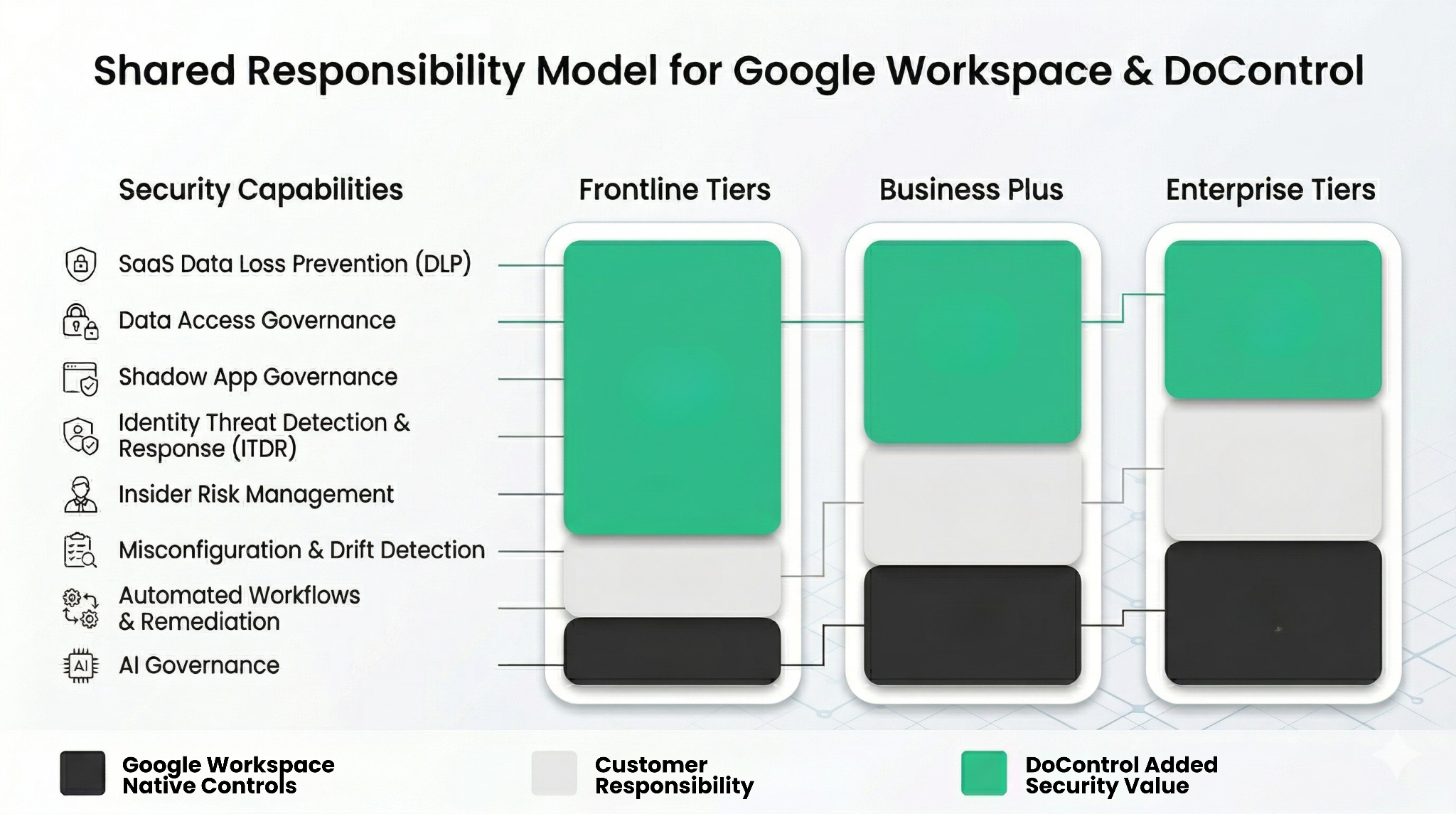
Below are the core areas where Google Workspace alone falls short, and where DoControl becomes essential.
1. Data Access Governance (Continuous Least Privilege)
During migrations, access becomes inherently chaotic:
- Legacy permissions migrate over
- External sharing increases rapidly
- Role assignments are rarely re-evaluated
Native Google controls:
- Allow restriction
- Do not continuously govern
DoControl provides:
- Continuous access monitoring
- Detection of excessive permissions
- Dormant access identification
- External collaboration lifecycle control
- Just-in-time governance workflows
- Automated permission adjustment and remediation
2. SaaS DLP Beyond Google Drive & Gmail
Google’s native DLP is inherently limited:
- Restricted in Business tiers
- Fully available only in Enterprise
- Covers Google apps only
But modern environments extend far beyond Google Workspace:
- Slack
- Salesforce
- Box
- GitHub
- Hundreds of OAuth-connected applications
DoControl provides:
- SaaS-wide DLP enforcement
- Policy-based detection across integrated SaaS tools
- Context-aware content inspection
- Automated remediation (quarantine, revoke, notify, restrict)
3. Identity Threat Detection & Response
Google provides foundational identity controls:
- MFA enforcement
- Context-aware access (Enterprise)
- Alert Center
But lacks:
- Cross-SaaS identity risk correlation
- Behavior-based anomaly detection across SaaS environments
- Automated identity-driven remediation
DoControl delivers:
- Identity-based anomaly detection
- OAuth abuse detection
- Detection of suspicious external collaboration patterns
- Contextual risk scoring per identity
- Automated response actions (session revocation, access suspension, sharing rollback)
4. Insider Risk Management
Migration significantly increases insider risk:
- Broader file access
- Data restructuring
- Role changes
- Offboarding inconsistencies
Native controls are reactive.
DoControl enables:
- Detection of abnormal data movement
- High-volume download monitoring
- External data exfiltration detection
- Context-aware alerts (who, what, sensitivity, historical behavior)
- Automated response workflows to eliminate insider risk
Insider risk isn’t always malicious, but it is always dangerous (and expensive) when unmanaged.
5. Shadow SaaS & Third-Party OAuth Governance
Across all Workspace tiers, third-party visibility is limited.
During migration:
- Users reconnect applications
- OAuth tokens accumulate
- Risky apps are approved informally
DoControl provides:
- Full OAuth ecosystem visibility
- Risk scoring of connected applications
- App permission auditing
- Revocation workflows
- Continuous third-party governance
6. Misconfiguration & Drift Detection
Even at higher tiers, drift detection is limited.
But SaaS environments are constantly changing:
- Sharing settings get modified
- Admin configurations shift
- Policies weaken over time
DoControl provides:
- Continuous misconfiguration monitoring
- Drift detection
- Policy deviation alerts
- Automated remediation workflows
7. The Remediation Layer (The True Differentiator)
This is where most security strategies fail. Many tools:
- Alert
- Log
- Report
But they all stop there. Visibility, alerts, and reports don’t actually solve your problem.
DoControl goes further:
- Detects risk
- Enriches it with contextual insight
- Executes automated remediation
Examples of automated workflows:
- Remove public file links
- Revoke risky OAuth tokens
- Downgrade excessive permissions
- Trigger approval chains
- Suspend user sessions
- Notify managers or SecOps
- Integrate with ticketing systems
These workflows are:
- Customizable per customer
- Aligned to specific risk profiles
- Adaptable to different use cases and environments
The shared responsibility model is straight-forward:
- Google Workspace tiers define your starting point
- DoControl defines your operational security reality
Lower tiers lack controls entirely.
Higher tiers introduce controls, but still require manual execution.
None of them deliver continuous governance, automation, or cross-SaaS protection on their own.
Conclusion
Choosing the right Google Workspace tier sets your organization’s security baseline, but it does not, on its own, deliver complete SaaS security.
Frontline plans provide essential controls for deskless environments. Business Plus (Pro) strengthens identity and audit capabilities for growing teams. Enterprise delivers the most advanced native protections within Google Workspace.
Yet across every tier, critical gaps remain:
- Limited third-party visibility
- Partial privilege oversight
- Incomplete misconfiguration detection
- Security controls that stop at the Google boundary
License selection determines your starting point, not your finish line. To achieve continuous governance, SaaS-wide DLP, identity threat detection, insider risk management, and real-time automated remediation, an additional control layer is required.
Embedding DoControl from day one ensures that no matter which Workspace tier is selected, security extends beyond configuration into continuous, cross-SaaS enforcement, turning migration into an opportunity to modernize security, not just collaboration.
{{cta-1}}