.png)
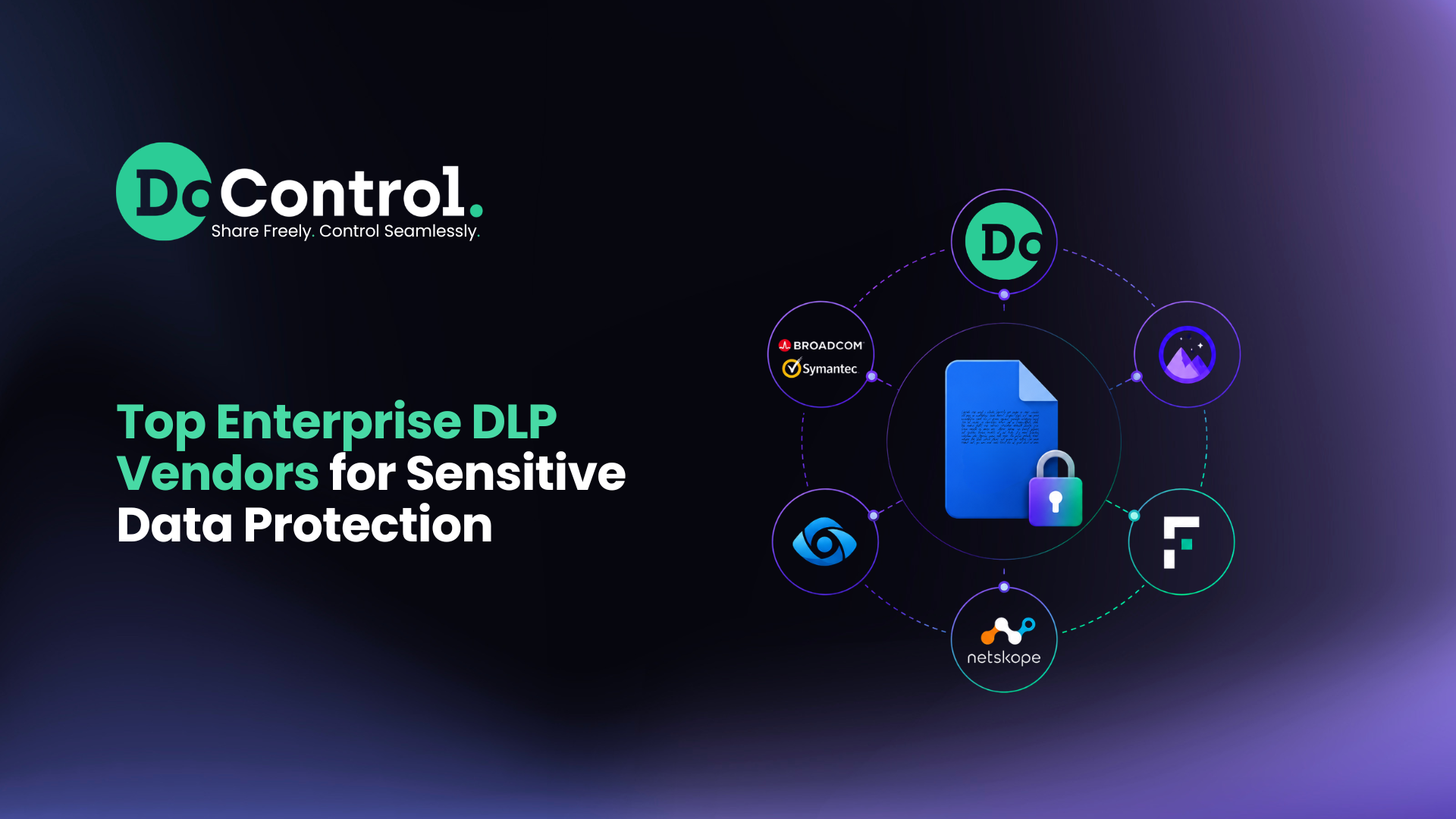
Data loss prevention (DLP) remains a core part of enterprise data security, but the environments DLP needs to protect have changed. Sensitive information now moves across endpoints, email, cloud services, SaaS applications, external collaborators, and AI-enabled workflows.
That means the best enterprise DLP solution depends heavily on where your sensitive data lives and how employees interact with it.
Established platforms such as Forcepoint and Broadcom Symantec provide extensive traditional DLP capabilities across endpoints, networks, email, and other enterprise infrastructure. Microsoft Purview takes a Microsoft-centric approach, extending DLP across Microsoft 365, endpoints, and other parts of the Microsoft ecosystem.
A newer group of enterprise data security vendors addresses the growing need to protect sensitive data across SaaS, cloud, and modern collaboration environments. DoControl, Nightfall, Cyberhaven, and Netskope approach this problem differently, but each provides capabilities designed for cloud-centric enterprise environments.
Rather than naming a single “best” DLP vendor, this guide compares seven leading platforms based on the environments and data security problems they are best suited to address.
Which Enterprise DLP Platform Is Right for Your Organization?
The right enterprise DLP platform starts with a simple question: Where does your sensitive data live, and how can users access or move it?
Organizations concerned primarily with endpoint activity, removable devices, email, and network data movement may require a traditional enterprise DLP platform. SaaS-heavy organizations have additional considerations, including external sharing, public links, permissions, third-party applications, cloud collaboration, and AI access.
Here’s a starting point for building a shortlist based on what you're looking for:
What Is the Difference Between Traditional Enterprise DLP and SaaS DLP?
Traditional enterprise DLP was designed primarily around controlling sensitive data across endpoints, networks, email, storage, and other enterprise infrastructure.
Forcepoint and Broadcom remain established examples of this approach. Microsoft Purview provides similar DLP controls within Microsoft's broader information protection, security, and compliance ecosystem.
SaaS DLP addresses another part of the enterprise data environment: sensitive information stored and shared inside SaaS applications (think Google Workspace, Slack, Box, etc.).
These platforms can provide visibility into application activity, sharing, permissions, identities, and other context that becomes important when collaboration happens directly inside SaaS applications.
These approaches aren't necessarily mutually exclusive. Enterprises may use traditional and SaaS DLP focused controls together depending on their tech stack, architecture, and security requirements.
To learn the differences between traditional DLP and SaaS DLP, read our full guide: How is SaaS DLP Different from Traditional DLP?
Enterprise DLP Vendor Comparison
Before we get into the deep details of each vendor, here's a brief snapshot to help you understand the landscape, and how each vendor compares across their own unique approaches and value propositions.
What Are the Top Enterprise DLP Vendors?
The following seven vendors include established traditional DLP providers and newer cloud-focused data security platforms. We evaluated each based on its strongest use cases as well as limitations enterprises should consider.
1. Forcepoint
Best for: Comprehensive traditional enterprise DLP
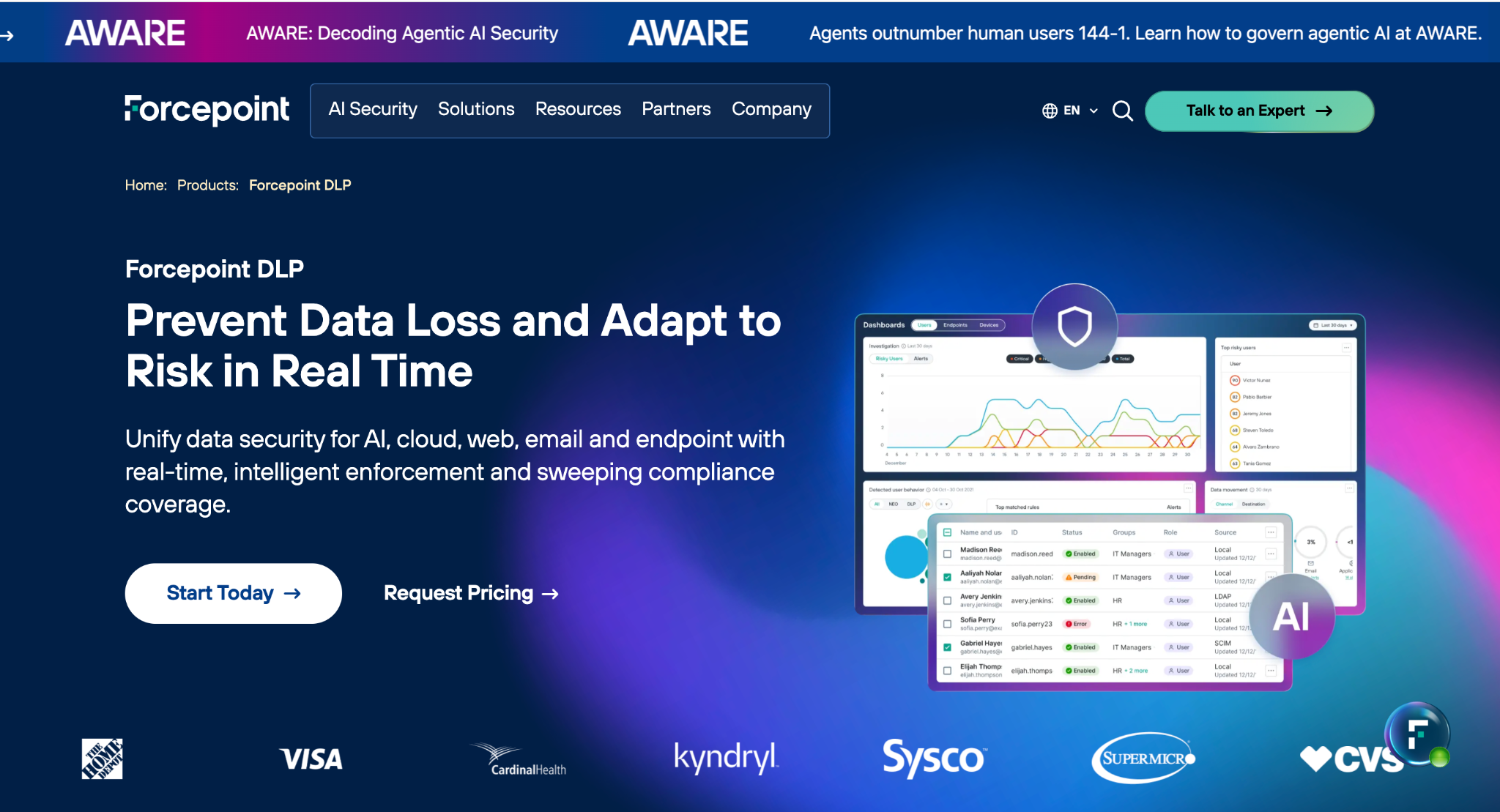
Forcepoint DLP provides discovery, classification, monitoring, and policy enforcement across endpoints, email, web, network channels, and cloud environments.
Its endpoint capabilities can monitor activities including copy/paste, printing, browser uploads, email, and transfers to external devices. Forcepoint also offers cloud-managed DLP capabilities for organizations looking to modernize deployment.
Strengths
- Broad endpoint, email, web, network, and cloud coverage.
- Mature classification and policy capabilities.
- Strong fit for complex enterprise environments.
Weaknesses
- Breadth can create more deployment and administration complexity.
- Rigidity in it’s DLP logic; either block or allow actions – which can hinder business productivity and block genuine work
- Does not offer automated remediation
- Organizations focused predominantly on SaaS collaboration may not require its full traditional DLP footprint.
- Multiple deployment and product options can make evaluation more involved.
2. Broadcom Symantec DLP
Best for: Large enterprises requiring mature, broad DLP controls
Symantec DLP provides sensitive data discovery and enforcement across endpoints, network file shares, databases, email, web, and cloud applications. Its detection capabilities include Exact Data Matching, Indexed Document Matching, OCR, and other content-aware techniques. Broadcom also provides cloud DLP and CASB capabilities for extending policies into SaaS environments.
Strengths
- Extensive enterprise DLP capabilities.
- Mature content inspection and classification.
- Unified policies across multiple control points.
Weaknesses
- Can represent a substantial platform for organizations with narrower requirements.
- Rigidity in actions; block or allow policies may hinder business ops and stop genuine work
- Architecture spans multiple traditional and cloud components.
- SaaS-first organizations should evaluate whether its cloud controls provide the depth they need for collaboration-specific risks.
3. Microsoft Purview
Best for: Microsoft-centric enterprises
Microsoft Purview Data Loss Prevention helps organizations detect and prevent inappropriate sharing of sensitive information across Microsoft services and endpoints. Purview supports DLP for Microsoft 365 workloads, Teams conversations, Windows endpoints, browsers, and certain on-premises repositories. It also sits within a broader portfolio that includes Information Protection, Insider Risk Management, DSPM, and other data security capabilities.
Strengths
- Deep integration with the Microsoft ecosystem.
- Combines DLP with Microsoft's broader security and compliance portfolio.
- Strong choice for enterprises standardized on Microsoft 365.
Weaknesses
- Licensing requirements vary by capability and scenario.
- Its strongest native advantages are concentrated in Microsoft environments.
- Organizations with large heterogeneous SaaS estates may need complementary controls.
The first three platforms represent established approaches to enterprise DLP. The following vendors place greater emphasis on protecting data across SaaS, cloud applications, and modern data workflows.
4. DoControl
Best for: Enterprise SaaS DLP and data access governance
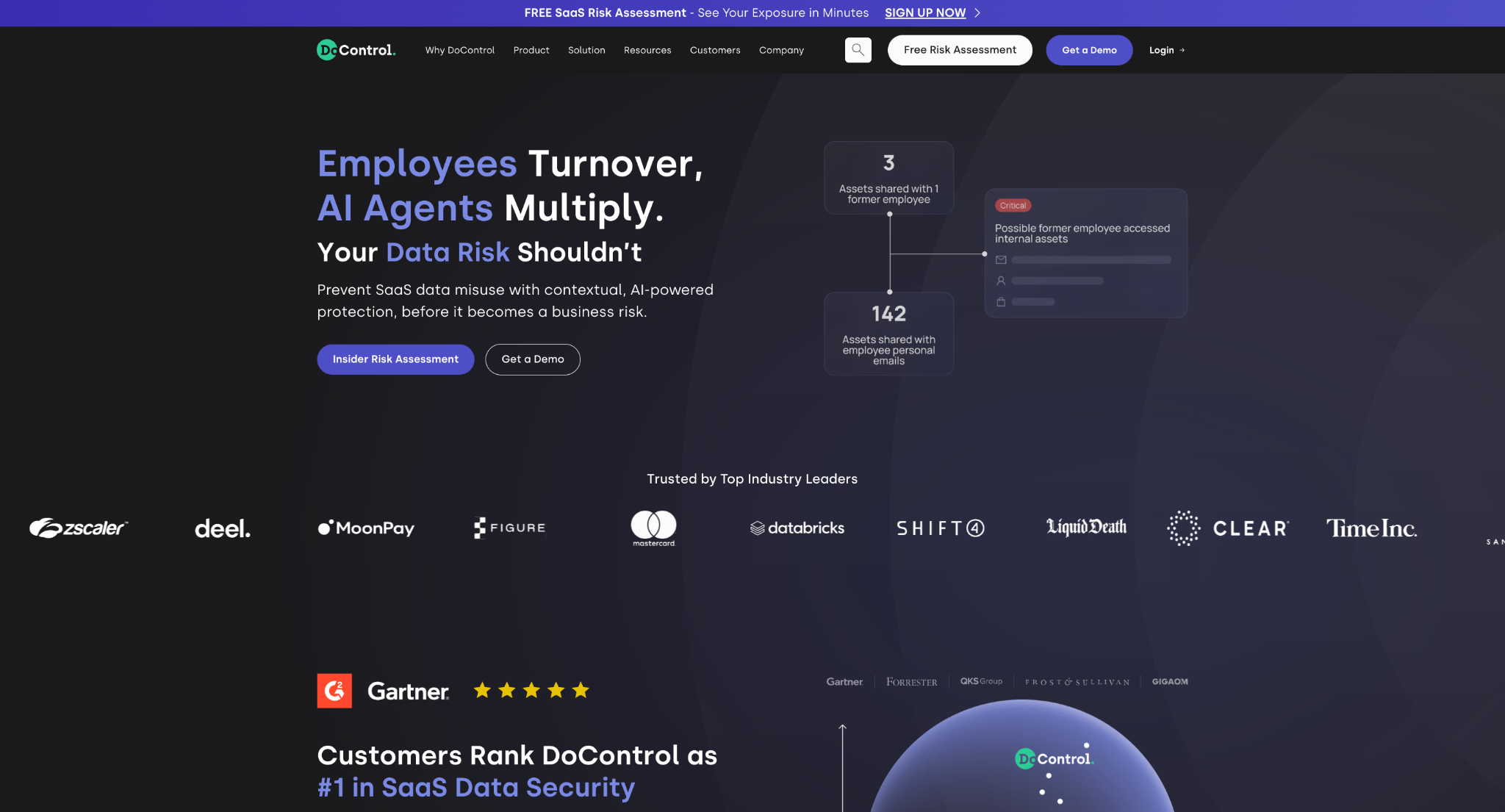
DoControl is an agentless SaaS data security platform built to protect sensitive information inside applications including Google Workspace, Microsoft 365, Salesforce, Slack, and Box.
Rather than relying on endpoint agents or inline network traffic inspection, DoControl connects directly to SaaS environments and combines sensitive data discovery with identity and business context, data access governance, and automated remediation.
Its particular strength is moving from visibility to action. Security teams can identify sensitive files and risky access or sharing, then use automated workflows or bulk remediation to revoke access, remove external exposure, and continuously enforce policies.
Strengths
- Deep focus on SaaS data, access, sharing, and identity context.
- Uses context from HRIS and IdP systems to correlate contextual signals to inform DLP actions, eliminate false positives, and prioritize truly risky events.
- Offers historical bulk remediation of sensitive data exposure, and ongoing automated remediation for reducing exposure at scale.
- Agentless architecture purpose-built for SaaS environments and scaling companies.
Weaknesses
- Not intended to replace endpoint DLP for device-level controls.
- Best suited to enterprises with meaningful SaaS adoption.
- Organizations requiring extensive network DLP will need complementary controls.
5. Nightfall
Best for: Cloud-native sensitive data detection
Nightfall is a cloud-native DLP platform that integrates directly with SaaS applications and data infrastructure. It provides prebuilt integrations for applications including Slack, GitHub, Google Drive, Confluence, Jira, and Salesforce, alongside APIs for incorporating detection into additional applications and workflows.
Strengths
- Cloud-native, API-based deployment.
- Broad selection of SaaS integrations.
- Machine-learning-based sensitive data detection.
Weaknesses
- Organizations needing traditional endpoint/device DLP should evaluate complementary controls.
- Does not offer deep business context into SaaS actions.
- Does not offer automated remediation, coverage and remediation capabilities vary by integration.
- Buyers should confirm application-specific capabilities for their SaaS stack.
6. Cyberhaven
Best for: Data lineage and contextual DLP
Cyberhaven differentiates its DLP through data lineage, tracking where information originated and how it moves, changes, and is used. Its current platform combines DLP with DSPM, insider risk, AI security, endpoint controls, and SaaS/cloud coverage.
Strengths
- Strong data lineage capabilities.
- Contextual understanding of data movement and user behavior.
- Coverage spanning endpoints, cloud, SaaS, and AI workflows.
Weaknesses
- Broader platform scope may exceed the needs of SaaS-only buyers.
- Endpoint components are part of its architecture.
- Buyers should evaluate implementation requirements against narrower API-only alternatives.
7. Netskope
Best for: DLP within an SSE/SASE strategy
Netskope combines DLP with broader cloud, web, SaaS, and security service edge capabilities. Its DLP supports sensitive data detection across SaaS, IaaS, web, and managed cloud services, with policy actions including blocking, alerting, quarantine, and user coaching.
Strengths
- Extensive SaaS, web, and cloud visibility.
- Strong fit within broader SSE/SASE deployments.
- Rich classification and policy capabilities.
Weaknesses
- Broader security platform than organizations seeking standalone SaaS DLP may need.
- Has trouble populating mass amounts of data quickly, deployment takes longer than an API-based solution.
- Rigidity in DLP controls; does not offer contextual signals that add nuance to policies.
- Deployment decisions can extend beyond DLP alone.
- SaaS-only buyers should compare its approach with API-native alternatives.
Enterprise DLP FAQs
What are the best enterprise DLP vendors?
Leading enterprise DLP vendors include Forcepoint, Broadcom Symantec, Microsoft Purview, DoControl, Nightfall, Cyberhaven, and Netskope. The best option depends on whether an organization primarily needs traditional endpoint and network controls, Microsoft-native DLP, SaaS data protection, data lineage, or broader SSE capabilities.
What is the best enterprise DLP for SaaS applications?
For SaaS-heavy enterprises, DoControl and Nightfall are purpose-built options worth evaluating. DoControl focuses heavily on data access governance, identity context, sharing, and automated remediation, while Nightfall emphasizes cloud-native sensitive data detection across SaaS applications. Cyberhaven is another option for organizations prioritizing data lineage across SaaS and endpoints.
What is the best DLP for Google Workspace?
Organizations evaluating DLP for Google Workspace should look beyond sensitive-data detection and consider sharing permissions, external access, identity context, remediation, and connected applications. DoControl is particularly focused on these SaaS data access and governance scenarios, while Nightfall provides direct Google Drive DLP integration.
Can enterprises use traditional DLP and SaaS DLP together?
Yes. The two approaches address overlapping but different data-loss scenarios. An enterprise may use traditional DLP for endpoints and network channels while using SaaS DLP to govern sensitive data, permissions, sharing, and application activity inside cloud collaboration platforms.
What should enterprises look for in a DLP platform?
Enterprises should evaluate DLP based on where sensitive data resides, the channels through which it can move, detection accuracy, application and endpoint coverage, identity context, policy enforcement, remediation, deployment requirements, and integrations with the organization's existing security stack.
Choosing the Right Enterprise DLP Vendor
There is no single DLP platform that solves every data protection challenge. Enterprise DLP spans multiple environments and channels, including endpoints, email, networks, SaaS applications, cloud collaboration, and increasingly AI-powered workflows. Forcepoint, Broadcom, Microsoft Purview, DoControl, Nightfall, Cyberhaven, and Netskope each approach these challenges differently, and many enterprises ultimately use multiple security solutions to achieve the coverage they need.
The right choice starts with understanding where your sensitive data lives, how users interact with it, and where your greatest exposure exists. Organizations should evaluate vendors based on those requirements rather than looking for a universal DLP winner.
For enterprises focused on protecting sensitive data across SaaS applications, DoControl provides contextual DLP, data access governance, and automated remediation designed specifically for modern cloud collaboration.
{{cta-1}}