.png)
.png)
For years, cybersecurity strategies have focused on protecting the perimeter—networks, endpoints, and infrastructure. But the way organizations operate has fundamentally changed. Data now lives everywhere: across cloud platforms, SaaS applications, collaboration tools, and remote endpoints. As a result, the data itself has become the primary target.
Traditional detection and response models were not designed for this reality. While they may identify suspicious activity on a device or network, they often lack the context needed to answer the most critical questions: What data is at risk? Who accessed it? What are they doing with it? And what is the real business impact?
This gap has created a growing challenge for modern data security. Security teams are flooded with alerts but still struggle to quickly determine whether sensitive data is being misused, exfiltrated, or exposed - especially in cases involving insider threats, compromised accounts, or rogue AI usage.
Managed data detection and response (MDDR) emerges as a response to this challenge. By shifting detection and response closer to the data itself, MDDR provides continuous visibility into how data is accessed and used, combined with expert-led investigation and response. The result is a more precise, context-rich approach to protecting what matters most.
In this article, we’ll explore what managed data detection and response is, how it works, how it differs from traditional models, and why it’s becoming a critical component of modern data security strategies.
What Is Managed Data Detection and Response (MDDR)?
Managed data detection and response (MDDR) is a data-centric security service that continuously monitors, detects, investigates, and responds to threats that directly impact sensitive data. Unlike traditional detection and response approaches that focus on infrastructure signals, MDDR prioritizes data activity, access behavior, and context.
At its core, MDDR combines advanced data monitoring technology with human expertise. It analyzes how users, systems, and applications interact with data in real time, looking for anomalous or risky behavior—such as unusual access patterns, mass data movement, or attempts to access sensitive information outside of normal workflows.
What distinguishes MDDR from other security models is its emphasis on managed response. Instead of simply generating alerts, MDDR providers actively investigate incidents, validate real threats, and help guide or execute response actions. This reduces alert fatigue and enables security teams to focus on incidents that pose genuine data security risk.
MDDR is designed to complement existing security investments, such as endpoint detection and response (EDR), security information and event management (SIEM), and data loss prevention (DLP). While those tools generate valuable signals, MDDR adds a critical layer of intelligence by answering not just what happened, but what data was affected and why it matters.
For organizations operating in SaaS-first environments, managed data detection and response provides a more effective way to protect sensitive information and strengthen overall data security.
How Managed Data Detection and Response Works
Managed data detection and response works by combining continuous data visibility, behavioral analytics, and expert-led investigation to identify and respond to real data security threats. Rather than relying on isolated alerts, MDDR focuses on understanding how data is accessed and used - and whether that behavior represents genuine risk.
Continuous Data Monitoring and Telemetry
MDDR begins with continuous monitoring of data activity across an organization’s environment. This includes tracking access to sensitive files, databases, and cloud drives, as well as how data is created, modified, shared, and moved across the company.
MDDR then establishes a baseline of normal data usage. These behavioral baselines are critical for identifying deviations and anomalous actions that may indicate insider misuse, compromised accounts, or early-stage breach activity.
Behavioral Analytics and Anomaly Detection
Once baseline behavior is established, MDDR uses behavioral analytics to detect anomalies. Rather than relying solely on static rules, MDDR evaluates user and system activity in context - such as time of access, data volume, data sensitivity, and historical usage patterns.
Ideally, it also provides user context: who the user is, their role within the organization, what they are doing, and whether those actions align with their typical scope of activity.
This approach enables MDDR to surface subtle but meaningful signals, including suspicious data access that may appear legitimate at the infrastructure level but is anomalous in behavioral context.
Human-Led Investigation and Threat Hunting
A defining feature of managed data detection and response is the involvement of experienced security practitioners from the SecOps team. When suspicious activity is detected, analysts investigate the event to determine whether it represents a true data security incident.
This investigation includes correlating data activity with identity context, behavioral history, and potential business impact. In addition to responding to alerts, MDDR teams proactively hunt for hidden or emerging threats that automated tools may miss.
Incident Response and Remediation
When a real threat is confirmed, MDDR supports or executes response actions to reduce data risk. This may include containing access, recommending privilege changes, guiding remediation steps, or supporting incident response workflows.
By providing clear context around what data is affected and how, MDDR enables faster, more confident decision-making during high-pressure security incidents.
Automation Meets Human Expertise
While automation plays an important role in scaling detection and analysis, MDDR does not rely on automation alone. Instead, it combines machine-driven insights with human judgment to reduce false positives and focus attention on incidents that truly impact data security.
This balance of automation and expertise is what allows managed data detection and response to deliver both efficiency and accuracy in modern environments.
MDDR vs. Traditional Detection and Response Models
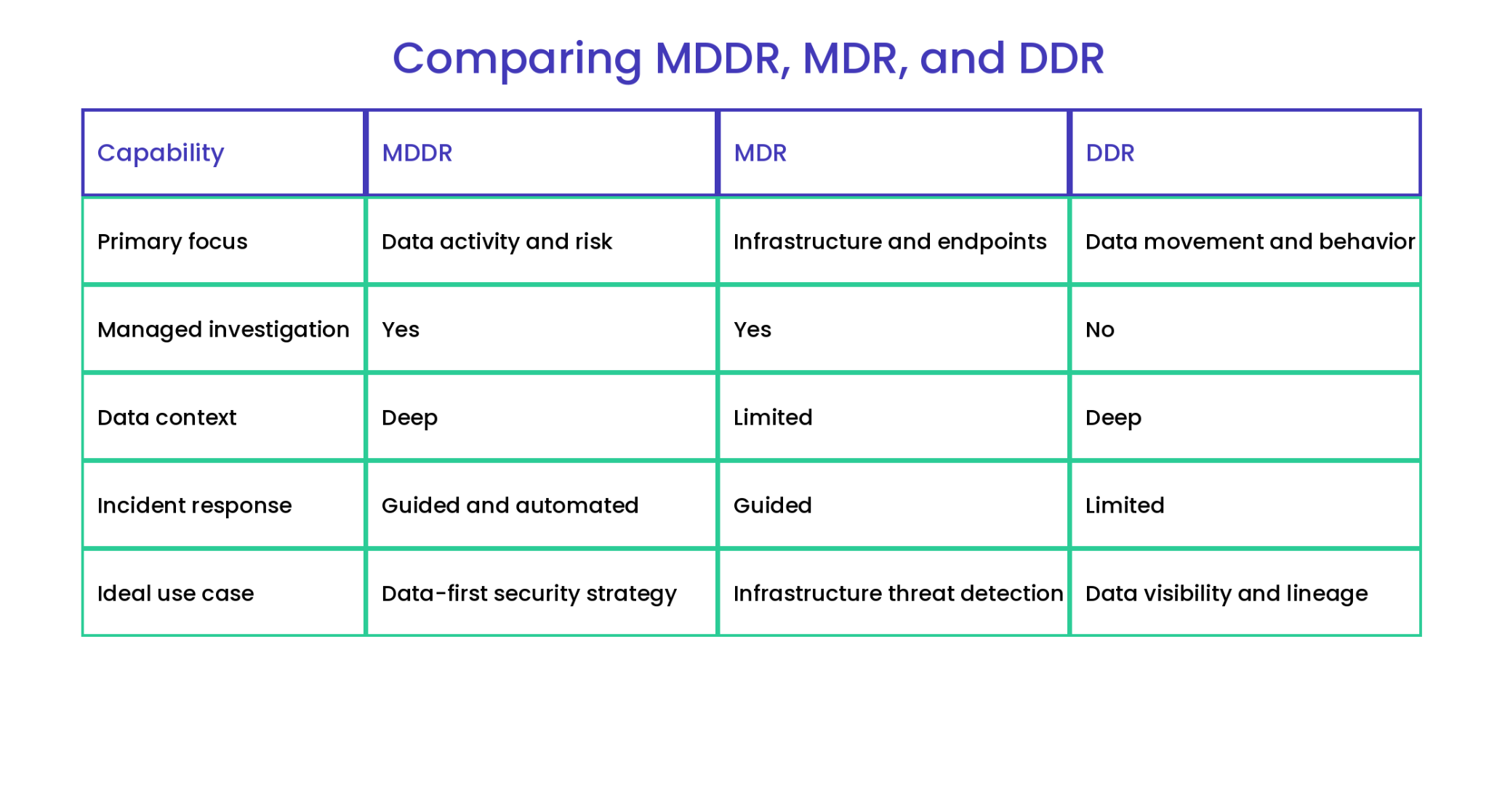
As organizations evaluate managed data detection and response, it’s important to understand how it differs from other detection and response approaches that may already be in place. While these models share similar goals—detecting threats and responding quickly—their scope, focus, and effectiveness for data security vary significantly.
MDDR vs. Managed Detection and Response (MDR)
Managed detection and response (MDR) focuses on identifying and responding to threats across endpoints, networks, and infrastructure. MDR services typically monitor telemetry from EDR, NDR, and SIEM tools to detect suspicious activity and guide incident response.
While MDR plays a critical role in identifying infrastructure-level threats, it often lacks visibility into how sensitive data is being accessed or used. As a result, MDR may detect that an account or endpoint is compromised without being able to determine which data is at risk or whether meaningful data exposure has occurred.
Managed data detection and response addresses this gap by shifting the focus to the data itself. By monitoring data access patterns and behavior, MDDR provides richer context around incidents, enabling security teams to assess impact and prioritize response based on actual data risk—not just technical indicators.
MDDR vs. Data Detection and Response (DDR)
Data detection and response (DDR) technologies focus on tracking and analyzing how data moves and changes across environments. By observing data lineage and behavior, DDR helps organizations identify suspicious data activity that traditional data loss prevention tools may miss.
However, DDR is typically delivered as a technology or platform rather than a fully managed service. While it can surface valuable signals, organizations are still responsible for investigation, validation, and response.
Managed data detection and response builds on the strengths of DDR by adding continuous monitoring, expert-led investigation, and guided or automated response. This managed layer helps organizations act on data risk more effectively, especially when internal resources are limited.
Choosing the Right Model
For organizations with modern, cloud-first environments, data is often the most critical asset to protect. While MDR and DDR each address important aspects of detection and response, managed data detection and response offers a more comprehensive approach for organizations looking to prioritize data security.
In many cases, MDDR complements existing MDR or DDR investments by adding the missing layer of data-focused context and response.
Real-World Use Cases for MDDR
Managed data detection and response is particularly effective in scenarios where traditional security tools struggle to provide clarity or timely response. Common use cases include:
Insider Threat Detection
MDDR helps identify anomalous data access patterns that may indicate malicious or negligent insider behavior, even when users have legitimate credentials.
Data Exfiltration, SaaS Sprawl, or Ransomware,
By monitoring unusual data movement and access behavior, MDDR can detect early signs of data exfiltration from departing employees, or even ransomware activity before sensitive data is exfiltrated or encrypted.
Unauthorized Access to Sensitive Data
MDDR enables organizations to detect when sensitive or regulated data is accessed outside of expected workflows, roles, or business hours.
SaaS Data Security
In distributed environments, MDDR provides visibility and response capabilities across SaaS platforms and cloud data stores where traditional controls fall short.
Post-Incident Investigation and Forensics
MDDR supports investigations by providing detailed context around data access, helping teams understand scope, impact, and root cause.
How DoControl Delivers Managed Data Detection and Response in Practice
While managed data detection and response defines what modern data security should achieve, organizations still face the challenge of how to operationalize it in day-to-day environments. This is where DoControl aligns directly with the core principles of MDDR, translating them into practical, scalable security modules within our product .
Continuous Data Monitoring Through Data Access Governance
At the foundation of effective managed data detection and response is continuous visibility into data activity. DoControl delivers this through robust data access governance, providing real-time insight into who has access to sensitive data, how that access is granted, and how it changes over time.
By continuously monitoring data access across SaaS applications, DoControl helps organizations understand not just where sensitive data lives, but how it is being accessed and by whom. This governance-first approach establishes the baseline visibility required for effective MDDR and reduces blind spots created by over-permissioned users or unmanaged access paths.
Behavioral Analytics and Context-Driven Anomaly Detection
Detecting meaningful data risk requires more than static policies. DoControl applies behavioral context through its data access governance capabilities and identity threat detection and response (ITDR), continuously evaluating how users interact with data relative to their normal behavior, role, and access patterns.
These behavioral baselines enrich downstream enforcement, including SaaS DLP policies, by adding critical context. Instead of treating every policy violation the same, DoControl enables security teams to distinguish between expected business activity and genuinely risky behavior, improving accuracy while reducing unnecessary disruptions.
Human-Led Investigation Built Into Business Workflows
A key challenge in managed data detection and response is balancing human judgment with operational efficiency. DoControl addresses this by embedding investigation and decision-making directly into automated workflows.
Rather than forcing every incident through a centralized security bottleneck, DoControl enables organizations to involve the right stakeholders (like security teams, managers, or data owners) at the right time and at the right stage of an incident. This keeps humans meaningfully engaged in investigation and resolution without slowing business productivity or overwhelming teams with constant approvals.
Incident Response Intermediation and Automated Remediation
When data risk is confirmed, response speed and consistency matter. DoControl supports managed data detection and response through automated remediation workflows that can take corrective action based on risk severity and context.
These actions may include adjusting access permissions, enforcing policy changes, or triggering follow-on controls. By intermediating response actions through workflow-driven automation, DoControl helps organizations reduce response times while maintaining governance and oversight.
Automation Augmented by Expertise
Like MDDR itself, DoControl balances automation with human expertise. Automation handles scale, consistency, and speed across complex SaaS environments, while human judgment is applied where nuance and business context are required.
This combination allows organizations to operationalize managed data detection and response in a way that is both effective and sustainable: reducing alert fatigue, improving response quality, and strengthening overall data security without introducing unnecessary friction.
Conclusion
As organizations continue to adopt cloud services, SaaS applications, and distributed work models, data has become both more valuable and more vulnerable.
Managed data detection and response represents a shift toward protecting what matters most: sensitive data itself.
By combining continuous data visibility, behavioral analytics, and expert-led investigation, MDDR provides organizations with a clearer understanding of data risk and the ability to respond more effectively when incidents occur.
For organizations looking to modernize their approach to data security, managed data detection and response offers a practical, scalable path forward in an increasingly data-driven world.
Frequently Asked Questions
What is managed data detection and response (MDDR)?
Managed data detection and response is a data-centric security service that continuously monitors, detects, investigates, and responds to threats that impact sensitive data. It focuses on how data is accessed and used, rather than relying solely on infrastructure-level signals.
How does managed data detection and response improve data security?
MDDR improves data security by providing real-time visibility into data access and behavior, combined with managed investigation and response. This helps organizations detect real data risk faster and respond with greater confidence.
What’s the difference between MDDR and MDR?
MDR focuses on detecting and responding to threats across endpoints, networks, and infrastructure. MDDR complements this by prioritizing data activity and context, helping organizations understand which data is at risk and why it matters.
What threats can managed data detection and response detect?
MDDR can detect a wide range of data-related threats, including insider misuse, compromised credentials, ransomware activity, unauthorized access to sensitive data, and suspicious data movement.
Is MDDR suitable for cloud and SaaS environments?
Yes. Managed data detection and response is particularly effective in cloud-first and SaaS-heavy environments, where data is distributed and traditional perimeter-based controls are less effective.
Does MDDR replace traditional data security tools?
MDDR is not a replacement for tools like DLP or EDR. Instead, it enhances existing security investments by adding data-focused context, continuous monitoring, and managed response capabilities.
How does MDDR help reduce alert fatigue?
MDDR reduces alert fatigue by correlating data activity with behavioral context and prioritizing high-confidence incidents. Managed investigation ensures security teams focus on real threats rather than noise.
Who should consider managed data detection and response?
Organizations that handle sensitive or regulated data - especially those operating in SaaS environments - can benefit from MDDR as part of a modern data security strategy.