.png)
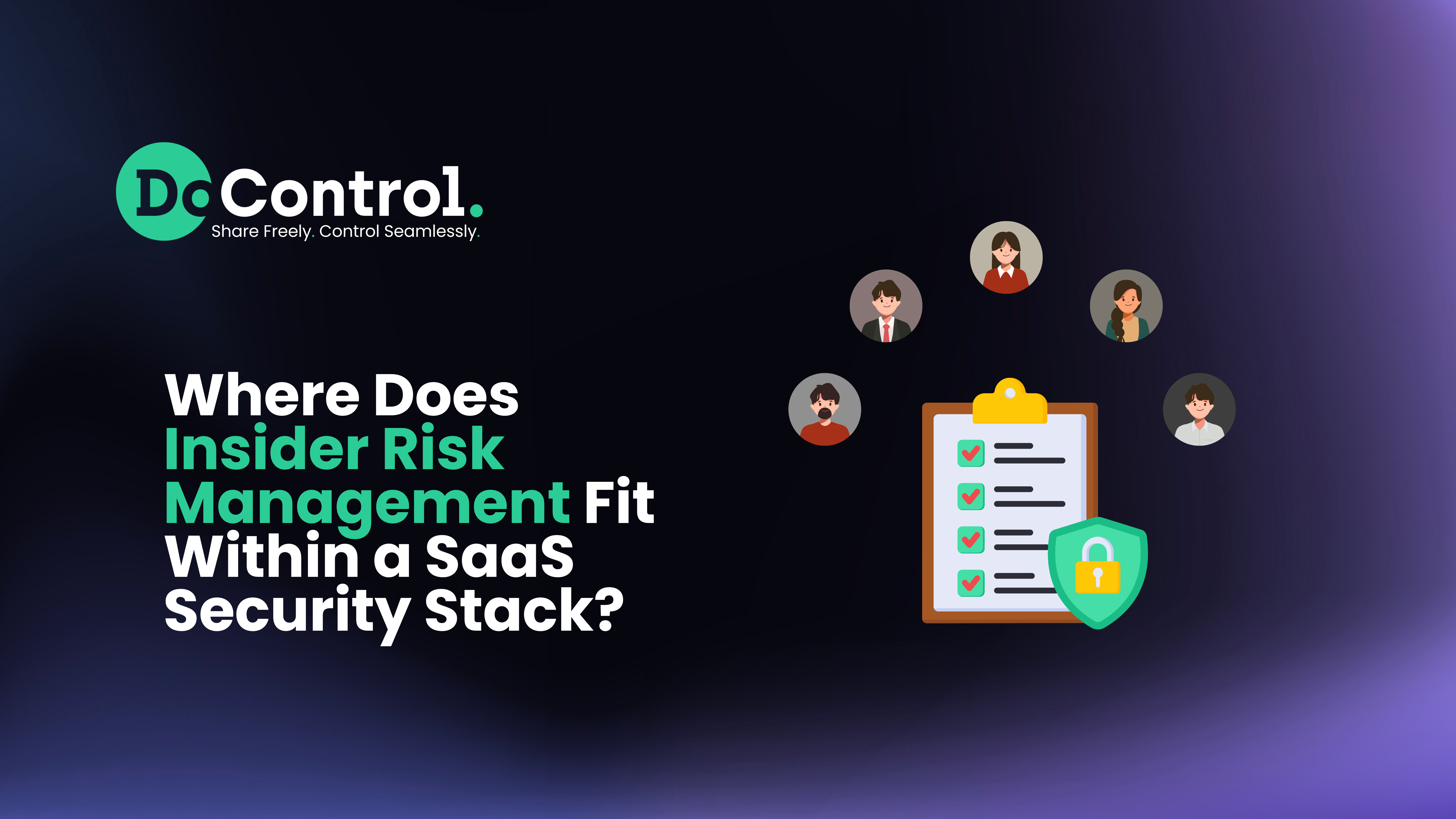
Insider risk management belongs inside your SaaS Security Posture Management (SSPM) platform. It is not meant to be a standalone alerting tool, but rather - it’s supposed to act as the intelligence layer that continuously reduces exposure.
In SaaS environments like Google Workspace or M365, most risks stem from user behavior, employee data misuse, oversharing, third-party integrations, and misconfigurations.
When these core signals are unified, contextualized, and automated within an SSPM solution, insider risk shifts from detection to real control.
To understand why, you have to look at how the SaaS security stack itself has evolved.
Why Legacy Security Layers Don’t Solve SaaS Risk
Security leaders today aren’t struggling with firewalls, they’re struggling with over-permissioned users, file sharing, OAuth abuse, ungoverned access control, and configuration drift across dozens (or hundreds) of SaaS applications.
The stack has changed, and insider risk lives where that change is happening.
1) Network security doesn’t see SaaS APIs
Traditional perimeter controls were built to inspect traffic flowing in and out of a network boundary. But SaaS platforms like Google Workspace, Microsoft 365, Slack, and Box operate over encrypted HTTPS sessions and API-based interactions.
Data exposure doesn’t happen through “network breaches.” It happens when:
- A sensitive document is shared externally with “Anyone with the link”
- A contractor retains access to sensitive files even after the engagement ends
- A third-party OAuth app gains excessive API scopes
And more.
Network tools simply don’t have the visibility into SaaS-native behaviors required to detect or remediate insider-driven risk.
For CISOs, this creates a blind spot: the organization may appear secure at the perimeter, while sensitive data is overshared internally and externally through sanctioned SaaS tools.
2) IAM authenticates, but doesn’t monitor behavior or remediate exposure
Identity providers answer one question: “Is this user allowed to log in?”
They do not answer:
- Is this user downloading 5,000 files before resignation?
- Is this AI agent (or another NHI) accessing data it never touched before?
- Is this user suddenly sharing sensitive folders externally?
Authentication is binary. Insider risk is behavioral and contextual.
In other words, authentication only requires a simple answer - but detecting and managing insider risk is much more nuanced and complex than that.
Security leaders increasingly recognize that identity without continuous monitoring + context = blind spots.
3) Static DLP lacks contextual awareness surrounding user behavior
Similar to the last point we made, traditional DLP policies are rule-based and lack context. They follow binary rules, like the following:
- Block credit card numbers
- Flag social security numbers
- Restrict all external sharing
But, insider risk is rarely that simple. Again, it’s much more nuanced and complex than that.
For example:
- A finance executive downloading financial models could be a legitimate action…unless they just put in their two weeks notice.
- A developer accessing sensitive source code may be normal…unless their role changed last week and they work in a different department now.
- A public share by the marketing team to a third-party contractor looks routine, unless that contractor had stopped working with the company five months ago.
Without business context (role, department, employment status, recent HR changes), DLP blocks legitimate actions and floods SecOps with false positives. That noise leads to alert fatigue - where security teams get overwhelmed and the real risks get buried.
Modern insider risk management must enrich detection with organizational context to separate negligence from malicious intent, and normal behavior from real threat.
4) Traditional tools don’t remediate SaaS exposure & misconfigurations automatically
Even when security teams do detect risky activity, most tools stop at alerting. But this is only half the battle.
In SaaS, exposure is dynamic, and the remediation policies need to be just as so. For example:
- Sharing links need to be revoked instantly if data gets exposed
- OAuth scopes need to be downgraded immediately if an AI app gets read & write access
- Excess permissions should be reduced automatically if data exfiltration is suspected
- Misconfigured settings need to be corrected in real time as soon as a drift is detected
These are just a few examples of what remediation should look like in practice. Visibility without remediation is useless. All it does is show you that there’s a problem.
If insider risk management doesn’t include remediation, the blast radius remains open.
For security leaders balancing lean teams with expanding SaaS footprints, automation is not a luxury, it’s a necessity.
What Insider Risk Management Actually Means in SaaS
Now that we’ve covered the basics of how legacy tools are quickly becoming obsolete in solving the insider risk problem within SaaS ecosystems, let's get into the details of what this truly looks like for teams operating in SaaS.
For many security leaders, “insider risk” still evokes outdated assumptions or stereotypes, like malicious employees stealing IP or dramatic data exfiltration events. Sometimes, it is this exact scenario - but it’s not always this cut and dry.
In reality, insider risk in SaaS environments is far more nuanced, more frequent, and very hard to catch.
It is driven by behavior, access, context, opportunity…and a whole other slew of factors.
Insider Risk in SaaS Is About Behavior + Access + Data Movement
In SaaS-driven environments, insider risk is rarely a single action. It is the intersection of three variables:
- User behavior
- Access settings
- Data movement
A secure SaaS security stack must analyze all three simultaneously - and contextually.
1) Behavior: Risk Emerges in Real Time
Every SaaS action leaves a behavioral trail:
- External file shares
- Bulk downloads
- Permission changes
- OAuth app authorizations
- Admin configuration updates
- Public link creation
For example, within Google Workspace or Microsoft 365, a user sharing a file externally may be completely legitimate.
But if that same user:
- Recently changed departments,
- Is accessing repositories outside their normal scope,
- Or just submitted resignation paperwork,
…the behavior shifts from routine to risky.
Effective insider risk management tools integrate with HRIS or IdP systems to sync what's happening at the user level to these actions being taken within the SaaS ecosystem.
This is where AI-powered behavior analytics become foundational: not flagging every deviation, but analyzing them in context - only detecting meaningful anomalies tied to sensitive data.
2) Access: Over-Permissioned Users Are Latent Risk
One of the most common insider risk accelerators is excessive access.
Security leaders often discover:
- Users retaining admin privileges after role changes
- Employees with active credentials even after leaving the company
- Sensitive files that are shared internally to everyone at the organization, even if they shouldn't be
- AI agents, service accounts, or other non-human identities (NHI’s) with broad file access
- Contractors who have ended their engagement with the company but are still shared onto sensitive documents
- Shared drives with overly permissive default settings
For CISOs, the priority shifts from simply managing identities to continuously evaluating exposure created by those identities.
Insider risk management within an SSPM platform correlates:
- Who the user is
- What they can access
- What they are actually doing 24/7
That triad transforms identity data into actionable risk intelligence.
3) Data Movement: Exposure Often Starts With Oversharing
In SaaS environments, data inadvertently leaks through collaboration.
For example, consider platforms like:
Data exposure may occur when:
- A Google Drive link containing company IP is set to ‘Anyone with the link can access’
- A Slack file containing confidential pay data is shared into a public channel
- A Box folder containing trade secrets is opened to external collaborators
Often, these actions are unintentional.
Insider risk management must therefore:
- Detect sensitive data exposure in context
- Identify who initiated the exposure
- Assess whether behavior aligns with business norms
- Automatically remediate if necessary
This is where detection alone is insufficient. Without automated revocation of risky sharing or permissions, exposure persists, and data falls into the wrong hands.
Different Types of Insider Risk in SaaS
A modern insider risk strategy acknowledges that intent is only one variable.
Insider risk isn’t just malicious employees. In fact, many insider incidents stem from negligence or operational friction rather than malicious behavior.
There are other types of insider risk that are separate from the common insider threat:
Compromised Accounts
An authenticated session does not guarantee legitimate behavior.
If credentials are compromised, actions taken inside SaaS applications may appear internal, even though they originate from an external actor.
Insider risk detection must identify anomalous activity even when authentication appears valid.
Negligent Sharing
Employees under pressure often prioritize speed over policy:
- Sharing sensitive documents externally for convenience
- Uploading files to unsanctioned apps
- Granting overly broad permissions to collaborators
Traditional enforcement-heavy approaches create friction and block collaboration entirely. True, effective insider risk management in SaaS introduces real-time guardrails, flexible DLP workflows, and educational feedback to reduce repeat behavior.
Departing Employees
Risk patterns frequently change around employment transitions.
Security leaders need visibility into:
- Unusual download spikes
- Sudden permission escalations
- Cross-department data access
- Bulk sharing activity
Context from HRIS and IdP systems dramatically improves accuracy within the SaaS security program, reducing false positives while surfacing legitimate threats and data exfiltration attempts.
Over-Privileged Service Accounts
Machine identities and integrations can be overlooked sources of insider risk.
OAuth-based third-party applications may:
- Request broad API scopes
- Access files across departments
- Persist access beyond necessity
This vector is becoming even more popular with the rise of AI tools and agents. Without monitoring third-party app behavior, insider risk visibility remains incomplete.
Unsanctioned Third-Party Integrations
Shadow SaaS apps create lateral exposure.
A user authorizing an unsanctioned app inside Google Workspace can unintentionally grant it access to sensitive repositories.
Effective insider risk management must evaluate:
- OAuth scope risk
- App reputation
- Data accessed by integrations
- Cross-SaaS activity correlation
And critically, it must be able to revoke high-risk access immediately. Similar to over-privileged accounts, AI shadow apps and tools added to the environment by employees who don’t know any better have become a serious risk to the modern SaaS stack.
{{cta-1}}
Where Insider Risk Management Sits Inside an SSPM Platform
If the first evolution of SaaS security was visibility, and the second was posture management, the third is intelligent risk reduction.
Insider risk management does not sit beside the SaaS stack. It operates inside the SaaS control plane - embedded within SSPM - correlating identity, behavior, configuration, and data exposure across applications.
For modern security leaders, this architectural distinction matters.
Insider Risk as a Core Capability of the SaaS Control Plane
In a SaaS-native architecture, the stack looks like this:
SaaS Applications
Google Workspace, Microsoft 365, Salesforce, Slack, Box, Zoom, etc.
↓
Unified SSPM Platform (Your Security Control Plane)
Within this control layer:
- Data Loss Prevention
- Data Access Governance
- Shadow App Discovery
- Third-Party App Risk Management
- Insider Risk & Insider Threat Detection
- Misconfiguration Management
- Automated Remediation Engine
Insider risk is not an isolated feature. It is the intelligence layer that connects all the above.
It answers questions like:
- Does this user have excessive access to sensitive files?
- What user onboarded this risky third-party app involved?
- Is this sort of sharing behavior normal for this business unit?
- Was this action done by a human or by a non-human identity?
- Is this risky behavior amplified by a current misconfiguration?
- Should this exposure be automatically remediated or is it legitimate?
Because insider risk is embedded within SSPM, it sees posture and behavior together - not in isolation.
Correlating Behavior With Context, Access, & Data
This is where many solutions fall short.
Alert-only tools detect actions.
Governance tools detect over-permissioning.
DLP tools detect data movement.
But insider risk in SaaS is rarely one-dimensional.
Example scenario:
A user creates a public sharing link for a sensitive financial model inside Google Workspace.
On its own, this may look low risk.
But layered context may reveal:
- The file resides in a misconfigured shared drive.
- The user recently changed departments.
- That same user downloaded several other financial documents minutes later.
When insider risk operates inside SSPM, all of that telemetry is unified, and risk scoring becomes materially more accurate.
For CISOs, this dramatically reduces false positives while surfacing high-confidence threats.
Why Insider Risk Must Be Unified Inside SSPM (Not a Standalone Tool)
Security leaders are increasingly wary of stack sprawl.
Adding another alerting tool without reducing exposure creates operational drag.
Fragmentation Creates Alert Fatigue
When insider risk exists outside posture and governance controls:
- Alerts lack user context, behavioral context, and data context.
- Access governance lacks prioritization or risk scoring.
- Remediation requires manual intervention.
This results in:
- Increased triage time
- SOC overload
- Unresolved exposures lingering for days or weeks
- Risks slipping through the cracks
- No way to effectively eliminate risks at scale
Moving From Alerts to Automated Remediation with DoControl
Detection without enforcement creates noise. Visibility without remediation creates stress.
In SaaS environments, remediation can and SHOULD be immediate, and that changes the equation.
With DoControl, insider risk management doesn’t stop at alerting your team. It moves immediately into action across your entire SaaS stack.
When risky behavior is detected, DoControl can take immediate, policy-driven action, including:
- Instantly removing public file links
- Revoking or restricting external sharing
- Reducing excessive user permissions
- Downgrading or disabling risky third-party OAuth integrations
- Enforcing stricter sharing configurations
- Locking accounts when behavioral thresholds are crossed
And more.
Because DoControl operates directly within SaaS APIs, these actions are executed in real time, before an exposure event turns into incident response.
For lean security teams managing dozens of SaaS applications, this changes the equation entirely.
Instead of chasing alerts, teams actually eliminate their exposure at scale.
Workflow-Based Policy Enforcement That Adapts to Risk
Automation shouldn’t be rigid. It should reflect your organization’s risk tolerance and be as flexible as possible.
DoControl enables security teams to build remediation workflows that are:
- Predefined and repeatable
- Conditional based on risk score and business context
- Triggered by behavioral thresholds
- Escalated automatically for high-confidence threats
- Continuously enforcing posture policies in the background
This means insider risk isn’t managed through one-off investigations. It’s governed through living, adaptive policy that you have complete control over.
Real-Time End-User Education Reduces Recurrence
Not every insider risk event is malicious. In fact, most aren’t.
Employees overshare because they’re collaborating. They authorize apps because they need to move fast. They don’t always understand the security implications of a “public link.”
DoControl addresses this in the moment.
When a user:
- Violates a sharing policy
- Connects a risky third-party app
- Exposes sensitive data
- Attempts behavior outside policy guardrails
They receive real-time, contextual notification, explaining what happened and guiding remediation.
This approach does two things simultaneously:
- It reduces immediate exposure.
- It reduces the likelihood of repeat behavior and educates employees.
Insider risk mitigation no longer scales linearly with your security team’s headcount. It scales through automation and user awareness.
Final Takeaway
Insider risk management doesn’t sit on the edge of your SaaS security stack, it lives at its center.
In a SaaS-first world, risk is driven by user behavior. All of the pieces of the puzzle need to come together to protect an entire company's SaaS environment, and it starts with the people themselves.
That’s exactly how DoControl approaches insider risk management: understanding users behavior - and unifying behavior, access, posture, and third-party risk inside a single SaaS control plane, offering automatic remediation before it turns into incident response.
Because in SaaS environments today, real security isn’t about seeing risk. It’s about reducing it.