.png)
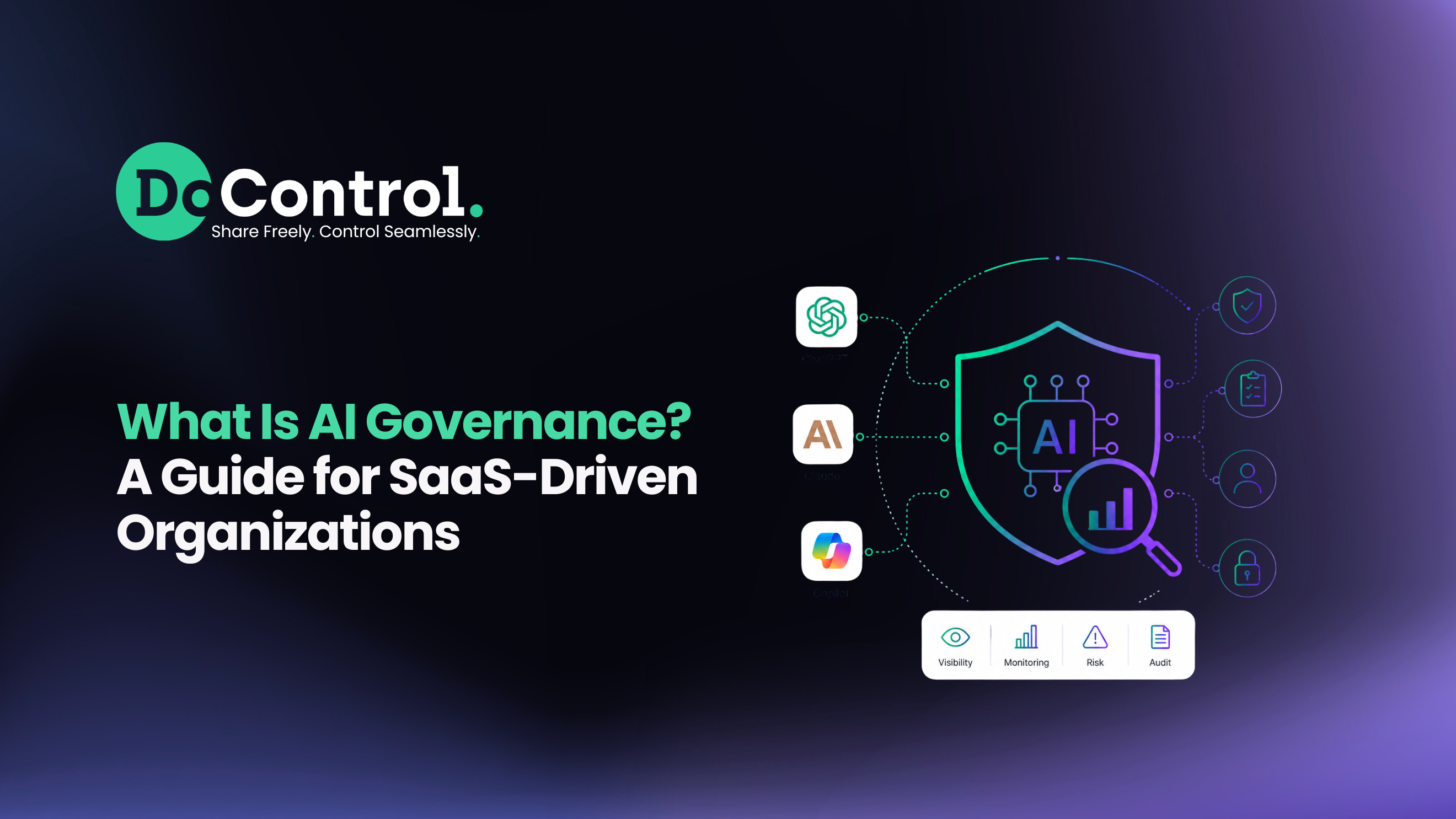
Every week, employees across your organization are connecting new AI tools to the apps your business runs on. ChatGPT gets linked to Google Drive. A sales rep authorizes a Copilot integration with Salesforce. Someone on the marketing team connects an AI writing assistant to Slack. These connections happen fast, they happen quietly, and they happen with almost no oversight.
Each one is a governance problem in the making.
The mainstream conversation about AI governance tends to focus on model fairness, algorithmic bias, and the ethics of large language model development. That matters — but it isn't the problem keeping your security and compliance team up at night.
What keeps them up is simpler and more immediate: sensitive corporate data is flowing into AI tools that nobody in IT or security ever approved, and the compliance frameworks your organization is audited against already have rules about exactly that.
This guide is written for the organizations living in that reality — SaaS-driven businesses where AI adoption is happening faster than governance policy.
We'll define AI governance, explain why it's fundamentally a SaaS compliance issue, identify the specific regulatory frameworks that create legal and audit exposure, and walk through what a practical, enforceable AI governance framework actually looks like when your data lives in Google Workspace, Salesforce, Slack, SharePoint, and two dozen other SaaS applications.
What Is AI Governance?
AI governance is the set of policies, processes, and controls that organizations put in place to ensure AI systems are used safely, ethically, and in compliance with applicable laws and standards. It covers who can use AI tools, what data those tools can access, how decisions made by AI are documented and audited, and what happens when something goes wrong.
At the enterprise level, AI governance spans the full lifecycle: from how AI models are built and trained, to how they're deployed, monitored, and eventually retired. It assigns accountability, establishes transparency requirements, and creates the audit trails regulators and auditors expect to see.
For most organizations, the hardest part of AI governance isn't writing the policy — it's enforcing it. The gap between what an acceptable use policy says and what employees are actually doing with AI tools inside your SaaS environment is where compliance exposure lives. That gap is what this guide is designed to help you close.
Why AI Governance Is a SaaS Compliance Problem First
The traditional framing of AI governance is a product development problem: how do you build AI responsibly? That framing made sense when AI was primarily something large technology companies built and shipped.
However, this framing doesn't map cleanly onto the reality most enterprises are dealing with in 2026, where AI is something every department is consuming — through SaaS integrations, browser extensions, workflow automations, and third-party apps connected via OAuth.
The risk has shifted from the model to the integration layer.
The Shadow AI Explosion Inside Enterprise SaaS
Shadow AI refers to AI tools and applications that employees use without IT's knowledge or formal approval. It's the enterprise equivalent of shadow IT — and it's growing at a pace that most security teams haven't caught up with.
The average mid-to-large enterprise today has hundreds of AI-connected apps linked to its core SaaS stack.
DoControl data found that on average, a midmarket organization has 730 connected shadow apps, of which 13% are risky, and 14% are abandoned (which is worse – forgotten about AND still serving as an active attack surface).
Most of those connections were made by individual employees or teams, not IT. They exist outside any procurement process, outside any vendor security review, and outside any data classification policy. When those tools request OAuth scopes — which they almost always do — they often gain broad read access to files, emails, calendar events, and internal communications.
This is a live data pipeline from your sensitive business information to a third-party AI system your security team has never evaluated.
How Unsanctioned AI Tools Create Compliance Violations Before Anyone Notices
The SaaS compliance problem starts the moment an employee authorizes an AI tool to access corporate data. It doesn't require a breach, and it doesn't require anything to go wrong. The violation is in the unauthorized access itself — to data that may be subject to GDPR, CCPA, HIPAA, or SOC 2 requirements.
Consider what's actually at stake when an employee connects an AI productivity tool to their work Google account: emails containing personally identifiable information (PII), documents with financial data, calendar entries with confidential meeting details, and shared Drive folders containing everything from legal contracts to HR records.
The AI tool now has access to all of it.
Whether it uses that access responsibly depends entirely on a vendor data processing agreement most employees never read and IT never reviewed.
This is the compliance exposure. It's not dramatic — no alarm goes off, no dashboard turns red. It's quiet, incremental, and it compounds every time another employee makes another unauthorized connection.
Why CASB and Legacy DLP Weren't Built for This
Cloud Access Security Brokers (CASBs) and traditional Data Loss Prevention tools were designed for a different threat model. They're built to monitor known applications and block specific data patterns — a social security number going out over email, a credit card number being uploaded to a personal file storage account.
They were not built to understand the semantic context of an AI app requesting read access to an entire Google Workspace tenant. They can't evaluate whether an OAuth integration is requesting more permissions than a task legitimately requires. They don't map data flows between SaaS applications and AI systems in real time. And they can't automatically remediate a new overpermissioned connection the moment it's created — they're too slow and too coarse.
Governing AI in a SaaS environment requires a different approach: one built around continuous visibility into app-to-app connections, data classification at the point of access, and automated enforcement rather than manual review queues.
The Compliance Frameworks That Apply to AI in SaaS Environments
Most AI governance content focuses on frameworks designed for AI model developers. That's useful background, but it isn't what your compliance and legal team is being audited against. The frameworks below are the ones that create direct, enforceable obligations for how data moves between your SaaS applications and the AI tools connected to them.
GDPR — When Employees Send Personal Data to AI Tools, Who's Liable?
Under GDPR, your organization is the data controller for any personal data it collects. When an employee authorizes an AI tool to access that data and no Data Processing Agreement (DPA) is in place with the vendor, your organization has facilitated unauthorized processing of personal data. The liability doesn't transfer to the employee who clicked "authorize" — it stays with you.
The practical implication: every AI tool with access to your SaaS data needs a reviewed DPA before it's authorized. Most don't have one.
SOC 2 — AI Tool Integrations as a Third-Party Vendor Risk
SOC 2 Trust Service Criteria require organizations to assess and monitor third-party vendors that have access to systems containing customer data. An AI tool with OAuth access to Salesforce, Zendesk, or any customer-facing SaaS application is, by definition, a third-party vendor with access to systems that likely contain customer data.
The problem is that most shadow AI connections are never submitted through a vendor review process. That means auditors reviewing your SOC 2 controls will find a gap between your stated vendor management policy and what's actually connected to your environment — a finding that can hold up certification or damage customer trust.
SOC 2 also requires logical access controls and audit logs. If an AI integration is accessing data without those controls in place, that's a direct control deficiency.
HIPAA — What Happens When AI Touches PHI Inside a SaaS Workflow
In healthcare and adjacent industries, the risk is more acute. Protected Health Information (PHI) regularly flows through SaaS applications — in Slack messages between care teams, in documents stored in SharePoint, in notes logged inside Google Drive. Any AI tool with access to those environments has potential access to PHI.
HIPAA requires a Business Associate Agreement (BAA) with any vendor that handles PHI on your behalf. Most AI tools employees are connecting to workplace SaaS apps have not signed a BAA, which means any PHI they access constitutes an unauthorized disclosure — a reportable breach, regardless of whether the data was misused.
ISO 27001 — Information Security Controls for AI-Connected Environments
ISO 27001's Annex A.15 requires organizations to assess information security risks associated with suppliers and third-party service providers, and to maintain appropriate controls. AI tools connected via OAuth to your core SaaS applications are suppliers in this context.
For organizations pursuing or maintaining ISO 27001 certification, undocumented AI integrations represent a supplier risk management gap. Certification bodies increasingly expect to see AI tool inventories, access scope reviews, and evidence of ongoing monitoring as part of Annex A.15 compliance.
EU AI Act — The Data Governance Requirements That Matter for SaaS
The EU AI Act classifies AI systems by risk level and imposes increasingly stringent requirements as that risk level rises. For SaaS-driven organizations, the most relevant provisions are the data governance requirements for general-purpose AI (GPAI) models and the transparency obligations that apply to AI tools used in employment, access to services, and critical infrastructure contexts.
If your organization operates in the EU or processes EU resident data, and you're deploying AI tools that affect decisions about employees, customers, or service eligibility, you may already be within scope for high-risk AI system requirements — including mandatory risk assessments, human oversight mechanisms, and documentation of training data sources.
The 5 AI Governance Risks That Create SaaS Compliance Exposure
Understanding the frameworks is one thing. Understanding the specific risk vectors that create violations inside a real SaaS environment is what makes a governance program enforceable rather than theoretical.
1. Shadow AI Apps with OAuth Access to Sensitive SaaS Data
This is the most common and most underestimated risk. Employees authorize shadow AI tools through OAuth in seconds, granting those tools read (and often write) access to applications containing sensitive business and customer data. Because these connections happen outside IT's visibility, they sit outside every vendor review, every DPA process, and every access control policy.
2. Unclassified Data Flowing Into AI Integrations
Most organizations don't have comprehensive data classification across their SaaS environment. When data isn't classified, there's no mechanism to enforce rules about which data can be shared with AI tools and which can't. Sensitive files, PII-containing documents, and confidential communications get treated the same as public-facing marketing collateral — and all of it flows freely into connected AI systems.
3. Overpermissioned OAuth Integrations That Violate Least Privilege
Least-privilege access is a foundational security and compliance principle. It's also routinely violated by AI app OAuth requests, which frequently ask for broad access ("Read all files in Google Drive") when the legitimate use case only requires narrow access. Most users approve these requests without scrutiny, and most organizations have no automated process for reviewing whether granted scopes are proportionate to the task.
4. No Audit Log of What AI Tools Accessed, When, and What They Did With It
Audit logging is a compliance requirement across SOC 2, HIPAA, and ISO 27001. For AI integrations, this means being able to answer: which AI tools accessed which data assets, when did that access occur, and what actions were taken? Most organizations relying on shadow AI tools, agents, or non-human identities cannot answer any of these questions.
DoControl's analysis found that AI identities are responsible for a substantial portion of SaaS activity, performing 70% of actions in SharePoint, 53% in Slack, 45% in Salesforce, and 40% in Google Drive.That's not just a security blind spot — it's a compliance deficiency auditors will flag.
5. Third-Party AI Vendors Without Reviewed Data Processing Agreements
When an AI vendor processes personal data on your behalf — which happens the moment their tool accesses your SaaS data — GDPR requires a Data Processing Agreement documenting how that data is handled, stored, and protected. HIPAA requires a Business Associate Agreement for any PHI. These agreements need to exist before access is granted, not after a problem is discovered. For the vast majority of shadow AI connections, they don't exist at all.
What a SaaS-Specific AI Governance Framework Actually Looks Like
A governance framework that lives as a PDF in your GRC tool isn't a governance framework — it's documentation. Effective AI governance in a SaaS environment means automated, continuous enforcement that keeps pace with the speed at which employees adopt new tools.
Step 1: Discover and Inventory Every AI Tool Connected to Your SaaS Stack
You cannot govern what you cannot see. The foundation of any AI governance program is a complete, continuously updated inventory of every AI application that has OAuth access to your core SaaS applications — authorized or not. That inventory should capture the application name, the OAuth scopes granted, which users authorized the connection, what data assets the tool has accessed, and whether a DPA or BAA is in place.
Step 2: Classify Data by Sensitivity Before It Reaches an AI Integration
Data classification is the prerequisite for enforcement. Before you can apply rules about which data AI tools can access, you need to know what your data is. Apply sensitivity labels — confidential, internal, PII-containing, PHI, publicly shareable — to the files, messages, and records living in your SaaS applications. Automated, ML-based classification that runs continuously is the only approach that scales.
Step 3: Establish Acceptable Use Policies With Automated Controls
Acceptable use policies for AI need to be backed by technical controls that enforce them automatically. Define which AI tools are approved for use with which categories of data, and implement controls that prevent unapproved tools from accessing data above their permitted sensitivity level. Policy without enforcement is aspiration.
Step 4: Apply Least-Privilege Access to AI App OAuth Scopes
Review every AI integration against the principle of least privilege. For tools that have been granted overly broad access, revoke and re-authorize with narrower scopes. For new tools entering the environment, build a review step into the authorization process that evaluates requested scopes before access is granted.
Step 5: Maintain a Continuous Audit Trail for AI-Adjacent Data Events
Every access event involving an AI tool and a sensitive data asset should be logged in real time: what tool, what data, what user, what time, what action. This audit trail satisfies the logging requirements of SOC 2, HIPAA, and ISO 27001, and gives your security team the forensic evidence needed to respond to incidents and answer auditor questions.
Step 6: Build a Remediation Workflow for New Violations, Not a Quarterly Review
When a new unapproved AI integration appears in your environment, the response needs to be immediate — automatic revocation of access, notification to the user, and escalation to IT for review. Event-driven remediation replaces the ticket queue with automated action that closes the exposure window before data has time to leave the environment.
AI Governance Best Practices for SaaS Security and Compliance Teams
- Treat every AI tool as a third-party vendor. Apply the same security assessment, DPA review, and access control standards you'd apply to any SaaS vendor with access to sensitive data.
- Don't rely on employees to self-report AI tool usage. Proactive discovery of OAuth connections will always surface more than voluntary disclosure.
- Classify before you connect. Data classification should precede any AI integration rollout, not follow it.
- Revoke, don't just flag. When a governance violation is detected, automated revocation of access is more effective than an alert waiting for human action.
- Audit trail completeness is non-negotiable. If you can't tell an auditor exactly what data an AI tool accessed and when, you have a compliance gap.
- Review OAuth scopes at every renewal. AI vendors update their permission requests over time. Scope creep is real — build periodic reviews into your vendor management process.
- Document your DPAs and BAAs in one place. When an incident or audit happens, you need to produce these documents quickly.
How DoControl Enforces AI Governance Across Your SaaS Environment
DoControl is built for exactly this problem. As a SaaS security platform, DoControl gives security and compliance teams the visibility and automated enforcement they need to govern AI tool usage across the SaaS applications their business runs on.
Shadow AI Discovery: DoControl continuously discovers every AI application connected to your SaaS stack via OAuth — including tools IT never approved. You get a real-time inventory of every integration, the scopes it's been granted, and the data it has the ability to access.
Data Classification: DoControl's ML-based classification engine automatically assigns sensitivity labels to data assets across your connected SaaS applications. When an AI tool accesses a classified file, DoControl evaluates whether that access is permitted under your governance policies — and acts on violations automatically.
Access Control Enforcement: DoControl enforces least-privilege access across AI integrations, flagging connections where OAuth scopes exceed what the use case requires and enabling automatic remediation when violations are detected.
Automated Remediation: Rather than creating tickets for human review, DoControl can automatically revoke overpermissioned connections, notify users of policy violations, and quarantine data assets accessed by unapproved AI tools — closing the exposure window in real time.
Audit Trails: Every AI-related data access event is logged in DoControl's audit trail, giving your compliance team the documentation they need for SOC 2 audits, HIPAA reviews, and regulatory inquiries.
The result is an AI governance program that doesn't depend on employees following policy voluntarily — it enforces policy technically, continuously, and at the speed your SaaS environment actually operates.
Start Governing AI Where the Risk Actually Lives
The AI governance frameworks your board wants to see and the compliance requirements your auditors are checking aren't two separate problems. In a SaaS-driven organization, they converge in exactly the same place: the integrations your employees are creating every day between the AI tools they want to use and the applications that hold your most sensitive data.
A governance program that only exists on paper won't close that gap. Automated discovery, classification, access control, and remediation is the only thing that will.
{{cta-1}}

.png)