.png)
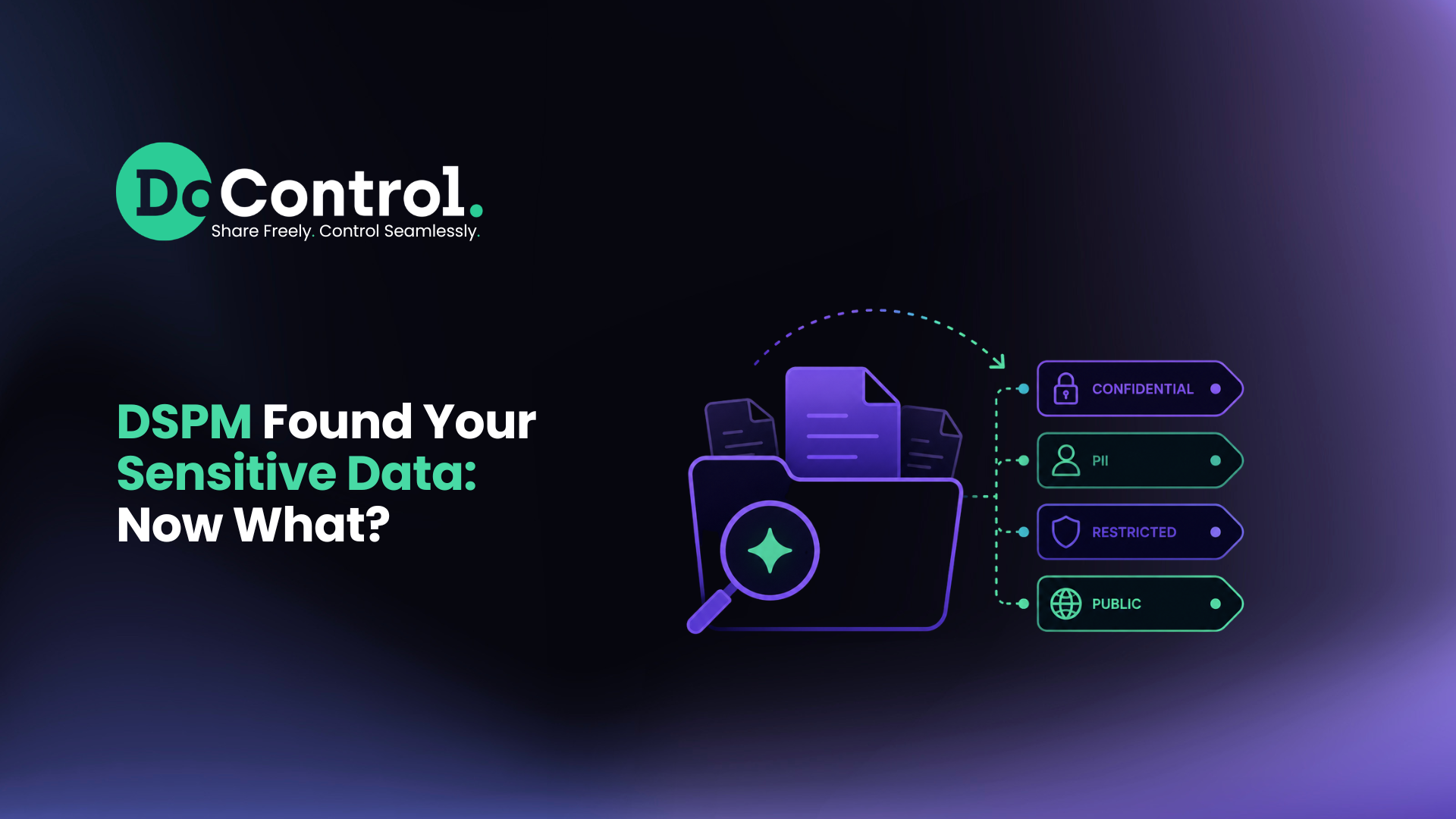
For years, DSPM has had one job: find the sensitive data hiding across your SaaS and cloud environments. For a lot of organizations, it delivers. Scanners now light up dashboards with PII, financial records, source code, contracts, regulated data – all cataloged, all classified, all seemingly under control.
Except "under control" is doing a lot of work in that sentence. While that data sits neatly classified in a report, it's also still moving.
It's being shared externally with vendors and partners. Downloaded onto personal devices. Copied into new files that inherit none of the original's protections. Accessed by employees who left the team months ago, or by AI tools and agents that were never supposed to touch it in the first place.
Classification didn't pause any of that. It just gave you a label for what's now exposed.
Here's the uncomfortable truth: knowing what's inside a file doesn’t protect that file.
The label the DSPM gives tells you nothing about whether that file is actually dangerous. Two documents can contain identical customer data. One sits in a folder only three people on the finance team can open. The other has been shared externally with a vendor whose contract expired last quarter, and it's been downloaded twice this week by an account nobody recognizes. Same content. Wildly different risk.
DSPM can't tell you which is which, and it shouldn’t need to.
DSPM isn’t a data protection strategy, it’s a data discovery strategy. There's a huge difference.
Visibility Was Never the Same as Protection
This is the mistake most CISOs are making right now, often without realizing it: treating DSPM as a data protection strategy when it's actually a data discovery strategy. Those are two fundamentally different problems, and confusing them creates a dangerous false sense of security.
DSPM answers one question well: where is our sensitive data?
That's valuable. It's also incomplete.
The questions that actually determine whether you're at risk today are the ones DSPM was never built to answer:
- Who is accessing this data right now?
- Who is it shared with, internally and externally?
- Is it publicly accessible?
- Does a former employee still have a way in?
- What is anyone doing with it?
- And when ten files all light up as "sensitive," which one do you fix first?
These are the fundamental data governance questions every organization needs to know. After all, attackers don't care how thoroughly you've mapped your data estate, they care whether they can reach it.
A perfectly cataloged file that's sitting wide open to the internet is not a win – it's a liability you now just have excellent documentation for.
Where Traditional Classification Strategies Fall Short
Discovery alone doesn't reduce exposure. The gaps aren't accidental – they're structural, and they show up the same way across nearly every DSPM deployment.
Before we get into them, it's worth being clear about something: these aren't failures of DSPM. They're simply the realities of the category. DSPM was never built to solve every data problem or protect every piece of data – it was built to find it.
Where organizations get it wrong isn't in choosing DSPM. It's in expecting it to do a job it was never designed to do.
1. Content without operational context.
Knowing a file contains sensitive data is a starting point, not an answer.
A classification report that says "this file contains PII" is functionally useless until you know who can see that file, whether it's left your environment, and whether it's sitting in a shared drive open to anyone with a link. Content tells you what's at stake. It says nothing about how exposed it already is.
Security teams end up with a long list of sensitive files and no way to distinguish the ones quietly sitting behind proper controls from the ones that have been shared with an external Gmail account for the last eight months.
2. Limited identity awareness.
Classification tools are built to read content, not to reason about people. They can't tell you who owns a file, who granted access to it, or whether that access still makes sense. That gap matters more than it sounds.
Access accumulates over time: a contractor gets added to a folder for a project that ended a year ago; an employee changes teams but keeps every permission from their old role; a former employee's account gets deactivated in the HR system but never fully stripped of file-level access.
None of that shows up in a content scan. All of it is exactly the kind of access an attacker – or a curious insider – would abuse first.
3. Alert volume without prioritization.
When every sensitive file gets flagged with equal urgency, security teams lose the ability to prioritize.
Imagine two files, both containing regulated financial data. One is locked down to a five-person internal team with no external sharing. The other was shared with third-party auditors last quarter and never had that access revoked.
A content-only scanner treats these two files identically – both "high sensitivity," both dropped into the same queue. Without visibility into sharing and access patterns, teams have no way to tell these apart, so they end up spending time on the file that was never actually at risk while the genuinely exposed one waits.
Alert fatigue isn't just an annoyance here; it's a direct path to missing the incident that mattered.
4. Detection without remediation.
Finding the risk is only half the job. Someone still has to revoke access, timebox a permission, kick off an access review, or enforce a policy – and in most DSPM tools, "someone" means a security analyst manually working through a spreadsheet of flagged files, one by one.
There's no built-in path from "we found this" to "we fixed this." For teams already stretched thin, a classification report with a thousand flagged files isn't a solution. It's a new backlog.
Layer these four gaps on top of how modern work actually happens – sharing links generated in seconds, files synced across a dozen SaaS apps, AI copilots and agents now reading and summarizing documents on someone's behalf – and it's clear why discovery alone can't keep pace.
The data doesn't stay still long enough for a quarterly classification sweep to matter. It's shared, downloaded, copied, and accessed continuously, often by users, vendors, and now AI tools that were never part of the original access decision. Every one of those moments is a potential exposure event, and none of them show up in a report that only tells you what's inside a file.
The Cycle DSPM Can't Close
This is where Data Loss Prevention (DLP) comes in – not as a replacement, and not as a nice-to-have layered on top, but as the piece that actually closes the loop DSPM opens. If DSPM's job is to tell you where sensitive data lives, DLP's job is to control what happens to it: who can access it, what they can do with it, and what gets shut down automatically when something looks wrong.
Discovery tells you what you have. Protection determines whether you get to keep it.
To learn more about the differences between DSPM and DLP, read our complete guide: DSPM vs DLP: Differences, Use Cases, How to Decide
DoControl's DLP Approach: Discovery, Context, + Action
That distinction is exactly why we built DoControl’s DLP around combining file content with sharing context, access patterns, and identity intelligence – because accurately identifying real risk requires all four, and acting on it requires a system built to do more than alert.
DoControl detects and remediates risk as it happens: during shares, downloads, and other critical moments. We also extend that same contextual intelligence to historical data, enabling teams to uncover and address existing exposure with full context already in place, starting with our unified, contextual Data Classification for Google Workspace.
By combining file content, sharing context, access patterns, and identity intelligence, DoControl helps organizations accurately identify which files present real security risk and automatically take action.
With DoControl, teams can understand risk with full context:
- Identify what's in each file (PII, financial data, source code, and more)
- See who has access to each file, and how that access was granted
- Understand when and why files are being accessed
- Track ownership, creation, and sharing activity across users
- Determine whether access aligns with legitimate business needs
And remediate exposure, both real-time and historical:
- Detect and address risky access, including stale or former employee permissions
- Uncover historical exposure based on data sensitivity and access patterns
- Audit and revoke access, permissions, or collaborators as needed
- Enforce least-privilege with time-based access controls and sharing policies
- Trigger automated remediation workflows to eliminate exposure
How DSPM and DLP Can Work Together
Again, both categories have their own purpose; and many organizations have a designated DSPM solution AND a designated DLP. They use a DSPM solution to classify sensitive data across cloud storage and SaaS platforms. That classification then gets leveraged within a SaaS DLP platform (such as DoControl) to automatically enforce access controls inside these collaboration tools and SaaS apps.
Here’s a real-world example of how data classification, combined with DoControl’s automated SaaS DLP workflows, can proactively protect sensitive data.
- A file was labeled as “Confidential” through the organization’s classification framework.
- The ‘Confidential’ file was shared externally, and an external collaborator was added to the document in Google Drive.
- DoControl detected the policy violation in real time and collected the context needed.
- The external collaborator was automatically removed.
- The file owner was notified and security operations received visibility into the event as it was effectively remediated.
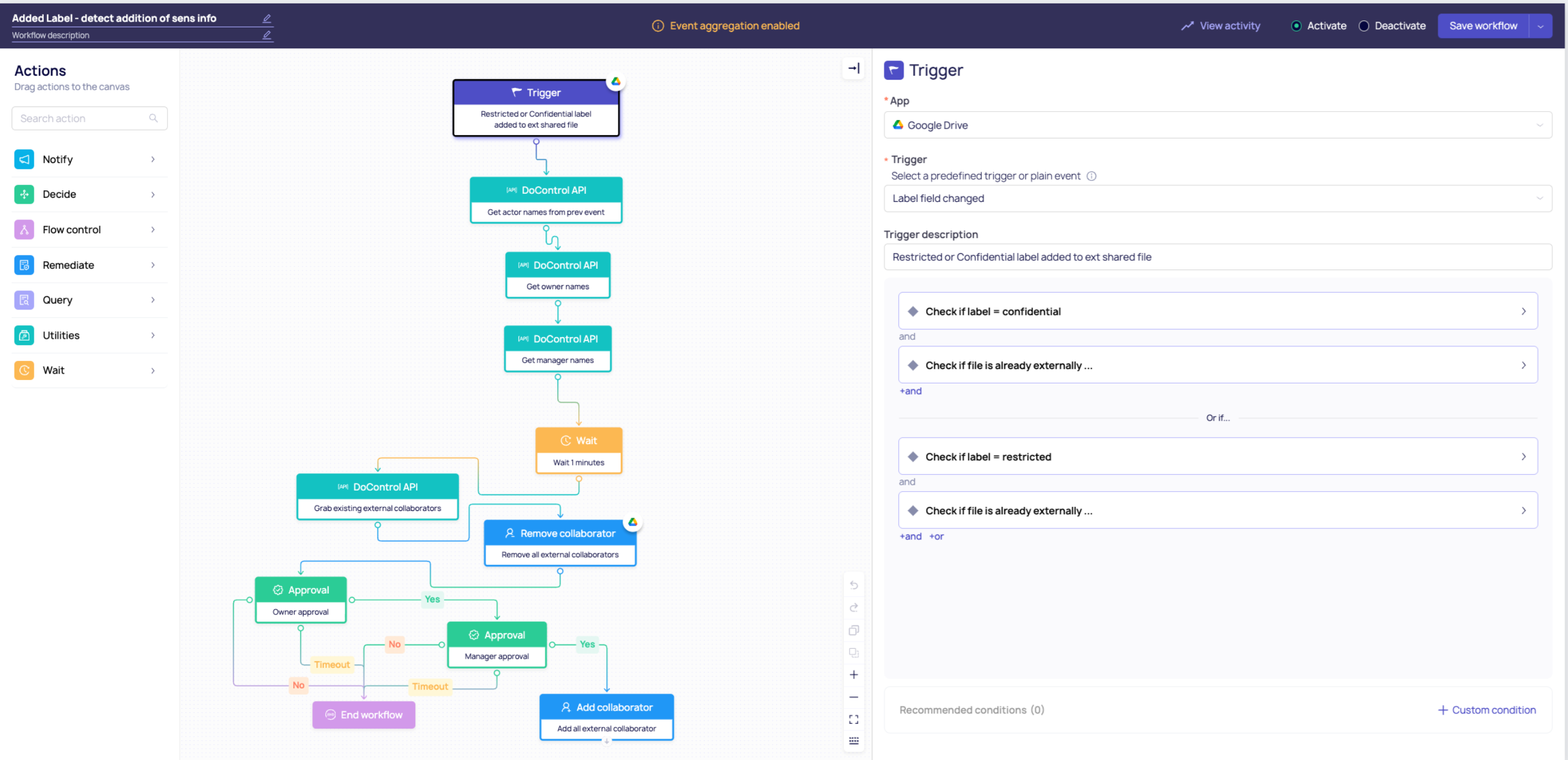
This type of automated, label-driven enforcement significantly eliminates exposure gaps and takes away the bottleneck of manual review; only engaging the relevant manager or security team as needed to keep the business moving.
In this model, classification informs enforcement - and enforcement ensures risk is not left unresolved.
For SaaS-first organizations, this approach allows security teams to move from visibility alone (which won’t tangibly protect that data) to measurable risk reduction.
Answers and Action, Not Just More Visibility
The next generation of data security isn't going to win by cataloging more data faster. Content, context, identity, remediation, and automation all have to work together, or the "risk" a scanner finds just sits there, cataloged and unaddressed, until someone downloads, shares, or exfiltrates it.
DSPM finds your sensitive data. This is step one, and it needs to happen. But visibility was always the floor, not the ceiling. The organizations that actually reduce risk are the ones that pair discovery with a real SaaS DLP layer – one that understands access, identity, and behavior well enough to act, not just alert.
Because in 2026, finding sensitive data is the bare minimum. Doing something about it is the job.
{{cta-1}}