.png)
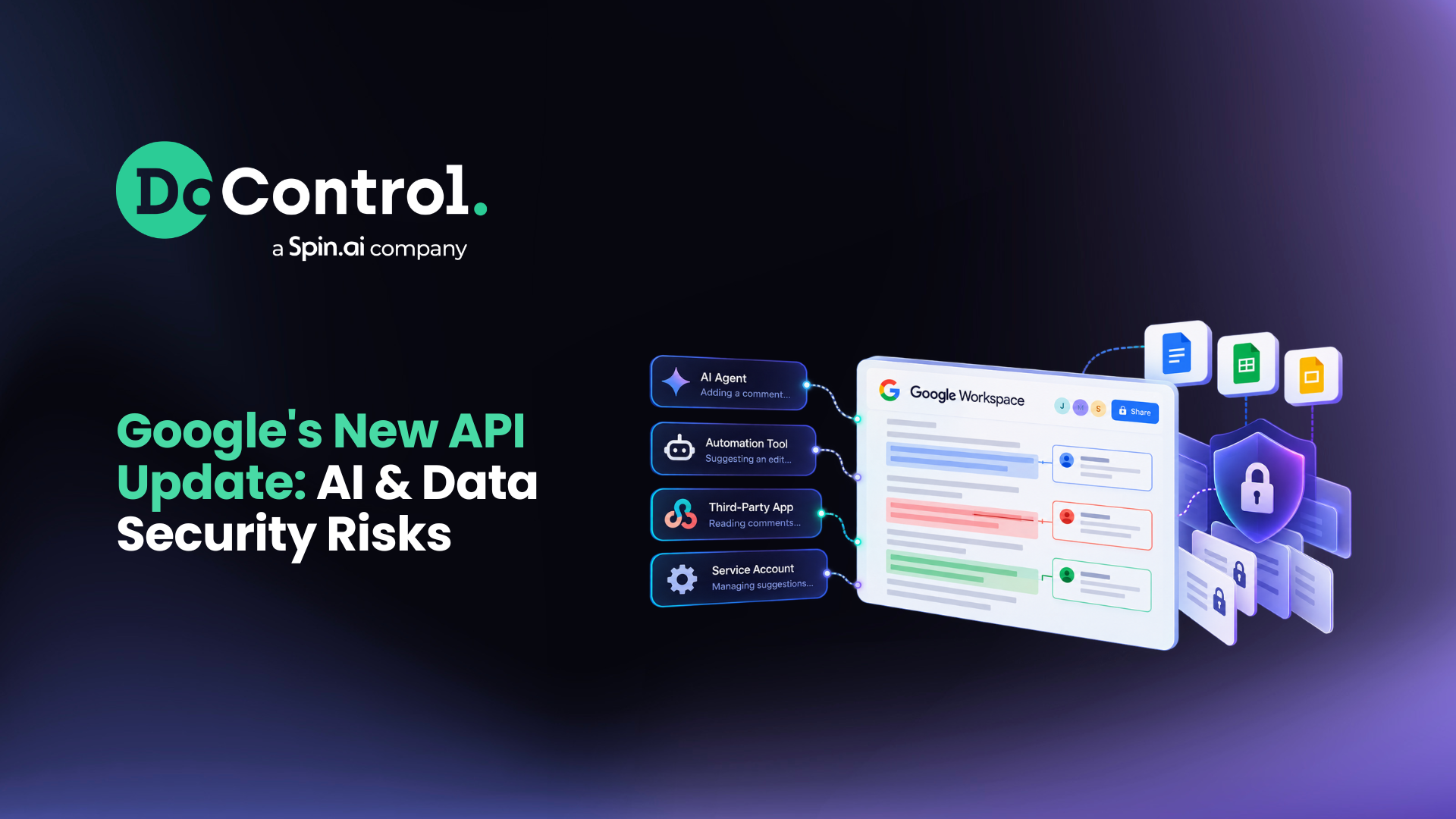
Google announced that developers can now programmatically create, read, and manage comments across Docs, Sheets, and Slides using their developer APIs.
Quietly, almost as a footnote in a routine developer update, Google just handed AI agents a new way into your company’s documents.
Buried in a September Workspace release is this line: Google now lets developers programmatically create, read, and manage comments across Docs, Sheets, and Slides – and in Docs, submit suggested edits outright.
Translation: it’s no longer just Gemini that can reach into your organization’s files. Any agent, any third-party app, any internal automation with the right credentials can now open a comment thread on a cell in your finance spreadsheet, rewrite a paragraph in your board deck, or leave feedback on a confidential slide – autonomously, at any hour, without a single human ever opening the file first.
Google calls this a workflow win. Content pipelines, project trackers, and review systems can now plug directly into Workspace files instead of routing through email or Slack. Fine, as far as developer convenience goes.
But strip away the product-update framing and look at what actually changed: a new class of non-human actors just got a standing, automated foothold inside the documents where your company keeps its most sensitive information, and Google shipped it with zero new admin controls.
There are no separate toggles or added guardrails to this update. Access to this capability rides entirely on whatever app-access settings and OAuth scopes you already have in place today -- the same settings most security teams haven’t audited in months.
If that doesn’t unsettle you a little, it should.
A bigger non-human identity surface, one API at a time
This update doesn't exist in isolation. It's the latest in a long pattern: Workspace keeps adding APIs that let non-human identities – OAuth apps, service accounts, bots, AI agents – act on content that used to require a logged-in human.
DoControl's own activity-log analysis puts roughly 40% of Google Drive events today as already performed by non-human identities, a number that's only going up as more of these programmatic touchpoints ship.
A comment-and-suggestion API is a comparatively low-risk way to extend that reach (as suggestions still require human review before they become real edits), but it's still a new channel through which an app's credentials, once granted, can read file contents, see who else is commenting, and inject text that a reviewer may approve without a second thought.
Let’s be clear: the security risk isn’t the feature itself.
It's that most organizations don't have continuous visibility into which apps request this kind of access, what scopes they hold, or whether that access still matches what the app actually needs.
This is a data governance gap, not a Google gap.
Google's own guidance on OAuth app review, access audits, and configuration drift already acknowledges as much.
Google is right to ship this update. Google isn’t a cybersecurity company, and they don’t claim to be. Their job is to make Workspace faster, more connected, and more useful for the people building on top of it. This new capability is genuine innovation, and it’s exactly what customers ask for.
Google built the door. Whether it’s locked is entirely on you.
What this means for your data security in the Gemini-era
For years, organizations have struggled with internal data exposure. Sensitive files get shared too broadly, employees inherit access they don't need, and contractors retain permissions long after their projects end.
The problem isn't always that data is leaving the organization. Sometimes, it's that too many people inside the organization can access information they were never supposed to see.
And with AI tools like Google Gemini, that problem becomes much harder to ignore.
Think about how employees traditionally found information in Google Drive. They searched for a file, navigated through folders, or asked a colleague to share something with them. Even if sensitive information was technically accessible, finding it often required some effort.
Gemini changes that dynamic.
An employee can ask Gemini a simple question, and Gemini can surface relevant information from documents they already have permission to access.
Imagine an employee asking Gemini to summarize the company's financial performance. If confidential financial reports have been shared too broadly, Gemini could potentially surface information that employee was never intended to see.
Gemini isn't bypassing Google's permissions. It's using the permissions that already exist. And that's exactly the problem.
As we explored in our article on internal data exposure and AI, AI-powered search makes existing access governance gaps significantly more consequential. Files that were previously difficult to discover can become accessible through a simple prompt.
Now, Google's latest update introduces another dimension to this challenge.
With the new comments and suggestions API capabilities, authorized developers and third-party applications can programmatically interact with comments in Google Docs, Sheets, and Slides, and submit suggested edits in Docs.
This means an AI-powered review tool, automated workflow, or third-party integration can participate in document collaboration without requiring an employee to manually open the file and perform those actions.
That's a meaningful productivity improvement. But it also raises an important security question: What happens when those applications have access to more company data than they actually need?
Consider an automated document review tool connected to Google Workspace. If it's authorized with overly broad permissions, it could potentially interact with sensitive documents outside its intended workflow, depending on its granted scopes and file access.
The new API doesn't automatically grant that access. But it creates additional ways for applications to use permissions they've already been given.
And that's the connection between Gemini and Google's latest update.
Gemini makes existing data easier to discover. New API capabilities make it easier for authorized applications and automated systems to interact with that data.
Both make the same underlying problem more important: organizations need to know who and what can access their information before AI and automation put those permissions to work.
You need data access governance, now more than ever
Every new way to reach a file is also a new way to inherit whatever permissions that file already has. A commenting bot connected to a Shared Drive with loose, inherited, or stale sharing settings sees exactly what a human with that same access would see – and now has a standing, automated presence inside the file rather than a one-time view.
This is where data access governance becomes essential.
At its core, data access governance is about understanding who has access to your company's data, what they can access, and whether they should have that access in the first place.
But in today's SaaS environments, who isn't limited to employees anymore.
It includes contractors, former employees, external collaborators, third-party applications, OAuth integrations, service accounts, and increasingly, AI agents.
Every one of these identities can introduce risk when permissions are too broad, outdated, or no longer necessary.
Consider a Shared Drive containing financial records, employee information, and confidential business documents. Over time, different teams receive access, contractors are added to projects, and applications are connected to automate workflows.
Eventually, the number of identities with access grows far beyond what was originally intended.
Now introduce Gemini.
An employee who inherited unnecessary access to that Shared Drive may be able to discover confidential information through an AI-powered search, even if they never knew those documents existed.
Or introduce an automated application using Google's new API capabilities.
If that application has been granted unnecessarily broad access, it may be able to interact with documents beyond the ones it was intended to work with.
Neither scenario necessarily involves an attacker, a compromised account, or a traditional data breach.
It's simply the result of permissions that were never properly governed.
And this is why data access governance matters more than ever in the AI era.
Organizations can no longer rely on the assumption that sensitive files are safe simply because they're stored internally or haven't been accessed in years. AI makes information easier to discover, while automation increases the number of systems interacting with it.
Security teams need continuous visibility into where sensitive data lives, which human and non-human identities can access it, and whether those permissions still align with legitimate business needs.
That also means going beyond visibility.
The fix isn't slowing adoption, it's governing the access layer
Before you can confidently govern how AI interacts with your data, you need to govern who and what has access to that data in the first place.
Google's latest update isn't a reason to restrict innovation, and neither is the growing adoption of Gemini or other AI-powered applications.
Organizations are going to continue integrating AI agents, third-party applications, and automated workflows into their SaaS environments. The productivity benefits are real, and these technologies are only becoming more capable.
But as the ways to discover, access, and interact with company data continue to expand, security teams need to make sure the permissions underneath those technologies are keeping pace.
That's why the answer isn't to block new tools or slow adoption. It's to govern the access layer that all of these technologies depend on.
With contextual SaaS DLP, organizations can apply security policies based on the sensitivity of the data, the identity accessing it, and the surrounding business context.
And with automated remediation, they can remove unnecessary sharing permissions, revoke outdated access, and address exposure risks without manually reviewing thousands or millions of files.
As we've said before, data security is the foundation of AI security.
You can put guardrails around AI models and monitor how employees use them. But if your underlying data permissions are already a mess, those controls alone won't solve the problem.
With continuous data access governance, contextual DLP, and automated remediation, organizations can identify sensitive data exposure, remove unnecessary permissions, and enforce security policies across human and non-human identities without disrupting legitimate collaboration.
Google will keep making Workspace more connected, automated, and AI-powered. And that's a good thing.
But every new capability makes one thing increasingly clear: AI security starts with data security. If you don't know who or what can access your data, you can't confidently secure the technologies built on top of it.